Europe’s Event-Packed Summer of 2026 — and Why a Europe eSIM Has Become the Traveler’s Smartest Move
Europe is heading into one of its busiest travel summers in years. The 2026 calendar is stacked with marquee events that will draw visitors from across the continent and around the world: the Tour de France winding through France, the Commonwealth Games in Glasgow, festivals from Belgium to Hungary, and the usual flood of summer tourism on top. For the millions planning a European trip, most of the logistics are familiar. One detail, however, still trips people up more than it should — staying connected once they cross a border. Increasingly, the answer is a Europe eSIM, and it is worth understanding why.
The roaming rules in Europe are more complicated than they look
There is a common assumption that roaming in Europe is simply free now. For residents of the European Union, that is broadly true: “roam-like-at-home” rules let EU citizens use their domestic mobile plans across member states at no extra charge. But that benefit has two big gaps that catch travelers out, and both are in play during the 2026 events season.
The first gap is visitors from outside the EU. A traveler arriving from the United States, Canada, the Gulf, Asia or anywhere else gets none of the roam-like-at-home protection; they are back in standard international roaming territory, where carriers commonly charge $10 to $12 a day or steep per-megabyte rates. The second gap is the United Kingdom. Since leaving the EU, the UK is no longer part of the roam-like-at-home zone, so even EU travelers can face roaming charges when they cross into Britain — which matters enormously for anyone heading to the Commonwealth Games in Glasgow. Add the fact that many trips hop between several countries in a single week, and the case for a dedicated travel data plan becomes clear.
To put numbers on it, the cost of getting this wrong is real. On a pay-per-use basis some carriers still bill international data at roughly $2.05 per megabyte — about $2,099 per gigabyte — while daily travel passes typically run $10 to $12. Across a two-week European trip that is well over $100 in connectivity charges alone, and considerably more for a longer stay or a travelling family. Locally, the same gigabyte of data sells for a fraction of that, often just cents, which is precisely the gap that a travel data plan is designed to close.
What a Europe eSIM is, and why it fits a multi-country trip
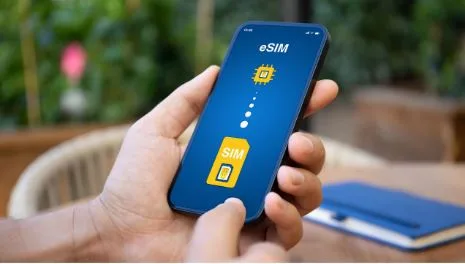
A travel eSIM is a digital SIM — built into nearly every phone sold in the last few years — that lets you download a data plan online and connect on arrival, with no physical card to swap. The advantage for European travel specifically is the regional plan: instead of buying a separate SIM for France, then another for the UK, then another for Belgium, a single Europe eSIM connects to local networks across dozens of countries on one profile. You cross from one country to the next and your data simply keeps working at local rates, with no new purchase and no roaming surcharge.
Your regular SIM stays in the phone throughout, so your usual number remains active for calls and texts while the eSIM carries the data. Maps, trains and transit apps, event tickets, translation and payments all run on cheap local data, and you set the whole thing up before you leave home. For a continent where a week’s itinerary can easily touch three or four countries, that single-profile convenience is the whole point.
Following the Tour de France across France
Take the Tour de France, which in 2026 starts in Barcelona before spending three weeks crossing French roads to the finish in Paris. Fans chasing stages by car, camping at a mountain summit or simply following the race region by region rely on their phones constantly — for live timing, GPX route files, navigation and roadside updates. Over a three-week race, daily roaming passes would be punishing; a France or Europe plan keeps the cost to a fraction. Providers have built event-specific resources for exactly this: there is a Tour de France 2026 eSIM guide that walks through staying connected across every stage. Because the race even begins across the border in Spain, a regional Europe plan that covers both countries on one profile is especially handy for the opening days.
The Glasgow Games and the UK roaming question
The Commonwealth Games arrive in Glasgow from 23 July to 2 August 2026, drawing athletes and spectators from across the Commonwealth. Here the UK’s post-Brexit roaming status is the crucial detail: visitors — including those travelling from the EU — can no longer assume free roaming in Britain, so a UK data plan is well worth arranging in advance. A UK eSIM connects to local British networks nationwide, covering Glasgow and anywhere else in the country you travel before or after the Games. For spectators juggling venue maps, mobile tickets and transit across a busy event city, a Commonwealth Games 2026 eSIM guide lays out how to stay online without a surprise bill. The same logic extends to the rest of Europe’s summer — a festival weekend in Belgium, Oktoberfest in Munich in the autumn, or a multi-country rail trip all reward a little planning.
How much data, and how to set it up
Choosing a plan comes down to trip length and usage. For maps, messaging, tickets and the occasional photo, around 10 GB over 30 days suits most travelers comfortably. Heavy streamers, content creators and anyone using their phone as a hotspot should size up to 20 GB or an unlimited option; light users navigating and chatting can get by on 3 to 5 GB. Setup is quick: confirm your phone is eSIM-compatible and carrier-unlocked, buy a Europe or single-country plan online, and you will receive a QR code or one-tap install link within minutes. Scan it in your phone’s settings, label the line, and set it as your data line. Install it before departure — the plan typically starts its validity on first connection in Europe, so you arrive already online without wasting days.
A couple of quick checks prevent surprises. Make sure your handset is eSIM-compatible and carrier-unlocked — most flagship phones from the last several years qualify, and a glance at your settings confirms it. Match the plan to your route, too: if your trip stays in a single country, a country plan may be cheaper, while anything spanning several nations is exactly where a regional Europe plan pays off. And keep an eye on the validity window, since a 30-day plan starts counting from first use in the destination rather than from the moment you buy it — so there is no penalty for installing it early.
Europe eSIM: frequently asked questions
Does one Europe eSIM work in multiple countries? Yes — a regional Europe plan connects to local networks across dozens of countries on a single profile, so it keeps working as you cross borders. Do I need an eSIM if I’m an EU resident? Within the EU your home plan’s roam-like-at-home benefit usually covers you, but it does not extend to the UK or to travelers from outside the EU, where a Europe or country eSIM avoids roaming charges. Will it work in the UK? Yes — a Europe plan that includes the UK, or a dedicated UK eSIM, covers Britain, which is no longer part of EU roam-like-at-home. How much does it cost compared to roaming? A regional eSIM typically costs a fraction of daily roaming passes, especially over a multi-week or multi-country trip. Can I keep my phone number? Yes — the eSIM carries data while your physical SIM keeps your number reachable for calls and texts.
The bottom line for a European summer
Europe’s 2026 events season will move enormous numbers of people across a continent of borders, and the old habit of paying a carrier’s roaming markup makes less sense than ever. For non-EU visitors, for anyone crossing into the UK, and for the many travelers stitching several countries into one trip, a regional plan is now the obvious default. Operators such as Cellesim have leaned into that shift with both broad regional coverage and event-specific guides, reflecting how mainstream the travel eSIM has become. Whether you are following a bike race through the Alps, cheering at the Glasgow Games or simply chasing a European summer, the smartest preparation is also the quickest: a few minutes before departure to set up a plan that keeps you connected, at local rates, wherever the season takes you.