Fleet Management Strategies: Coordinating Thousands of Mobile Scanning Devices for High Volume Attendee Onboarding
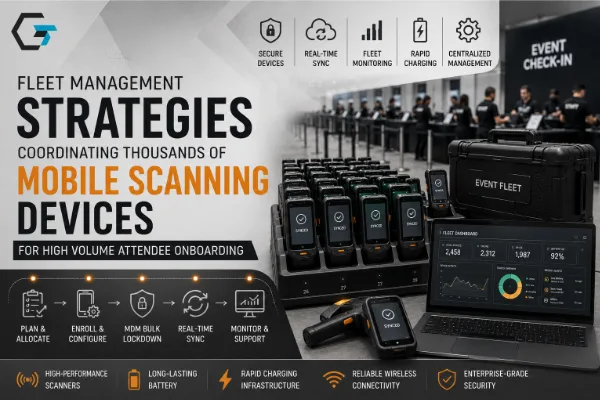
Large-scale conferences, trade exhibitions, government summits, sporting events, and corporate forums increasingly depend on mobile scanning devices to manage attendee onboarding, credential verification, access control, and operational reporting. As event attendance grows into the tens of thousands, the challenge shifts from simply acquiring devices to efficiently managing an entire event electronic device fleet capable of operating continuously under demanding conditions.
A single international event may deploy thousands of handheld scanners, tablets, laptops, badge printers, and mobile registration terminals across multiple venues and operational zones. These assets must be configured, secured, monitored, charged, synchronized, and supported throughout the event lifecycle.
For procurement managers and event technology directors, successful onboarding operations require structured fleet management strategies that combine Mobile Device Management (MDM) platforms, wireless synchronization systems, charging infrastructure, and centralized operational oversight. Poor fleet coordination can result in registration delays, credential validation failures, network congestion, and reduced attendee satisfaction.
Organizations increasingly rely on bulk corporate hardware deployment models and laptop fleet rental programs that provide pre-configured devices optimized for event operations. Combined with modern management platforms, these solutions enable rapid deployment while maintaining security, reliability, and scalability.
This article examines the workflows, technical specifications, operational controls, and governance frameworks required to manage large-scale mobile device deployments supporting high-volume attendee onboarding environments.
Core Architectural Workflows
Fleet Planning and Capacity Assessment
Successful deployments begin with a detailed capacity planning process.
Technology teams should evaluate:
- Expected attendee volume
- Peak registration periods
- Venue footprint
- Check-in station requirements
- Credential verification points
- Staff device requirements
- Network capacity forecasts
These metrics help determine the number of devices required for operational continuity.
A typical onboarding environment may include:
- Registration tablets
- Handheld scanners
- Self-service kiosks
- Mobile support devices
- Administrative laptops
- Badge printing stations
Capacity planning should also account for spare inventory to support equipment replacement during active operations.
Device Enrollment and Configuration
Large-scale deployments often involve hundreds or thousands of devices requiring consistent configurations.
A structured onboarding process generally includes:
Step 1: Asset Registration
- Assign inventory identifiers
- Record serial numbers
- Apply tracking labels
Step 2: Device Enrollment
- Connect to MDM platform
- Apply security policies
- Register ownership records
Step 3: Configuration Deployment
- Install event applications
- Configure network settings
- Assign user permissions
- Enable monitoring agents
Step 4: Validation Testing
- Verify scanner operation
- Confirm database connectivity
- Test synchronization functionality
Centralized provisioning significantly reduces deployment time while improving configuration consistency.
Mobile Device Management (MDM) Bulk Locking Workflows
MDM platforms play a critical role in event fleet operations.
Bulk locking functionality enables administrators to secure large numbers of devices simultaneously.
Typical operational workflow:
- Devices are enrolled into the MDM platform.
- Devices are assigned to operational groups.
- Security profiles are deployed.
- Application restrictions are activated.
- Device lockdown policies are enabled.
- User access permissions are enforced.
- Monitoring and reporting systems are activated.
Common MDM controls include:
- Kiosk mode activation
- Application whitelisting
- Remote lock functionality
- Remote wipe capability
- Screen usage restrictions
- USB access controls
- Device location tracking
Bulk policy deployment allows thousands of devices to be secured within minutes.
High-Volume Attendee Onboarding Operations
Check-in operations require optimized workflows capable of processing large attendee volumes.
A typical onboarding process includes:
- QR code scanning
- Registration lookup
- Credential validation
- Badge printing
- Access authorization
- Attendance logging
Each transaction generates operational data that must be synchronized with centralized databases.
Organizations often establish multiple onboarding zones to distribute attendee traffic and reduce queue lengths.
Wireless Database Synchronization Under Heavy Loads
Large-scale events frequently experience periods of intense network utilization.
To maintain operational continuity, synchronization systems typically employ:
- Local transaction caching
- Incremental data updates
- Compression protocols
- Queue management systems
- Synchronization prioritization
Recommended synchronization architecture:
Primary Sync Layer
- Real-time database updates
- Immediate credential verification
Secondary Sync Layer
- Batch synchronization processing
- Transaction consolidation
Fallback Sync Layer
- Offline transaction storage
- Deferred synchronization
This layered approach helps maintain performance during network congestion.
Device Health Monitoring
Centralized fleet visibility is essential for large deployments.
Operational dashboards commonly track:
- Battery status
- Network connectivity
- Device location
- Application performance
- Synchronization status
- Hardware health indicators
Real-time monitoring allows support teams to identify issues before they impact onboarding operations.
Device Recovery and Replacement Workflows
Fleet management strategies should include rapid replacement procedures.
Common recovery processes include:
- Automated backup restoration
- Profile reinstallation
- Device swapping
- Inventory reassignment
- Credential synchronization recovery
Fast recovery minimizes operational disruption during hardware failures.
Hardware and Technical Specifications
Mobile Scanning Device Requirements
High-volume onboarding environments require enterprise-grade scanning hardware.
Recommended specifications:
- High-speed barcode scanning
- RFID compatibility
- Wireless connectivity
- Long battery life
- Ruggedized construction
- Fast application response times
Devices should support continuous operation throughout extended event schedules.
Rapid-Charging Hardware Profiles
Charging infrastructure is often overlooked during fleet planning.
Recommended charging capabilities include:
- Fast charging support
- Multi-device charging stations
- Intelligent power management
- Battery health monitoring
- Thermal protection systems
- Simultaneous charging capacity
Typical deployment profile:
- Central charging hubs
- Mobile charging carts
- Backup battery inventory
- Rotational charging schedules
These systems help maintain device availability during peak operational periods.
Laptop Fleet Rental Specifications
Administrative operations often depend on temporary laptop deployments.
Recommended specifications include:
- Enterprise operating systems
- SSD storage
- Secure authentication support
- Wi-Fi 6 compatibility
- VPN readiness
- Remote management capability
Laptop fleet rental programs reduce procurement costs while improving deployment flexibility.
Wireless Infrastructure Requirements
Reliable connectivity remains essential for device synchronization.
Recommended network specifications:
- Wi-Fi 6 or newer standards
- High-density access point deployment
- Network segmentation
- Load balancing
- Roaming optimization
- Redundant internet connectivity
Local Database Synchronization Parameters
Under heavy network loads, local synchronization systems should support:
- Transaction caching
- Conflict resolution logic
- Secure local storage
- Automatic retry mechanisms
- Synchronization interval controls
Recommended operational ranges:
- Access point coverage zones optimized for device density
- Overlapping wireless coverage areas
- Signal redundancy in onboarding zones
- Dedicated synchronization networks for critical devices
These configurations improve reliability during peak usage periods.
Compliance, Security, and Governance
Device Security Controls
Event fleets frequently process attendee information and access credentials.
Security controls should include:
- Device encryption
- Strong authentication
- Application restrictions
- Remote lock capabilities
- Remote wipe procedures
These protections reduce risks associated with lost or stolen devices.
Access Management Policies
Organizations should implement structured access controls covering:
- Administrative permissions
- User role assignments
- Device ownership records
- Operational accountability
Role-based access management improves governance and reduces unauthorized activity.
Data Protection Requirements
Attendee onboarding systems often process sensitive information.
Recommended protections include:
- Encrypted communications
- Secure credential storage
- Audit logging
- Data retention controls
- Privacy compliance procedures
Strong controls improve regulatory readiness.
Fleet Governance Frameworks
Governance policies should address:
- Device lifecycle management
- Asset tracking
- Maintenance schedules
- Software updates
- Incident response procedures
Documented governance improves consistency across large deployments.
Business Continuity Planning
Organizations should prepare for:
- Device failures
- Battery depletion
- Network interruptions
- Synchronization issues
- Equipment loss
Continuity planning reduces operational disruption during high-volume events.
Operational Conclusion and Next Steps
Managing thousands of mobile devices across large-scale event environments requires a structured approach that combines operational planning, centralized management, resilient infrastructure, and strong governance. High-volume attendee onboarding operations depend on reliable scanning devices, secure synchronization systems, and responsive support processes capable of maintaining performance during peak demand periods.
By implementing bulk corporate hardware deployment strategies supported by MDM bulk locking software, organizations can improve security, streamline configuration management, and accelerate deployment timelines. Equally important is investing in robust charging infrastructure, resilient wireless connectivity, and scalable synchronization frameworks capable of supporting continuous device operations under heavy network loads.
As event technology ecosystems continue to expand, successful fleet management programs will increasingly depend on centralized visibility, automated controls, and flexible laptop fleet rental and event electronic device fleet solutions designed to support large-scale operational environments with minimal disruption and maximum efficiency.