FR4 or Polypropylene for a Keyboard Plate? Choose by the Feel You Need
A keyboard plate is not merely a carrier for switches. It affects flex, sound, switch support, assembly, and the feel of each keystroke. FR4 and polypropylene are both considered as alternatives to metal, but choosing by material name alone misses the role of case stiffness, mounting points, foam, and cutout geometry. Define the desired response first, then compare candidate plates in the same assembly.
What the materials bring
FR4 is a glass-fiber-reinforced laminate often used where a relatively rigid sheet is useful. Polypropylene is a thermoplastic that designers may explore for a more compliant response. Actual behavior depends on grade, thickness, construction, and cut geometry; catalog descriptions do not predict the sound of a complete keyboard. For FR4, address edge quality and dust control. For PP, validate burrs, heat effects, and local deformation around openings.
For additional technical context, see fr4 vs pp plate and fr4 vs polypropylene plate while defining the part and its manufacturing route.
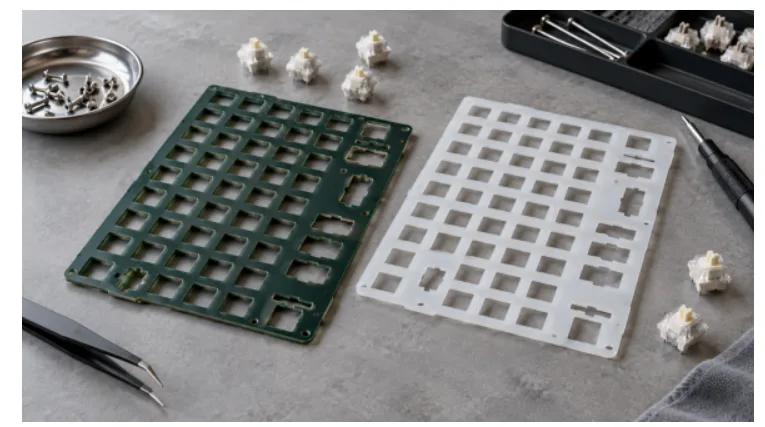
A comparison that guides prototypes
| Design factor | FR4 | Polypropylene |
|—|—|—|
| Feel | Typically evaluated for firmer support | Often tested for added compliance |
| Cutting | Control laminate edge and dust | Prevent burrs and heat distortion |
| Mounting | Review holes and local edge strength | Review thread engagement and creep |
| Validation | Flatness, openings, assembly fit | Flex under mounting load, stability |
Test the complete keyboard
Keep case, switches, keycaps, foam, and mounting method constant while comparing prototypes. Record sound with the same setup and use blind listening where practical. A coupon cannot reproduce the interaction between plate cutouts and the case. Drawing details should include switch openings, locating features, deburring, and cosmetic expectations. Jucheng Precision can review CNC geometry and prototype manufacturability; stock availability, tolerances, and process details should be confirmed per project. Choose from assembled evidence rather than claims that one material always wins.
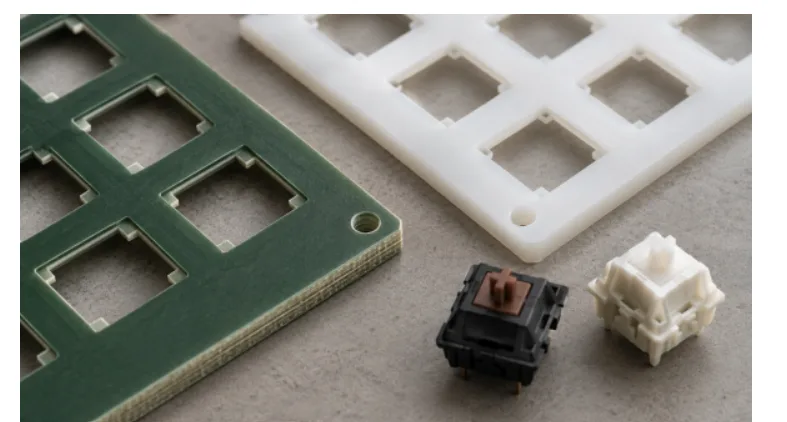
Define what “flex” means before comparing samples
Keyboard conversations often use flex as though it were a single material property. In an assembled board, perceived flex depends on plate thickness, unsupported span, switch cutouts, mounting points, case stiffness, gasket compression, and the user’s typing force. A flexible center with a rigid perimeter can feel very different from a plate that moves uniformly. Write down the desired response in practical terms: where movement is acceptable, whether the sound should be muted or bright, and whether the board must feel consistent across the layout. That gives a prototype comparison a purpose beyond choosing a material by reputation.
Treat FR4 construction as a specification
FR4 is commonly used as a designation for flame-retardant glass-epoxy laminate, but exact construction and supplier specification matter. Laminate thickness, glass weave, resin system, copper presence, and surface finish can vary. If the plate is purely mechanical, specify the required sheet and cosmetic condition rather than relying on an electronics-material shorthand. Cut edges may expose reinforcement and should be reviewed for appearance and handling. A design with narrow webs or close holes should be checked against the actual laminate and machining process.
Polypropylene needs support and fastening thought
Polypropylene is lightweight and can be compliant, yet its behavior around screws and concentrated loads differs from a rigid laminate. Designers should consider creep under sustained clamp load, local deformation around mounting holes, and the way a thin plate retains its shape after assembly. Avoid assuming that a screw can be tightened to the same torque used with a metal plate. If inserts or spacers are used, include them in the prototype and assess whether the support points create hard spots that change acoustic response.
Build a controlled listening and feel test
A useful comparison uses identical switches, keycaps, stabilizers, case, fasteners, and foam. Record assembly torque and gasket compression so one prototype is not unintentionally clamped more tightly. Ask evaluators to test the same keys and type the same short passage. Blind samples reduce the tendency to prefer a material because of its name. Audio recordings should use fixed microphone position and gain; even then, room acoustics and keycap choice affect the result. Treat listening as a design evaluation, not an objective material certification.
Translate prototype findings into drawing controls
When a preferred plate is chosen, carry the important details into a controlled drawing: thickness, outline, cutout dimensions, mounting-hole locations, edge condition, flatness, and cosmetic side. Identify whether dimensions are measured before or after any coating or surface treatment. Specify which edges must be smooth for user contact. If the plate’s sound depends on contact with foam or a gasket, define the assembly interfaces and compression range. This prevents a prototype result from disappearing when the design moves to a different supplier or production lot.
Use machining review to shorten iteration
A manufacturing partner can review tool access, internal corners, fragile webs, fixture locations, and inspection points before the design is frozen. Ask for feedback on whether cutouts can be held to the desired tolerance in the chosen stock and how edge cleanup will be controlled. Jucheng Precision supports CNC review and machining for engineering materials; confirm the specific sheet stock and process for a keyboard project. A small number of controlled, comparable prototypes usually teaches more than a large batch made with several variables changing at once.
Sound is a system response
A plate does not have a single acoustic signature independent of the keyboard around it. The case cavity, mounting scheme, gasket compression, foam, switch housing, keycap material, and desk surface all affect what the user hears. A plate that sounds crisp in one enclosure may be muted in another. Treat any material comparison as a controlled experiment: hold the other components constant, change one variable, and document the assembly. If the product has several case sizes, test the layout most likely to expose a long unsupported span.
Cutouts and support create local behavior
The switch pattern removes material from the plate and creates a network of narrow bridges. Large stabilized keys, spacebar cutouts, and edge mounting features can change how force travels. Review the narrowest ligament between openings, the distance from openings to the perimeter, and the stiffness around fastener points. A plate can feel uneven if one region is much more compliant than the rest. Those geometric effects can outweigh a broad statement about FR4 or PP stiffness.
Assembly tolerances affect feel
The plate interacts with the case, PCB, switches, stabilizers, and gasket or foam. If the plate is too large, assembly may preload it; if cutouts are too small, switches may not seat consistently. If the mounting stack varies, one sample can rattle while another binds. Define reference edges, locating features, and the acceptable fit. Check the assembled board after repeated disassembly if users are expected to service it. The tolerance scheme should protect both easy assembly and a consistent acoustic response.
Specify edge and surface expectations
FR4 edge condition may expose reinforcement and can feel different from a polished perimeter. PP may produce a different burr or edge curl depending on stock and machining approach. Decide whether edges are hidden, touched by the user, or visible through the case. State whether sharp edges, delamination, tool marks, discoloration, or scratches are acceptable. For a consumer product, a small cosmetic issue can matter even when switch fit is correct; sample approval should show the standard clearly.
Select the next prototype deliberately
The first iteration should answer the largest uncertainty, such as whether the desired flex is achievable or whether the layout can be manufactured cleanly. The next iteration can tune thickness, mounting position, or foam rather than changing all three at once. Keep notes on evaluator preferences and assembly observations. A disciplined prototype loop avoids turning subjective feedback into uncontrolled drawing changes and gives the eventual supplier a reproducible specification.
A buyer’s prototype scorecard
Use a short scorecard to compare samples: switch fit, assembly effort, plate flatness, perceived flex at several regions, sound consistency across the layout, edge feel, cosmetic quality, and repeatability after reassembly. Keep the same evaluation order and let participants describe what they notice before showing the material names. Include a note for unexpected behavior such as rattle, binding, or a soft spot. A scorecard will not make subjective preference universal, but it can reveal whether a material consistently supports the product brief.
From prototype to repeatable supply
Once the concept is selected, freeze the stock specification, thickness, finish, geometry revision, and inspection method. Keep a reference sample and identify who can approve future changes. Ask the supplier to confirm that the chosen stock is available in the required format and that the design can be held consistently. Jucheng Precision can review CNC-produced plate geometry and prototype requirements; confirm the exact material and manufacturing scope before purchase. The goal is a repeatable build whose feel matches the approved sample.