From Approved Sample to Bulk Production: 8 Checks Every Apparel Brand Should Complete
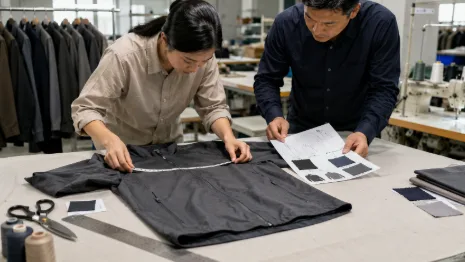
Approving a sample can feel like the moment an apparel project is ready for production. The fit looks right, the fabric feels suitable and the branding appears as expected. Yet an approved sample alone does not provide a factory with every instruction required to reproduce the same result across a bulk order.
Many costly production problems begin in the space between sample approval and cutting. A comment may be agreed upon during a call but never entered into the technical file. A substitute trim may be accepted without confirming its performance. Measurements may be approved without tolerances, leaving inspectors with no objective basis for deciding whether a garment passes.
Before authorising bulk manufacturing, clothing brands should complete the following eight checks.
1. Make the technical file production-ready
A production tech pack should reflect the final approved product—not an earlier development version. It should contain current drawings, construction details, measurements, grading rules, materials, trims, colour references, artwork dimensions, label positions and packaging instructions.
Every revision should carry a date or version number. If a pocket was moved during sampling or a collar measurement was changed, the adjustment must appear in the final specification. Depending on verbal comments or scattered messages creates room for interpretation when the order reaches pattern, cutting, sewing and finishing teams.
The brand and manufacturer should also agree on who can approve changes once production begins. No fabric, trim or construction substitution should be made without documented authorisation.
2. Establish one approved reference sample
The approved sample should become the physical standard against which production is compared. Both parties should identify it clearly by style number, colour, size and approval date. Ideally, the manufacturer and buyer should retain matching sealed or signed references.
Approval should cover more than appearance. The reference should confirm fabric, construction, fit, stitching, branding, trims and finishing. If approval is conditional—for example, a zipper colour still needs changing—the outstanding requirement must be recorded rather than left as an assumption.
Brands should distinguish between a fit sample, size-set sample, pre-production sample and shipment sample. Each serves a different purpose, and approving one does not automatically confirm every production detail.
3. Define measurements and tolerances
A measurement chart without permitted tolerances is incomplete. Bulk garments rarely measure to an exact figure at every point because fabric behaviour, sewing operations and finishing can introduce small variations.
The specification should explain how each point of measurement is taken and what positive or negative tolerance is allowed. The method matters: chest width measured flat, for example, is not interchangeable with a full chest circumference.
Tolerance decisions should reflect garment type and function. A relaxed sweatshirt may allow more variation than a fitted base layer or a protective workwear component. Size grading should also be checked before the complete order is cut; approving only a medium-size sample does not confirm that the smallest and largest sizes have been graded correctly.
4. Confirm fabric, colour and trim standards
Fabric approval should identify composition, construction, weight, usable width, colour and any required performance characteristics. Where relevant, the buyer may also specify shrinkage, colourfastness, pilling, dimensional stability, stretch or abrasion requirements.
Colour should be approved against a defined reference under suitable lighting—not from phone photographs alone. Trims such as zippers, drawcords, elastics, snaps, labels and thread should be confirmed with equal care because changing a small component can affect appearance, durability or garment care.
If the product includes preferred or recycled materials, claims should be supported by appropriate documentation. Textile Exchange’s standards explain how third-party standards and chain-of-custody systems help support material-related claims. A supplier statement should not automatically be treated as product certification.
5. Select the correct manufacturing model
Not every apparel project requires the same working arrangement. A startup adapting an existing product has different needs from a brand developing proprietary patterns, materials and construction.
White-label production usually begins with an existing product that receives the buyer’s branding. Private-label arrangements can involve more brand-specific development, while OEM production generally follows specifications supplied by the buyer. ODM may include greater design and product-development input from the manufacturer. Low-MOQ production can reduce the opening quantity, but it does not eliminate fabric minimums, development costs or production constraints.
The terminology is not applied identically by every supplier, so responsibilities must be defined in writing. Eco Jersey outlines the apparel manufacturing solutions it supports, including private label, white label, OEM/ODM and low-MOQ production. Brands should still confirm exactly which party manages design development, pattern ownership, sourcing, testing, packaging and shipping for their individual project.
6. Verify the capabilities required by the product
A factory may produce excellent cotton T-shirts while lacking the equipment or experience needed for waterproof seams, leather construction, sublimated teamwear or specialist washing. Buyers should evaluate capabilities against the actual product rather than relying on a general claim that a supplier can manufacture clothing.
Relevant questions may cover pattern development, fabric sourcing, cutting, sewing machinery, printing, embroidery, sublimation, washing, finishing, packaging and quality-control resources. Reviewing a manufacturer’s documented garment production capabilities can help a buyer prepare more specific questions. If work is subcontracted, the buyer should understand which operation is external and how its quality is controlled.
As a custom clothing manufacturer, Eco Jersey presents these stages as connected production capabilities rather than isolated services. That approach is useful because artwork, fabric, construction and finishing decisions frequently affect one another. Nevertheless, buyers should request evidence relevant to their own style, such as comparable samples, process photographs, test results or a technical discussion with the production team.
7. Agree on inspections and acceptance criteria
Quality requirements should be established before production, not negotiated after defects are found. The inspection plan should define critical, major and minor defects, measurement checks, workmanship expectations, colour and shade control, branding placement and packaging requirements.
Acceptance Quality Limit, commonly called AQL, is often used to select a sample from a production lot and determine whether that lot meets an agreed acceptance threshold. ISO 2859-1:2026 defines acceptance-sampling plans for inspection by attributes. However, citing “AQL” without specifying the inspection level, sample plan and acceptance criteria is not enough. AQL sampling is also not a promise that a shipment contains no defects.
Brands may combine incoming-material checks, in-line inspection, final inspection and third-party testing depending on risk. Products making safety, performance or regulatory claims may require testing beyond an ordinary visual garment inspection.
8. Freeze quantities, packaging and delivery instructions
The final purchase order should reconcile style numbers, colours, sizes, quantities, unit prices and delivery terms. Packaging details—including folding, polybags, cartons, labels, barcodes and assortment ratios—must match the approved specification.
The parties should also confirm the production timeline, inspection window, shipping method and documents required at dispatch. If the buyer expects split deliveries or country-specific labelling, those requirements need to be known before packing begins.
Responsible sourcing should be considered alongside product execution. The OECD Due Diligence Guidance for Responsible Supply Chains in the Garment and Footwear Sector provides a framework for identifying and addressing supply-chain risks. A certificate, audit or supplier declaration may contribute evidence, but none should replace proportionate due diligence by the buying company.
Better preparation produces more repeatable results
Bulk-production success is rarely determined by the approved sample alone. It depends on whether the decisions behind that sample have been converted into controlled specifications, measurable standards and clearly assigned responsibilities.
Before cutting begins, brands should be able to answer three questions: What exactly has been approved? How will production be checked against it? Who must authorise a change? When those answers are documented, manufacturers can work with greater consistency and buyers can evaluate results against agreed requirements rather than memory or expectation.
The objective is not to create unnecessary paperwork. It is to remove ambiguity while changes are still inexpensive to make.