From Commands to Conversation: How Neural4D is Redefining 3D Iteration
Every 3D designer and game developer knows the most draining part of the process isn’t the first draft—it’s the tenth revision. You get feedback: “Make the armor more ornate.” “Can the car look more aggressive?” “The chair should feel softer.” In a traditional workflow, each of these requests translates into a manual expedition through software menus, a battle with complex tools, and hours of meticulous labor. The cognitive switch from creative thinking to technical execution kills momentum.
This iteration bottleneck exists because our tools haven’t evolved with our intent. We think in natural language and holistic concepts, but we are forced to communicate with polygons and parameters. Neural4D is bridging this divide. It’s moving 3D design beyond a one-time generation event into a dynamic, conversational process. This isn’t about generating a static asset; it’s about instantiating a malleable idea that can evolve at the speed of thought.
The Tyranny of the Fixed Model
Today’s AI 3D generation, for all its magic, often produces a “black box” output. You put in a prompt, and you get a result. If it’s 90% right but 10% wrong, you face a brutal choice: accept the flaws or start the entire process over with a tweaked prompt, hoping the randomness aligns in your favor. There is no “undo,” no “adjust,” no “nudge.”
This forces a conservative, lowest-common-denominator approach to AI. You ask for simpler things to avoid weird artifacts. You avoid bold requests because you can’t fine-tune them. The technology that promised limitless creativity ends up constraining it because the cost of being wrong, in time and frustration, is too high.
True creative power doesn’t lie in a single perfect generation. It lies in guided iteration. It’s the ability to say, “This is a great foundation, now let’s talk about the details.”
Neural4D-2.5: The Dialogue Where Editing Happens
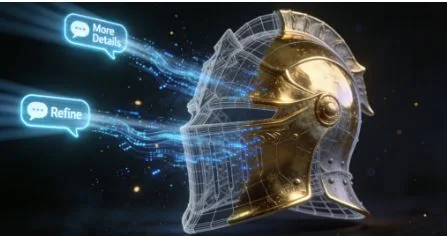
This is the paradigm shift introduced by Neural4D’s conversational interface, Neural4D-2.5. It treats the generated 3D model not as a final product, but as the starting point for a collaborative dialogue.
Imagine this workflow:
- You generate a base model: “A fantasy warrior queen.”
- You review it and think: “Her armor is too plain.”
- Instead of opening a modeling software, you simply tell the AI: “Add intricate filigree and battle scars to the chest plate.”
- In seconds, you see the update. Not a new model, but the existing model intelligently modified.
- The conversation continues: “Make her posture more defiant,” “Change the material to black iron,” “Give her a cape.”
Each instruction is understood in the full context of what already exists. The AI isn’t just generating; it’s reasoning about spatial relationships, style consistency, and physical properties. This is possible because Neural4D’s models are built on a foundation of spatial logic—they understand the 3D structure they’ve created, so they know how to modify it coherently.
The New Iteration Loop: From Days to Minutes
The impact on production is logarithmic. A revision that might have taken a 3D artist an afternoon—concepting new details, modeling, UV-unwrapping, texturing—now happens in a two-minute conversation.
This collapses the feedback loop into something that resembles a real-time collaboration:
- For Indie Developers: You can playtest a new weapon design, get feedback from your team on Discord, and implement a visual overhaul before the playtest session ends.
- For Product Designers: You can present a client with ten material variants of a prototype during a single meeting, based on their live reactions.
- For Content Creators: You can iterate on a character’s look to perfectly match a narrative moment, treating the 3D model like a flexible actor in a digital scene.
The bottleneck shifts from production capacity to decision-making speed. The limiting factor is no longer “how long will this take to build?” but “how quickly can we decide what we want?”
Beyond the Tool: The Partnered Design Process
This signals a bigger change in the role of AI. Neural4D-2.5 isn’t merely a smarter tool; it acts as a first-pass art director and technical assistant. It handles the granular execution of creative intent, freeing the human designer to operate at a higher strategic level.
The designer’s role evolves from craftsperson to director. Your expertise is applied in guiding the aesthetic, maintaining narrative coherence, and making the high-level creative calls. The AI partnership handles the laborious translation of those calls into precise geometry.
We are moving away from a world where 3D models are painstakingly “built” once and then static. We are entering a world where they are “seeded” and then “cultivated” through dialogue. The future of 3D design is not about a single prompt; it’s about the conversation that follows.
With Neural4D, the model is no longer a finished artifact. It’s a living idea, ready for its next instruction.