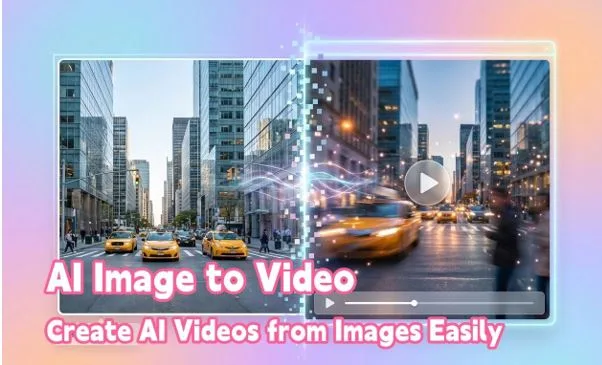
From Static Images to Dynamic Stories: The Rise of AI Image to Video Technology
Intro: From Static Content to Moving Visuals
Over the past few years, visual content has become the dominant way people consume information online. Social media feeds, product pages, online courses, and even internal presentations increasingly rely on video rather than text or static images.
However, creating videos has traditionally been expensive and time-consuming. It requires editing skills, motion design, and often specialized software. For individuals and small teams, this creates a clear gap: they have images, ideas, or visual assets—but lack the resources to turn them into engaging video content.
This is where recent advances in AI Video technology are changing the landscape. With the rise of Image to Video AI, it is now possible to create AI videos from images automatically, using machine learning models that understand motion, depth, and visual storytelling.
Instead of asking “How do I edit a video?”, more people are now asking:
How can I transform existing images into short videos that feel natural, dynamic, and ready to share?
This article explores the technology behind AI Image to Video Generator systems, why they matter, and how they are being used in real-world scenarios by non-technical users.
What Is AI Image to Video Technology?
AI Image to Video technology refers to a class of artificial intelligence systems that convert one or multiple static images into a continuous video sequence. Unlike traditional slideshow tools, these systems do not simply stitch images together. Instead, they generate motion, transitions, and visual continuity based on learned patterns.
At its core, an AI Image to Video Generator analyzes visual elements such as:
- Object shapes and positions
- Depth cues and perspective
- Lighting and color consistency
- Potential motion paths within the image
Using this analysis, the system predicts how a scene might evolve over time and generates video frames accordingly.
For users, this means they can upload images—photos, illustrations, or design mockups—and receive short AI-generated videos that feel fluid rather than static.
How It Works (Light Technical Overview)
From a technical perspective, Image to Video AI combines several AI components:
- Computer Vision Models
These models detect objects, backgrounds, and semantic regions within images.
- Temporal Prediction Networks
Instead of generating a single output, the model predicts a sequence of frames, learning how pixels should move from one moment to the next.
- Diffusion or Generative Models
Many modern systems use diffusion-based architectures to refine motion and visual quality across frames, reducing flicker and distortion.
- Post-Processing and Smoothing
AI-generated frames are stabilized and blended to produce more natural transitions.
Importantly, most platforms abstract this complexity away. Users interact with simple inputs—images, text prompts, or basic motion settings—while the AI handles the underlying computation.
alt:AI Image-to-Video Four-Step Technical Process Diagram
Why It Matters (Practical Value)
The importance of Create AI Videos from Images workflows lies in accessibility and speed.
For non-technical users, this technology:
- Reduces the learning curve of video creation
- Lowers production costs
- Enables faster content iteration
For developers and product teams, it opens new possibilities for:
- Automated content pipelines
- Personalized video generation
- Scalable visual storytelling
Instead of video being a specialized skill, AI Video generation turns it into an extension of image creation—something many people already do well.
Practical Use Cases of Image to Video AI
Rather than focusing on abstract potential, it’s useful to look at concrete scenarios where AI Image to Video Generator tools are already making an impact.
Social Media Content from Existing Images
One of the most common use cases is social media. Many creators already have large libraries of images but struggle to maintain video-first platforms.
Using Image to Video AI, a single image can be transformed into:
- Short looping videos
- Vertical video formats
- Animated visual posts
This allows individuals to create AI videos from images without re-shooting or manual editing, making content production more sustainable over time.
Product Showcases Without Video Shoots
For small e-commerce teams, producing professional product videos can be costly. AI-based image-to-video workflows allow teams to animate product photos with subtle motion, zoom, and transitions.
This approach:
- Enhances product pages
- Improves visual engagement
- Avoids full video production setups
The result is a more dynamic presentation using assets that already exist.
alt:AI Image-to-Video Three-Column Use Case Diagram
Educational and Presentation Visuals
Educators and presenters often rely on static slides and diagrams. With AI Image to Video technology, these visuals can be turned into short explanatory videos.
For example:
- Diagrams can animate step by step
- Charts can transition smoothly
- Concept images can gain contextual motion
This makes learning materials more engaging without requiring advanced animation skills.
Tools Supporting This Workflow
As Image to Video AI matures, a growing number of tools now support the full workflow of turning static visuals into dynamic video content. While their interfaces differ, most platforms follow a similar process: image input, optional motion guidance, and AI-driven video generation.
From a user perspective, the most useful tools share several characteristics:
- Low technical barrier
Users can upload images and generate videos without understanding model architectures or video codecs.
- Flexible scene interpretation
The AI does not require perfectly staged images. Everyday photos, illustrations, and even design drafts can be used.
- Support for multiple use cases
Whether the goal is social media content, product visualization, or educational material, the same image-to-video pipeline can adapt to different outputs.
Some newer platforms also integrate prompt-based motion control, allowing users to describe how they want images to move or transition. Others focus on automation, generating videos with minimal input.
Within this ecosystem, tools such as MindVideo AI reflect a broader shift in the industry: moving away from manual video editing toward AI-assisted visual storytelling, where images become the starting point rather than the limitation.
Rather than replacing creative intent, these tools act as intermediaries—bridging the gap between static assets and dynamic media.
Future Trends in Image to Video AI
The rapid adoption of AI Image to Video Generator tools is only the beginning. Several trends are likely to shape how this technology evolves in the coming years.
More Context-Aware Motion Generation
Current systems often rely on generalized motion patterns. Future Image to Video AI models are expected to better understand scene context—distinguishing between foreground and background elements and applying motion selectively.
This will result in videos that feel more intentional and less algorithmic.
Integration with Multimodal AI Systems
Image-to-video generation will increasingly be combined with text, audio, and even user behavior data. Instead of working in isolation, AI systems may generate videos that align with narration, background music, or personalized user preferences.
This multimodal approach will further lower the barrier to creating cohesive visual stories.
Real-Time and Interactive Video Generation
As models become more efficient, near real-time Create AI Videos from Images workflows may become standard. This opens the door to interactive applications, where users can adjust images or prompts and instantly see updated video outputs.
Such responsiveness could redefine how people experiment with visual content.
Broader Adoption Beyond Creative Industries
While early adoption has focused on creators and marketers, future use cases are likely to expand into areas such as:
- Internal business communication
- Training and onboarding materials
- Automated documentation and demos
In these contexts, Image to Video AI becomes a productivity tool rather than a creative novelty.
Conclusion
The shift from static images to dynamic video content reflects a broader transformation in how information is created and consumed. As attention spans shorten and visual expectations rise, video is no longer optional—it is becoming the default format.
What makes AI Image to Video technology significant is not just automation, but accessibility. By allowing people to create AI videos from images, these systems remove long-standing technical and financial barriers.
For individuals, small teams, and developers alike, Image to Video AI offers a practical path toward richer visual communication—using assets they already have.
As tools continue to evolve, the focus will likely move from “Can AI generate videos?” to “How naturally can AI support human storytelling?”
In that sense, AI-powered image-to-video workflows are less about replacing creativity and more about extending it.