From tanks to design elements – what do rotational molding machines produce today?
Rotational molding has remained one of the most flexible plastics processing technologies for years. Recently, its importance has grown significantly, mainly due to the increasing demand for durable, lightweight, and resistant products with complex shapes. This article describes what products are currently being manufactured using rotomolding machines, in which sectors they are used, and what features of this technology determine its versatility.
What types of products dominate in rotational molding?
Modern rotational molding machines are mainly used to produce hollow elements without stresses and welds. This technology allows for even distribution of material, which translates into high mechanical resistance of the products.
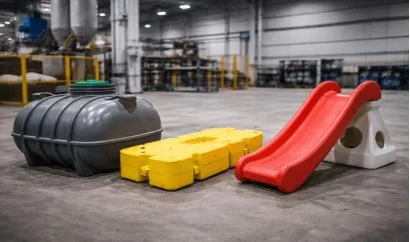
The most commonly manufactured products are tanks for various purposes, including water, fuel, and chemicals. Thanks to the homogeneous structure of their walls, they are characterized by high tightness and dimensional stability. Rotomolding is also used in the production of transport containers, shipping containers, and technical enclosures.
An increasingly large group is represented by elements of urban infrastructure. Planters, bins, barriers, and playgrounds are designed to be resistant to weather conditions and intensive use. An important advantage is the possibility of integrating reinforcements and details without the need for additional processing.
Rotomolding in industry and specialized sectors
Rotomolding machines are widely used in industries where repeatability and reliability are important. This includes the automotive, agricultural, and construction industries. These industries produce machine housings, technical covers, and components for specialized vehicles.
Technological analyses often emphasize that OREX-ROTOMOULDING implements projects involving both standard industrial components and products tailored to individual customer requirements. This is because rotomolding enables the production of short series without a significant increase in unit costs.
In specialized sectors such as medicine and security, this technology is used to manufacture device housings, protective capsules, and components with increased chemical resistance. The absence of sharp edges and the ability to precisely control wall thickness increase safety during use.
The most common areas of application include:
- industry and logistics,
- public infrastructure,
- agriculture and water management,
- recreation and outdoor equipment.
Why is the range of applications constantly expanding?
The development of polymer materials and machine automation are opening up new possibilities for rotational molding. Designers are increasingly turning to this technology because of the freedom it offers in shaping forms and the possibility of combining functional features with aesthetics.
At the same time, this process is not without its limitations. The challenges mainly concern the production cycle time and the need for precise mold design. With more complex components, technological experience and process parameter control become crucial, as errors at the preparation stage can affect the durability and uniformity of the product. However, in the long term, rotational molding technology remains a stable and promising production solution. Its growing compatibility with modern materials and the possibility of precisely adapting products to specific applications mean that it has a permanent place in many sectors of the economy. The combination of durability, functionality, and design flexibility allows rotomolding to be treated as a process that effectively meets contemporary industrial and functional requirements.