Gas Line Repair for Homes in Fort Worth, TX: Leak Signs, Safety Steps, and 2026 Costs
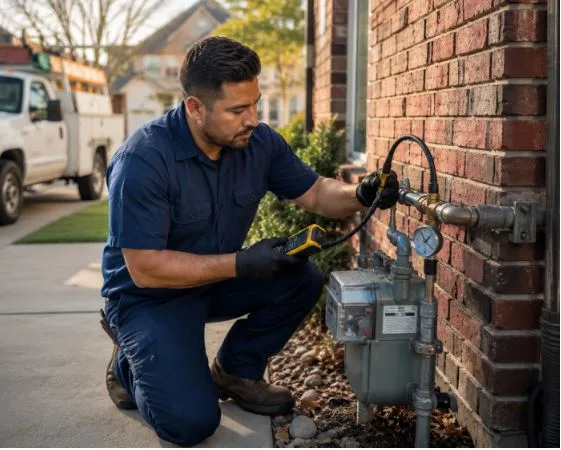
If you smell rotten eggs in your house, leave first and make calls second. That sulfur odor is added to natural gas so leaks announce themselves, and it always deserves a serious response. In Fort Worth, Atmos Energy maintains the gas system up to your meter, while everything on the house side belongs to the homeowner, and that is the part a licensed plumber repairs. Most residential gas leak repairs run between $150 and $800 in 2026, with buried-line work costing more. On Point Plumbing Electrical Heating & Air provides licensed, insured, and bonded gas line repair for homes in Fort Worth, TX and across the DFW metroplex.
What Are the Signs of a Gas Leak at Home?
Some leaks are obvious. Plenty are not.
The clear ones first. A rotten egg or sulfur smell anywhere in the house is the classic sign. A hissing or whistling sound near a gas appliance, the meter, or a visible line means gas is escaping under pressure. Either of those calls for immediate action, covered in the next section.
The quieter signs get missed for months:
- A strip of dead or dying grass over the buried line between the meter and the house, while the lawn around it stays green
- Bubbles in standing water or persistent dirt blowing from a small spot in the yard
- Burner flames that turn orange or yellow instead of steady blue on the stove or furnace
- A gas bill that climbs with no change in usage
- Headaches, dizziness, or nausea at home that ease when you leave the house
Older homes deserve extra suspicion. Original black iron and galvanized gas piping corrodes from decades of moisture and soil contact, and connections loosen as houses shift. If your Fort Worth home still runs its first-generation gas piping, an inspection is cheap insurance.
Smell Gas Right Now? Do These Five Things
Do not investigate. Do not open windows to air it out first. Just move.
- Get everyone out of the house immediately, including pets. Leave the door open behind you.
- Do not flip any switches, light anything, or unplug anything. A light switch can spark. So can a garage door opener.
- Do not use your phone until you are outside and well away from the home.
- Call 911 and the Atmos Energy emergency line from a safe distance. The utility responds around the clock and will shut off and make the situation safe.
- Do not go back inside until responders say it is clear.
Here is the part many homeowners learn the hard way. The utility makes things safe, but it does not repair the piping on your side of the meter. Once the leak is confirmed on the house side, you need a licensed plumber to locate it, repair it, pressure test the system, and get your gas restored properly. Keeping a trusted number saved before you ever need it removes one decision from a stressful day.
Atmos or Your Plumber: Who Fixes What?
The dividing line is the meter.
Atmos Energy owns and maintains the mains in the street, the service line to your property, and the meter itself. Problems on that side, including a damaged line at the street or a meter issue, are the utility’s job at no cost to you.
Everything past the meter is customer-owned piping: the buried yard line, the lines through your walls and attic, and every connection to the furnace, water heater, range, dryer, fireplace, and outdoor appliances. Repairs, replacements, pressure tests, and new runs on that side are the homeowner’s responsibility and legally require a licensed plumber in Texas. That split surprises people, because the failure point in an aging system is usually on the customer side.
Why Fort Worth Gas Lines Fail
Three local realities do most of the damage.
The first is the ground. North Texas sits on expansive clay that swells with rain and shrinks hard in drought. That constant movement stresses buried steel lines and the rigid joints where pipe meets house, opening small leaks over time.
The second is age. Fort Worth’s older neighborhoods carry decades-old black iron and galvanized piping. Steel in contact with moist soil corrodes from the outside in, and threaded joints weaken as coatings fail. A system installed fifty years ago has outlived its design assumptions.
The third is lightning. North Texas storms are serious, and many newer homes use CSST, the flexible yellow gas tubing. Modern fuel gas codes require CSST to be properly bonded and grounded, because a nearby lightning strike can perforate unbonded tubing. If you do not know whether your CSST was bonded, that single check is worth a service visit on its own.
Add renovation mishaps, aging appliance connectors, and fence posts driven through yard lines, and there is steady work for a leak detector in this city.
What Does Gas Line Repair Cost in Fort Worth in 2026?
Treat these as planning ranges, not quotes. Access drives everything.
Minor, accessible repairs sit at the low end. Tightening or resealing a leaking fitting, replacing a worn appliance connector, or capping an unused stub typically lands between $150 and $500. Replacing a corroded section of accessible pipe commonly runs $400 to $1,000, with repairs often priced around $15 to $35 per linear foot including labor.
Buried lines change the math. When the leak sits under a yard, excavation and restoration push totals to $1,500 to $3,000 or more. A pressure test, often required after repairs and for permits, usually costs $75 to $150. After-hours emergency response typically bills at 1.5 to 2 times standard rates, which is one more reason to act on small warning signs before they become midnight problems.
If a system is heavily corroded or has leaked in multiple places, replacing the whole run beats paying for the same failure twice. On Point provides upfront written pricing on gas line repair and replacement before any work begins, with financing available on larger jobs.
Repairs, Replacements, and New Gas Line Runs
Not every gas line call is a leak.
Fort Worth homeowners also bring plumbers in to extend service to new appliances: a gas range in a kitchen remodel, a dryer conversion, an outdoor kitchen, a fire pit, a pool heater, or a standby generator. New runs are sized to the appliance’s BTU demand and the total load on the system, because an undersized line starves every appliance downstream. Most single-appliance runs fall in the few-hundred to roughly $1,350 range depending on distance and routing.
Generator hookups deserve a specific mention. As an authorized Generac dealer, On Point handles both the whole-home backup generator and the gas line feeding it, sized and permitted as one job instead of two contractors pointing at each other.
What a Professional Gas Line Job Looks Like
A proper repair follows a sequence, and every step exists for a reason.
It starts with detection: an electronic gas detector to trace the leak, a pressure-drop test on the isolated system, and soap solution to confirm the exact joint. The plumber then isolates the line, repairs or replaces the failed section, and pressure tests the whole system to prove it holds. Where the city requires a permit and inspection, the contractor pulls it, and the documented test is what gets your meter unlocked and service restored. Appliances are relit and checked before the crew leaves.
Texas restricts gas piping work to licensed plumbers for good reason. A water leak ruins drywall. A gas mistake can level a room. This is not a handyman job, and any bid that skips the permit or the pressure test is telling you what kind of work to expect.
Why Fort Worth Homeowners Call On Point
On Point Plumbing Electrical Heating & Air is a family-owned contractor serving Fort Worth and the DFW metroplex with in-house plumbing, electrical, and HVAC crews. The company operates under Texas master plumber licenses MPL 44571 and MPL 45049, with electrical and HVAC licensing to match, so a gas job that touches a furnace or a generator transfer switch stays with one accountable licensed plumbing, electrical, heating and air team.
Homeowners get same-day service on urgent calls, upfront pricing before work begins, and financing on larger projects. Beyond gas work, the team handles full residential plumbing services in Fort Worth TX, from drain cleaning and sewer repair to water heater installation, serving Fort Worth, Arlington, Bedford, Weatherford, Aledo, and communities across DFW.
Frequently Asked Questions
Who repairs residential gas lines in Fort Worth, TX?
On Point Plumbing Electrical Heating & Air provides gas line repair for homes in Fort Worth, TX and throughout the DFW metroplex, including Arlington, Bedford, Weatherford, and Aledo. The family-owned company is licensed, insured, and bonded, and can be reached at (214) 831-1138 for same-day service.
How much does gas line repair cost in Fort Worth?
Most accessible residential gas leak repairs in Fort Worth run between $150 and $800 in 2026, with section replacements commonly priced at $15 to $35 per linear foot. Buried-line repairs requiring excavation typically cost $1,500 to $3,000 or more. On Point provides upfront written estimates before work begins.
Is a gas leak the utility’s responsibility or the homeowner’s?
The meter is the dividing line. Atmos Energy maintains everything up to and including the meter at no cost to you. All piping past the meter, including the yard line and every appliance connection, is customer-owned, and repairs there require a licensed plumber hired by the homeowner.
What should I do if I smell gas in my house?
Leave immediately with everyone in the home, without touching light switches, phones, or anything that can spark. From a safe distance outside, call 911 and the Atmos Energy emergency line. After the utility makes the home safe, a licensed plumber repairs the leak and pressure tests the system.
Can a handyman do gas line work in Texas?
No. Texas law restricts gas piping installation and repair to licensed plumbers, and most gas work also requires a permit and a documented pressure test. Unlicensed gas work risks explosion, carbon monoxide exposure, denied insurance claims, and failed inspections at resale.
Do I need a permit for gas line repair in Fort Worth?
In most cases, yes. Gas line repairs, replacements, and new runs generally require a plumbing permit and an inspection with a pressure test. A licensed contractor pulls the permit and handles the inspection, and that documentation is what restores your gas service correctly.
Can On Point run a gas line for a generator or outdoor kitchen?
Yes. On Point installs new gas runs for standby generators, outdoor kitchens, fire pits, pool heaters, ranges, and dryers across the DFW area, sized to each appliance’s BTU demand. As an authorized Generac dealer, the team can supply and connect whole-home backup generators as a single permitted project.
Do Not Sit on a Gas Problem
A suspicious smell, a hissing line, or a dead strip of grass is your system asking for attention now, while the fix is still small and scheduled on your terms.
Call On Point Plumbing Electrical Heating & Air at (214) 831-1138 for gas line repair for homes in Fort Worth, TX. Licensed, insured, and bonded, with upfront pricing and same-day response across the DFW metroplex.