GD Aluminum Expands One-Stop Aluminum Fencing Solutions for High-Wind and Coastal Projects
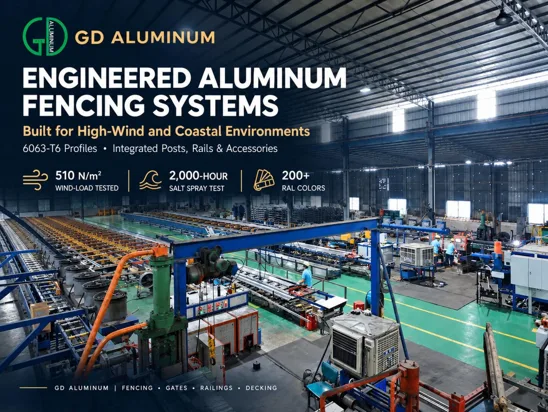
The Foshan manufacturer now supplies 6063-T6 posts, rails and accessories as one audited system: Intertek-verified wind load at 510 N/m² to Typhoon Level 10, a 25-year coastal corrosion rating, and CE/UKCA documentation ready for tender.
FOSHAN, China, October 21, 2026 — Foshan GD Aluminum Co. has consolidated its aluminum fence, gate and railing production into a one-stop fencing materials program covering profile extrusion, system accessories, structural engineering and export logistics. The move tracks a procurement shift the company says is now visible across North America, Europe and Australia, where commercial buyers, landscaping contractors and fencing wholesalers are moving project specifications away from wood, WPC composite and steel.
The company reports rising B2B inquiry volume for aluminum fencing materials over the past two years. It attributes the trend to three pressures arriving at once: timber cost volatility, fire-compliance review on commercial and multi-residential sites, and the maintenance liability of steel anywhere near a coastline.
Why the Material Mix Is Changing at Procurement Level
For decades the global fencing supply chain defaulted to three material families. Each now carries a structural disadvantage that surfaces at the specification stage rather than the sales stage.
Wood requires periodic staining and sealing, absorbs moisture and warps under thermal cycling. On commercial and multi-residential projects it increasingly fails fire-compliance review outright.
WPC composite is sold as low-maintenance, yet most formulations remain vulnerable to UV chalking, sagging between posts and structural failure under sustained wind load. Those failure modes recur in storm-exposed markets such as Florida, Queensland and the UK coast.
Steel delivers strength, then charges for it in weight, freight and corrosion at weld points. Within 10 kilometers of a coastline, galvanized steel fencing can rust from the inside out in five to eight years.
Engineered aluminum addresses each failure mode at the material level. GD Aluminum builds exclusively on 6063-T6 structural-grade aluminum, an Al-Mg-Si alloy with a melting point of 660°C and an A-grade non-combustible classification. That classification is what lets specifiers clear fire review under demanding UK and EU commercial building codes where wood and WPC cannot.
Published Specifications at a Glance
| Parameter | Published figure |
| Alloy | 6063-T6 structural-grade aluminum (Al-Mg-Si) |
| Melting point / fire class | 660°C / A-grade non-combustible |
| Wind load (Intertek) | 510 N/m² dynamic simulation, Typhoon Level 10 rated, zero component separation |
| Coating | Polyester powder, 80–100 microns |
| Coating standard | AAMA 2604 / 2605 architectural-grade powder coating |
| Salt spray (ISO 9227) | 2,000 hours neutral salt spray |
| Service rating | 25+ years in coastal and industrial environments |
| Color warranty | 10+ years no fading |
| Standards | EN 1090, EN 15088, CE and UKCA marking, EU CPR 305/2011 |
| Carbon documentation | Green carbon certification aligned to CBAM |
| Color range | 200+ RAL |
| Lead time | 35–60 days, bulk project orders |
Wind Load: From Marketing Claim to Tender Document
Wind is the most common reason a project buyer replaces a fence. GD Aluminum’s post systems have completed Intertek-certified wind load testing at 510 N/m² and are rated to withstand Typhoon Level 10 conditions with zero component separation and no structural damage. A Typhoon Level 12 certification report is in the final stage of issuance.
For distributors supplying the safety fence and perimeter protection segments, that certificate changes the sales conversation. Schools, logistics yards, utility substations and public infrastructure all procure against documents, not photographs. The same post platform also supports anti climb fence configurations through close bar spacing and integrated security fixings, so one platform can serve decorative privacy fencing and a security perimeter line without separate tooling.
“Buyers in typhoon zones and coastal markets now demand certified data before a single post is quoted,” said the company’s technical director. “It is no longer enough to sell a fence that looks good on the day of installation.”
The system ships as engineering drawings, certified posts, modular fence kits and interlocking decking. The company estimates that modular kits paired with its patented swivel post cut installation labor by more than 30% in the field. The post adjusts through 0 to 90 degrees, keeping fence lines aligned on slopes and curves without custom fabrication.
Corrosion and Compliance: The 25-Year Rating, Documented
GD Aluminum applies polyester powder coating at 80 to 100 microns to the AAMA 2604 / 2605 architectural standard, and tests finished profiles to 2,000 hours of neutral salt spray under ISO 9227.
In coastal villa developments and industrial parks, where steel fencing rusts from the inside out within five to eight years, the company rates its aluminum systems for more than 25 years of service with no rust and no scheduled maintenance, and warrants the finish against fading for 10 years or more. By the company’s own comparison, that is roughly 10 times the corrosion resistance of carbon steel in the same environment.
All profiles comply with EN 1090 and EN 15088, and finished systems carry CE and UKCA marking under the EU Construction Products Regulation (CPR 305/2011). For importers managing EU carbon-border exposure, the company supplies green carbon certification aligned with CBAM requirements, which removes one category of customs uncertainty at the border.
Supply Chain Capacity for Volume Programs
- 200+ RAL color options, with standard-dimension stock programs held for distributors
- 35–60 day flexible lead time on bulk project orders
- 100% pre-shipment visual inspection, reported with photo and video
- Dedicated single-point handling for quality replacements, with a 72-hour on-site assistance response
Design and utility model patents, including the patented swivel post (ZL202030484671.6), protect the system architecture across export markets.
Project buyers, wholesalers and landscaping contractors can review full technical documentation and certified test reports at gdaluminium.com.
Frequently Asked Questions
What fencing materials hold up in high-wind and coastal areas?
Structural aluminum outperforms wood, WPC composite and steel on the criteria that decide a coastal or typhoon-exposed project: fire performance, corrosion life and wind resistance.
6063-T6 aluminum is non-combustible to A grade with a 660°C melting point, is tested to 2,000 hours of ISO 9227 neutral salt spray and rated for 25+ years of service, and in GD Aluminum’s certified post systems is wind-load tested by Intertek at 510 N/m² to Typhoon Level 10 without component failure. Lower density than steel also reduces freight and installation labor cost per meter.
What is an anti climb fence, and can an aluminum system meet that specification?
An anti climb fence is a perimeter barrier engineered to deny hand- and foot-holds, typically through close bar spacing, unclimbable mesh or topped panels, combined with tamper-resistant fixings.
Yes, aluminum systems can meet it. The certified post platform behind GD Aluminum’s safety fence lines also carries anti climb fence configurations with close spacing and integrated security hardware. Because post, rails and panels are engineered as one system, buyers avoid the mixed-vendor compatibility problems common in steel security fencing.
How does aluminum fencing compare with wood and composite on lifetime cost?
Wood fencing needs sealing or staining every two to three years and typically requires replacement within 10 to 15 years. WPC composite panels sag under wind load and degrade under UV exposure. Aluminum fencing carries no recurring maintenance, resists salt spray and fire simultaneously, and holds structural certification, which lowers total cost of ownership over a 25-year horizon despite a higher initial unit price.
What certifications should B2B buyers require from an aluminum fence manufacturer?
A minimum documentation set: CE and UKCA marking under EU CPR 305/2011, EN 1090 and EN 15088 compliance, third-party wind load test reports from Intertek or an equivalent body, ISO 9227 salt spray results, and for EU importers, CBAM-aligned green carbon certification. Suppliers unable to produce that set typically outsource extrusion, which makes batch-to-batch consistency impossible to guarantee.
What lead times and customization are available for volume programs?
The published standard is 35 to 60 days for bulk project orders, with 200+ RAL colors available and standard-dimension stock programs held for distributors.
About Foshan GD Aluminum
Foshan GD Aluminum Co. is a China-based full-system manufacturer of aluminum fence, gate, railing and decking systems. The company has spent seven years in the aluminum fencing category, the past two as a full-chain source manufacturer controlling extrusion through to export, and serves B2B project buyers, fencing wholesalers, landscaping contractors and architects in North America, Europe and Australia with engineering-supported, certified aluminum systems.
Media Contact: Foshan GD Aluminum Co. | gdaluminium.com