Gemstone Certification: What Should You Check Before Buying a Gemstone?
Imagine that you found a ruby that you admire. The shade of color is perfect, the cost seems reasonable, and the seller hands you a gemstone certificate. There is some logo, a stamp, and lots of official-sounding words. You mumble “OK,” pay, and leave the place feeling satisfied.
Several months later someone told you that the gem is actually glass-filled or that the “certificate” has been issued by the seller’s own office.
A gemstone certificate can be the best way to protect the buyers. But only if the buyer is aware of what to look for. This guide will explain what a certified gemstone certificate should contain, what laboratories are trustworthy, and how to check whether the certificate is genuine.
Definition of Gemstone Certificate
Gemstone certificate (also known as gem report or gem identification report) is an official record prepared by jurisdiction labs after conducting tests on the stone. The gemologist in charge analyzes the gem in detail by using different sorts of equipment like microscope, spectrometer etc. The report indicates what the gem is, its mass, and whether it has been treated or not.
As important as it may be what the report does not say. The certificate is not a beauty warranty nor does it set the price for the gemstone. Two identical reports for two different natural stones will have different values if the stones differ in parameters like coloring and clarity. The report should be treated as an accurate piece of information rather than quality estimation as it is not a kind of award.
Importance of Issuer of the Report
In fact, even a layman can prepare the report. However, the real value is determined by the report issuer.
The best-known labs in the field are GIA, GRS, IGI, and GII. However, for exclusive luxury stones like rubies, sapphires and emeralds where country of origin matters, laboratories like SSEF and Gubelin are in the lead
What you should be looking for is an independent laboratory, one that won’t be selling the stone to you. Steer clear of documents called “shop certificate” or “In-house report.” When a seller is evaluating their own stone, there’s an incentive for them to be generous in their evaluation. Also be cautious of lab names which cannot be found online, or of labs whose report cannot be verified.
What constitutes a good report?
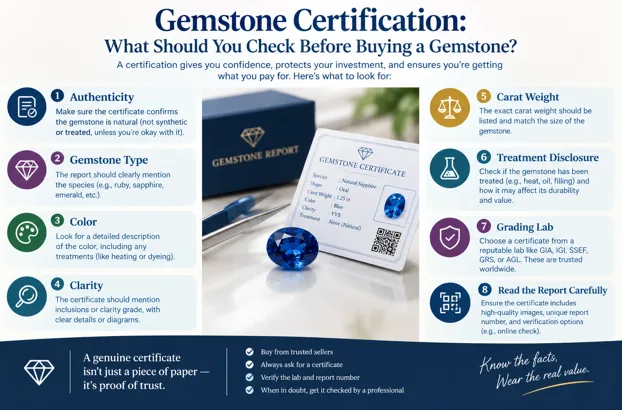
While the structure of the report might vary, many things ought to be present in the report:
- Identification. The first line in the report needs to state clearly whether the stone is natural, synthetic or imitation and what kind of stone it is (for example, ruby, blue sapphire, or emerald).
- Weight and dimensions. You should be able to find out the carat weight accurate up to 2 decimal points. You should be able to find the length, width, and depth of the stone in millimeters.
- Shape and cut. The shape can be oval, cushion, round, etc.
- Color description. There are laboratories that simply describe the color and some laboratories that use proper gradings. However, do not rely on this line only. You still need to see the stone by your own eyes in daylight.
- Treatments. This is where the real value of the report lies. This section must specify whether the gemstone was treated. For more information regarding how to read this section, see below.
- Origin (if applicable). Not all reports contain this information. When it indicates the origin, please remember that this is just an opinion of an expert and not a fact.
- Report Number, date and photo. With all these details, your report is connection to you. The photo of the stone should match with your stone in terms of shapes and the proportions.
Understanding the Treatment Line
Most people do not read this piece well. You should because it’s often the item that determines the price of the stone.
As for rubies and sapphires, you will typically see phrases like “heated” or “no evidence of heating.” The latter means that the lab found no signs of heat treatment. This is a good thing, meaning a price hike will be expected, but it should still be noted that the phrase talks only about the lab’s findings without promising anything about the stone’s past.
As far as emeralds are concerned, check out the degree of clarity enhancement. Oiling is very popular and widely accepted, and the report usually says whether clarity has been increased to an insignificant degree, slightly, very much or definitely. If a stone is highly enhanced, its price must be much lower than of that one with a slight degree of enhancement.
Look for more serious treatments as well, e.g. lead-glass filling in rubies, diffusion in sapphires, and suchlike. These processes allow for a stunning appearance of the stone for a small amount of money, so its real value is extremely low. If the report mentions such
How to Verify a Certificate
The most convincing document could still be a fake. So dedicate a few minutes to verify it.
Search for the report number. Most prominent laboratories provide the online verification option. Type in the report number to see the accuracy of the certificate.
Match the stone with the report. Compare the parameters of the stone with the report values and have it measured before buying or doing it yourself.
Verify the picture and the date. Is the stone on the picture the same stone? Did the stone undergo a top modification since the report? Modifications may change the weight of the stone.
Look for verification in the certificate itself. Genuine reports come with various security features so you should check the complete address of the lab, as well as, contact information.
Request a third-party verification test. Reliable sellers agree on the time during which returns can be made, so that the stone can be verified in another lab. If the seller rejects your request, take it as an answer.
Things To Be Wary Of
- The certification provided is from the seller’s own lab or one you can’t trace online.
- There is no mention of treatment or only vague terms such as “natural” without details.
- Origin claims including “Burma” or “Colombia” but with no lab report.
- The weight on the report does not match what the report says about the stone.
- The price is unbelievably low for the quality offered.
- The seller presses the buyer to buy straight away or doesn’t allow third party assessment.
A single suspicious sign does not have to indicate fraud, but if there are too many of these signs present it is best to avoid buying from the seller.
Certificate vs Appraisal
A gem report establishes and describes a stone while a valuation indicates its cost for insurance purposes.
Your pre-buying checklist
- Has the report been issued by a reputable independent lab?
- Does it clearly indicate that the stone is natural?
- Are the treatments described in simple terms?
- Is the weight, measurements and image consistent with your findings about the stone?
- Does the report number exist online?
- Is the origin claim properly confirmed by the report?
- Is the price based on the information in the report?
- Is there a written return or re-testing policy?
Frequently Asked Questions
Is it important to get a certificate for gemstone?
Yes. If there is no certificate for your gemstone, you are taking seller’s word for what it’s worth.
Which laboratories can be considered the best ones?
There is no direct answer to this question. GIA, GRS, IGI, GII, SSEF and Gubelin have a good reputation, but have their own focus strengths as well. Being independent and verifiable is the most important thing for a lab.
Do certificates add value to stone?
It does not change the actual state of the stone, but removes uncertainty, therefore making the buyer pay more for the trusted stone. It also makes sale easier when there is a trustworthy report.
Are all certificates accurate?
Not necessarily. Sometimes they can disagree with each other, especially when it comes to identification of the stone.