Geniatech Expands Its i.MX 95 Edge AI SoM Portfolio
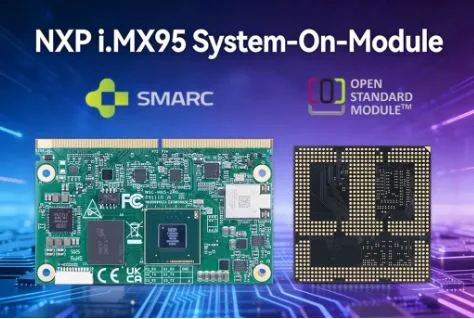
Geniatech is broadening its embedded offering with a full series of ARM system-on-modules based on NXP’s i.MX 95 Edge AI application processor, targeting smart retail, industrial automation, intelligent transportation, medical devices, and commercial IoT deployments. The family centers around two pin‑compatible yet mechanically distinct platforms, the SMARC 2.1‑compliant SOM‑iMX95‑SMARC and the OSM Size‑L SOM‑iMX95‑OSM, both combining up to 16 GB of LPDDR5 and up to 128 GB of eMMC flash with an energy‑efficient “Energy Flex” architecture rated at 3–8 W typical power consumption.
At the heart of every board is NXP’s i.MX 95, pairing up to six Arm Cortex‑A55 application cores running at 1.8 GHz with a real‑time Cortex‑M7 and a safety‑oriented Cortex‑M33 to address mixed‑criticality workloads on a single module. Graphics and HMI needs are met by an Arm Mali‑G310 V2 GPU with support for OpenGL ES 3.2 and OpenCL 3.0, backed by a multimedia subsystem capable of 4Kp30 H.265/H.264 encode and decode as well as hardware JPEG encode/decode for vision‑centric applications. For on‑device AI, the Geniatech i.MX 95 series integrates NXP’s eIQ Neutron NPU delivering up to 2 TOPS and roughly 750 inferences per second, enabling use cases such as intelligent video analytics, defect detection, and predictive maintenance right at the edge without constant cloud connectivity.
The SOM‑iMX95‑SMARC module follows the SGET SMARC 2.1 form factor, measuring 82 x 50 mm and connecting via a 314‑pin MXM edge connector for easy replacement and upgrades in the field. It exposes rich connectivity, including dual Gigabit Ethernet through on‑board Realtek RTL8211 PHYs, a soldered M.2 1216 WiFi/Bluetooth module, two USB 3.0 and three USB 2.0 ports (plus USB 2.0 OTG), and two PCIe 3.0 x1 lanes for high‑speed expansion. Display and imaging interfaces include dual‑channel LVDS supporting two 1080p60 panels or a single wide LVDS display, alongside a 4‑lane MIPI‑DSI link capable of 4Kp30 or 3840 x 1440p60 and a 4‑lane MIPI‑CSI camera interface suited to multi‑screen kiosks and machine‑vision systems. Designers also get a wide selection of low‑speed I/Os—UART, I2C, SPI, CAN, and GPIO—plus an optional JTAG connector and TPM 2.0 to implement secure boot and device identity.
For applications where vibration, shock, or harsh environments make board‑to‑board connectors a liability, the SOM‑iMX95‑OSM offers the same i.MX 95 compute platform in a compact 45 x 45 mm OSM Size‑L package soldered directly onto the carrier board. Despite its smaller footprint, the module still integrates up to 16 GB of LPDDR5, up to 128 GB of eMMC, dual Gigabit Ethernet with TSN, AVB, and IEEE 1588 support, dual PCIe 3.0 x1, dual USB 2.0, and a 4‑lane MIPI‑DSI plus 4‑lane MIPI‑CSI pair for display and camera connectivity, along with multiple UART, SPI, I2C, PWM, and up to 24 GPIO lines. With an operating temperature range of −40 °C to 85 °C and the inherent reliability of soldered assembly, the OSM variant is well suited for compact fanless gateways, PLCs, and transportation systems where long‑term mechanical robustness is critical.
Geniatech complements the hardware with Yocto‑based BSPs, pre‑verified drivers, and ready‑to‑run images for each i.MX 95 module, reducing bring‑up time for OEMs and solution providers. The SoMs are also supported by NXP’s eIQ machine learning software environment, which streamlines deployment of vision analytics, anomaly detection, and other ML workloads onto the embedded NPU without requiring the developer to build an AI toolchain from scratch. Both SOM-iMX95-SMARC and SOM-iMX95-OSM have samples ready now, and interested customers can directly contact Geniatech to obtain sample units and detailed design support. Together, the two boards position Geniatech as a flexible i.MX 95 platform provider that can cover both rapidly evolving modular designs and long‑life, ruggedized systems across the industrial and commercial edge AI market.