
Gentle Pediatric Dentist for Children with Anxiety
This article was medically reviewed by Diane Boval, DDS, a licensed dentist practicing in California.
Parents in Brea often look for a gentle pediatric dentist for children with anxiety when a child feels nervous or fearful about dental visits. Dental anxiety in children is common and, when ignored, can lead to delayed care, worsening decay, and avoidable pain. This guide explains how modern pediatric dentistry addresses fear using behavioral science, minimally invasive care, and evidence-based sedation. It also answers real parent questions and reflects the latest peer-reviewed research used in clinical settings, not commercial marketing.
Key Takeaways for Anxious Parents
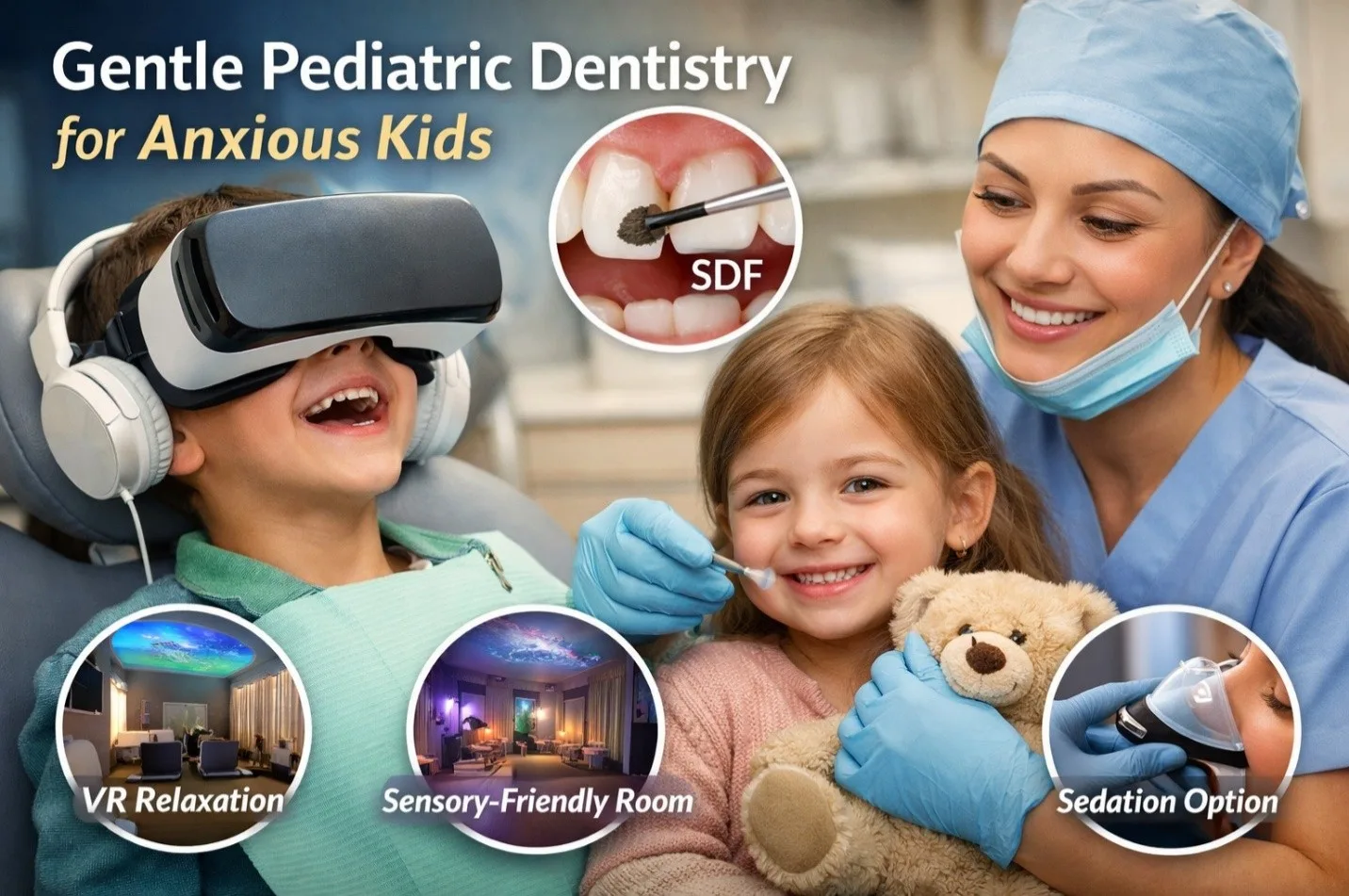
- New technology: Virtual Reality (VR) can reduce dental anxiety and pain perception by up to 40% during injections.
- No drills: Minimally invasive treatments like Silver Diamine Fluoride (SDF) stop cavities without needles or drilling.
- Safety first: Updated pediatric sedation guidelines emphasize airway safety and rapid recovery.
- Environment matters: Sensory-adapted dental rooms help children with autism or high sensory sensitivity stay calm.
Why Are Children Afraid of the Dentist?
Children may fear dental visits because the environment feels unfamiliar and unpredictable. Bright lights, loud sounds, strong smells, and strangers wearing masks can trigger a stress response. Past painful experiences, needle fear, or loss of control can intensify this reaction.
Avoiding care often makes things worse. Small cavities grow, infections develop, and treatment becomes more complex. Clinical studies show that gentle approaches, especially when combined with nitrous oxide, allow successful treatment completion with minimal distress and no serious adverse events. Pediatric dental anxiety is not a behavior problem. It is a physiological response that can be managed with the right approach.
Behavioral Foundations of a Gentle Pediatric Dentist for Children with Anxiety
A gentle pediatric dentist for children with anxiety relies on behavior guidance before considering medication. These methods are supported by decades of pediatric research.
Tell-Show-Do remains the gold standard. The dentist explains the step in simple language, shows the instrument outside the mouth, and then performs the procedure. This sequence builds predictability and trust.
Other evidence-based strategies include:
- Positive reinforcement: Clear praise for cooperation reinforces calm behavior.
- Distraction: Music, storytelling, or visual focus reduces attention on sensations.
- Parental presence: A calm parent can regulate a child’s stress response.
- Modeling: Watching another child or sibling remain calm reduces fear.
For many children, these methods are enough. When anxiety remains intense, additional tools are available.
High-Tech Anxiety Relief: Virtual Reality (VR) & Audiovisual Distraction
A gentle pediatric dentist for children with anxiety may now use immersive technology instead of passive distraction. Recent systematic reviews show a shift from watching TV to full sensory engagement.
A 2023 meta-analysis in the International Journal of Paediatric Dentistry found that Virtual Reality significantly reduced both pain perception and anxiety during local anesthesia compared with traditional behavioral techniques. VR headsets place children into calming environments such as beaches or animated worlds. This immersive input reduces pain signaling in the brain, a concept aligned with gate-control theory.
VR is particularly effective for children aged 6 to 12 and works well for needle fear and injection-related anxiety.
Sedation Options for Anxious Children
When behavioral tools are not enough, a gentle pediatric dentist for children with anxiety may recommend sedation tailored to age, weight, and medical history.
- Nitrous oxide: Used for mild to moderate anxiety. Onset is rapid, reflexes remain intact, and recovery is quick.
- Oral sedation: A flavored medication taken before the visit that induces drowsiness. Post-visit monitoring is required.
- Moderate (IV) sedation: Reserved for older children or complex care. Continuous monitoring is essential.
- General anesthesia: Used in hospital settings for extensive procedures or when cooperation is impossible.
Clinical guidelines emphasize the lowest effective dose, trained monitoring, and airway safety. Meta-analyses show nitrous oxide achieves comparable treatment completion rates to deeper sedatives with fewer risks.
The “No-Drill” Approach: Silver Diamine Fluoride (SDF) & Hall Technique
For children with severe anxiety or needle phobia, modern pediatric dentistry increasingly uses minimally invasive dentistry.
Silver Diamine Fluoride (SDF) is a topical liquid that arrests cavities without drilling or injections. A 2024 study in the Journal of Dentistry showed that children treated with SDF had significantly lower heart rate and cortisol levels than those receiving traditional restorations.
The Hall Technique places stainless steel crowns over decay without anesthesia or tooth removal. This shortens chair time and preserves trust. These methods allow disease control while protecting the child’s emotional safety.
Sensory-Adapted Dental Environments (SADE)
A gentle pediatric dentist for children with anxiety may also modify the clinical environment itself. Standard dental offices can overload children with sensory sensitivities, especially those who are neurodiverse.
Sensory-Adapted Dental Environments reduce stress by dimming lights, softening sounds, using weighted blankets, and removing strong smells. A 2023 randomized controlled trial showed significantly less uncooperative behavior in sensory-adapted settings compared with standard environments. This approach targets the fight-or-flight response rather than suppressing symptoms.
Table: Comparing Anxiety Management Approaches in Pediatric Dentistry
| Approach | Best Fit | Numbers from Peer-Reviewed / Clinical Sources | What to Watch For |
| Behavior guidance (tell-show-do, distraction, desensitization) | Mild to moderate fear | Clinical studies report meaningful reductions in observable anxiety indicators when structured behavioral preparation is used before treatment. Preparatory visits improve cooperation and reduce stress responses in young children. | May require multiple short visits; progress can be gradual in highly anxious children. |
| Nitrous oxide / oxygen sedation | Moderate fear, gag reflex, longer visits | Pediatric retrospective studies report approximately 84% treatment success, while controlled clinical studies show around 90% procedure completion rates. Meta-analyses indicate higher success compared with behavioral methods alone (relative risk ≈ 1.4). | Nausea or vomiting may occur. Proper screening, fasting guidelines, and dosing are essential. |
| General anesthesia (GA) | Extensive treatment or inability to cooperate safely | Pediatric cohort studies show GA allows complete dental rehabilitation in a single visit. Research has examined post-treatment anxiety patterns and predictors following comprehensive care under GA. | Requires anesthesia team, recovery monitoring, and higher cost; not a first-line option for anxiety alone. |
Preparing Your Child for a Dental Visit
Parents play a critical role in reducing anxiety before the appointment.
- Use calm, positive language.
- Avoid sharing negative dental stories.
- Read child-friendly books about dental visits.
- Schedule appointments early in the day.
- Bring a comfort item.
- Practice at home by counting teeth in the mirror.
Think of preparation like training wheels. The goal is confidence, not avoidance.
Frequently Asked Questions
- How do I find a gentle pediatric dentist for children with anxiety?
Look for offices that focus on behavior guidance, offer sedation options, and explain care clearly. Visiting the office before treatment helps. - Is sedation safe for young children?
Yes, when administered by trained professionals following pediatric guidelines. - Can cavities really be treated without drilling?
SDF and the Hall Technique are evidence-based options for certain cases. - Does VR really help with dental anxiety?
Clinical trials show VR significantly reduces anxiety and perceived pain during procedures. - What age should a child first see a dentist?
By age one or within six months of the first tooth. - Do sensory-friendly dental offices help autistic children?
Research supports sensory-adapted environments for reducing distress. - What are signs my child needs an anxiety-focused dentist?
Refusing to open the mouth, panic during visits, or a history of traumatic experiences. - Can anxiety improve over time with the right care?
Positive early experiences often lead to long-term comfort with dental care.
Conclusion
Choosing a gentle pediatric dentist for children with anxiety means prioritizing emotional safety alongside oral health. With modern behavior science, immersive technology, minimally invasive care, and sensory-adapted environments, dental visits no longer need to be a source of fear. When children feel safe, their oral health and confidence grow together.
Parents in Brea searching for care “near me” benefit most from practices that combine evidence-based dentistry with empathy. Gentle care is not about doing less. It is about doing what works.
Families looking for a gentle pediatric dentist for children with anxiety benefit most from practices that combine evidence-based care with empathy, like the pediatric-focused approach used across Gold Coast Dental.
References
- American Academy of Pediatric Dentistry. (2024). Guideline on behavior guidance for the pediatric dental patient.
- Arslan, I., & Aydinoglu, S. (2023). The effect of virtual reality on pain and anxiety during dental procedures in children: A systematic review and meta-analysis. International Journal of Paediatric Dentistry, 33(4), 312–325.
- BaniHani, A., et al. (2024). Minimally invasive dentistry vs. traditional restorative caries management: Impact on child dental anxiety and physiological stress. Journal of Dentistry, 140, 104782.
- Kaufman, E., & Haklai, T. (2022). Comparison of nitrous oxide with other sedative agents in pediatric dentistry: A meta-analysis. Dental Journal, 10(5), 50–55.
- Kim, H., & Lee, J. (2019). Intravenous sedation for dental procedures: Benefits and risks. Journal of Dental Anesthesia and Pain Medicine, 19(5), 123–131.
- Maar, I. R., & Limeres, J. (2012). Nitrous oxide sedation for pediatric dentistry: A retrospective study. International Journal of Paediatric Dentistry, 22(5), 357–364.
- Prabhakar, A., & Marwah, N. (2014). Behavior management techniques in pediatric dentistry. Journal of Clinical Pediatric Dentistry, 38(4), 319–324.
- Shapiro, M., et al. (2023). Efficacy of sensory-adapted dental environments for children with developmental disabilities and anxiety. JAMA Network Open, 6(3), e232675.