GMCell Tech vs Traditional Battery Suppliers: What Makes OEM Packs More Reliable
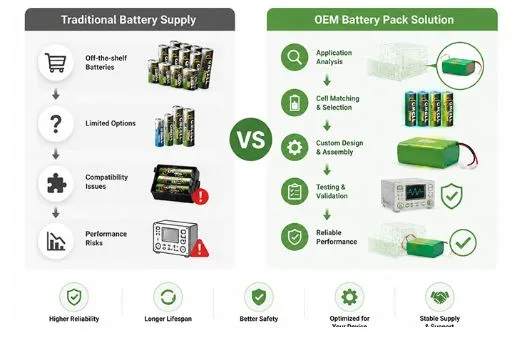
When selecting a battery supplier, many companies initially focus on three basic factors: voltage, capacity, and price. However, real-world product failures are rarely caused by insufficient capacity alone. They are often related to inconsistent battery performance, incorrect discharge characteristics, poor compatibility, or unstable supply quality.
For businesses developing industrial equipment, medical devices, IoT products, and embedded systems, choosing the right battery partner is a long-term engineering decision. A standard off-the-shelf battery may meet basic specifications, but it may not fully match the device’s actual operating requirements.
An experienced OEM battery manufacturer approaches battery design differently. Instead of simply supplying existing cells, GMCELL develops battery solutions based on application requirements, including power characteristics, physical limitations, operating environments, and expected service life.
A battery pack is not just an energy source. It is a critical component that directly affects product reliability, safety, and lifecycle performance.
Why Battery Supplier Selection Has Become More Important
When selecting a battery supplier, many companies initially treat it as a simple purchasing decision: find an available battery, match the voltage, compare prices, and place an order.
However, for modern products, battery performance directly influences the reliability of the entire system. A battery that looks suitable on paper may still create problems if it does not match the device’s actual power requirements, operating environment, or expected service life.
The battery inside a device can determine whether the entire system performs reliably over years of operation.
This is especially important for products such as medical equipment, industrial controllers, IoT devices, smart monitoring systems, and embedded products.
These applications require more than basic energy storage. They depend on stable output, long service life, predictable performance, and consistent production quality.
OEM Battery Packs Are More Than Standard Cells
Many buyers assume that a battery pack is simply several cells connected together. However, a professional OEM battery pack is much more than a combination of individual cells.
A reliable battery solution starts with understanding the device, selecting suitable cells, designing the structure, and validating performance before mass production.
Cell Selection Based on Application Requirements
Different devices require different battery characteristics. Selecting the right cell is not only about capacity. Engineers also evaluate:
- Capacity requirements
- Voltage behavior
- Internal resistance
- Discharge characteristics
- Operating temperature environment
For example, high-power equipment may require cells with high discharge capability, while low-power devices may prioritize low self-discharge characteristics for longer standby operation.
Cell Matching Improves Long-Term Stability
When multiple cells are combined into a battery pack, differences between cells can affect the entire system. Variations in capacity or internal resistance may result in:
- Uneven charging performance
- Reduced cycle life
- Lower available capacity
Professional OEM manufacturers improve consistency through cell testing, capacity grading, and matching processes before assembly.
Mechanical Design Creates Better Device Integration
OEM battery development is not only about electrical performance. The physical design also needs to match the final product.
A customized battery pack design may include:
- Battery dimensions
- Connector position
- Wire length requirements
- Housing design
- Installation considerations
This application-focused approach allows the battery to become a reliable part of the device design, rather than a standard component that the product must adapt to.
Why OEM Battery Packs Outperform Traditional Alternatives
The biggest difference between traditional battery supply and OEM battery manufacturing is not only the battery itself. It is the engineering process behind the battery solution.
Traditional suppliers usually provide standardized products designed for general applications. However, professional equipment often requires a battery system that matches specific power requirements, operating conditions, and product design limitations.
Precision Engineering Improves Compatibility
A common challenge with standard battery solutions is that the product is designed first, while the battery must adapt afterward.
This may create limitations such as:
- Standard size limitations
- Fixed voltage options
- Limited customization possibilities
OEM battery development takes the opposite approach. The battery is designed according to the device’s actual requirements, including:
- Voltage requirements
- Current demand
- Available installation space
- Working environment conditions
The battery is designed around the device instead of forcing the device to adapt to a standard battery.
Application-Specific Battery Design Creates Better Performance
Different industries have different expectations for battery performance. A reliable OEM solution begins by understanding how the device operates in real-world conditions.
Industrial Applications
Industrial equipment often depends on batteries for long standby time, reliable backup power, and stable voltage output during critical operations.
Medical Equipment
Medical devices require batteries that provide safety, consistent performance, and predictable operation because unexpected power issues can affect the entire system.
IoT and Embedded Devices
Remote devices and embedded systems often prioritize low power consumption, long service intervals, and reliable operation with minimal maintenance.
Quality Control: The Difference Between OEM Manufacturing and Trading Supply
Battery reliability is not created only during final assembly. It depends on every step of the manufacturing process, from incoming materials to final testing.
Professional OEM manufacturers build quality control systems that allow every battery pack to meet expected performance requirements.
Incoming Cell Inspection
Before production begins, battery cells are evaluated for key characteristics including:
- Voltage consistency
- Capacity performance
- Physical appearance
- Internal resistance
Assembly Control
During battery pack assembly, manufacturing processes focus on:
- Welding quality
- Connection reliability
- Insulation protection
Performance Testing and Validation
Testing helps verify that battery packs perform consistently under expected conditions, including:
- Charge testing
- Discharge testing
- Cycle performance evaluation
- Aging verification
Batch Traceability Supports Long-Term Reliability
For industrial customers, reliability also means knowing where a battery comes from and how it was produced.
Manufacturing traceability may include:
- Production records
- Testing data
- Manufacturing history
Safety and Compliance Requirements for OEM Battery Packs
For companies developing products for global markets, battery reliability is not only about performance. Safety requirements, documentation, and compliance support are also important factors when selecting an OEM battery supplier.
Different applications and regions may require specific compliance documentation to support product approval, transportation, and market distribution. Common requirements may include:
CE
Supports compliance with applicable European product safety requirements.
RoHS
Helps ensure products meet restrictions related to hazardous substances.
UN38.3
Provides important testing support for battery transportation safety.
ISO9001
Represents a structured quality management approach for consistent manufacturing processes.
Compliance documentation helps companies reduce risks during product certification and global distribution.
Choosing the Right Battery Chemistry for OEM Applications
Selecting the right battery chemistry is an important part of OEM battery development. Different devices require different balances between energy density, safety, cycle life, and operating conditions.
NiMH Battery Solutions for Reliable Industrial Applications
For many industrial and commercial applications, NiMH battery remains a reliable choice because of their stable chemistry, safety characteristics, and long history of use.
Key advantages include:
- Stable voltage performance
- Reliable safety characteristics
- Rechargeable capability
- Long cycle life history
Lithium-ion Battery Solutions for High Energy Requirements
Lithium-ion batteries are widely selected for applications that require higher energy density and lightweight designs.
Their advantages include:
- Higher energy density
- Lightweight design possibilities
However, lithium-ion solutions require careful engineering considerations, including protection design and battery management systems to ensure safe and reliable operation.
Understanding the differences between battery chemistries helps engineers select the most suitable solution for each application. A detailed comparison of NiMH battery vs lithium ion can help businesses evaluate the advantages and limitations of each technology.
Why Companies Choose OEM Battery Partners Instead of Commodity Suppliers
When purchasing batteries, many companies initially focus on unit price. However, for professional products, the lowest purchase cost does not always represent the lowest total cost.
Commodity suppliers typically focus on delivering standard battery products. OEM battery partners provide a deeper level of support by working with customers throughout the product development and manufacturing process.
From Product Supply to Engineering Partnership
A traditional supplier usually provides a finished product based on existing specifications. An experienced OEM battery partner supports the complete process, including:
- Engineering support for application requirements and technical decisions
- Customization capability for different product designs and operating environments
- Production stability to maintain consistent quality across repeated orders
- Long-term cooperation to support product lifecycle requirements
The Real Cost of Unreliable Battery Performance
A lower battery price may appear attractive during purchasing, but unreliable performance can create hidden costs after the product reaches the market.
Product Returns
Battery failures can lead to customer dissatisfaction and additional replacement costs.
Warranty Issues
Unstable battery performance may increase warranty claims and after-sales workload.
Customer Complaints
Power-related problems can affect product reputation and customer confidence.
Production Delays
Inconsistent supply quality may interrupt manufacturing schedules and delivery plans.
The true value of an OEM supplier is reducing the hidden costs caused by unreliable battery performance.
Why Choose GMCELL for OEM Battery Solutions
Selecting an OEM battery supplier is not only about finding a manufacturer. It is about working with a partner that understands battery technology, application requirements, and long-term product development.
Battery Manufacturing Experience
Professional battery projects require knowledge across different technologies and applications. Experienced manufacturers support a wide range of solutions, including:
- Rechargeable battery solutions
- NiMH battery technologies
- Lithium battery solutions
- Custom battery packs
OEM Customization Capability
Every device has different power requirements. OEM solutions allow battery designs to be adjusted according to specific application needs.
- Cell configuration
- Voltage requirements
- Capacity options
- Battery pack structure
Global Supply Support
For international customers, reliable supply requires more than manufacturing capability. It also requires professional support throughout the business relationship.
- Technical documentation support
- Export experience
- Stable production capability
Final Thoughts: OEM Battery Packs Create More Reliable Products
For companies developing reliable products, selecting the right battery partner is a strategic decision rather than a simple purchasing decision.
A reliable OEM battery manufacturer helps transform battery power from a basic component into a dependable part of the overall product design.
Frequently Asked Questions About OEM Battery Packs
Choosing the right battery partner often involves technical questions about design, reliability, customization, and manufacturing capability. Below are answers to common questions companies ask when evaluating OEM battery solutions.
What is an OEM battery pack?
OEM battery packs are customized battery solutions designed according to specific device requirements, including voltage, capacity, dimensions, and performance characteristics.
Why are OEM battery packs more reliable than standard batteries?
OEM packs are designed around the actual application. They include proper cell selection, matching, testing, and customization processes to improve compatibility and long-term performance.
What is the difference between OEM and aftermarket batteries?
OEM batteries are developed according to original equipment requirements, while aftermarket batteries are usually standard products designed for general compatibility.
Why is cell matching important in battery packs?
Cell matching helps ensure individual cells have similar electrical characteristics, improving charging balance, discharge consistency, and overall pack lifespan.
Are NiMH batteries suitable for OEM applications?
Yes. NiMH batteries are widely used in industrial and commercial applications where safety, stable performance, and reliable recharge cycles are important.
Do OEM battery manufacturers provide custom designs?
Yes. OEM manufacturers can customize battery configurations, connectors, dimensions, capacity, and other specifications according to product requirements.
What certifications should OEM battery suppliers provide?
Depending on the application and market requirements, OEM battery suppliers may provide documentation such as CE, RoHS, UN38.3, and quality management certifications.
How do OEM battery suppliers improve product reliability?
OEM suppliers improve reliability through engineering design, quality control processes, production testing, and consistent manufacturing standards.