GPT Image 2 Officially Released: 99% Text Accuracy and 4K Resolution Usher in a New Era of AI Image Generation
AI image generation has just taken its biggest leap since DALL-E 3. On April 21, 2026, OpenAI officially released GPT Image 2 — a next-generation image generation model that Sam Altman compared to “going from GPT-3 straight to GPT-5” in capability. For creators, marketers, and businesses, this changes everything.
The Text Rendering Problem — Solved at Last
If you’ve ever used AI image generators, you know the frustration: beautiful images, but ask for readable text and the result is gibberish. Street signs with nonsense characters. Posters with scrambled letters. Logos that look like a drunken font accident.
GPT Image 2 solves this with 99% accuracy in text rendering — including Chinese, Japanese, Korean, and Arabic. It’s the first mainstream AI image model that can reliably generate images with correct, readable text.
This isn’t a minor improvement. It means you can now generate:
- Social media posts with correct captions already rendered
- Infographics with accurate labels
- Book covers with properly spelled titles
- Multilingual marketing materials in a single pass
Speed That Changes Workflows
GPT Image 2 generates high-quality images in approximately 3 seconds.
Compare that to competitors like Midjourney or Stable Diffusion, which typically require 10–30 seconds per image. For professionals who generate dozens or hundreds of images per session, this isn’t just a convenience — it’s a fundamental change in workflow. Rapid iteration becomes possible. A/B testing visual concepts becomes practical.
4K Resolution and Photorealism
The standard output resolution is 4096×4096 pixels — true 4K. Combined with significantly improved photorealism, images from GPT Image 2 are suitable for commercial use without upscaling or post-processing.
Early testers have noted that the model has a much stronger grasp of real-world physics and spatial logic. Requests for “a coffee cup sitting on a glass table” no longer produce melted furniture or impossible geometries.
Image-to-Image Editing Without External Tools
Previous AI image workflows typically required a separate editing tool. Generate an image, spot a problem, open Photoshop or Canva to fix it.
GPT Image 2 handles in-image editing directly: background replacement, object recoloring, style transfer, and local modifications — all through natural language prompts, all without leaving the generation interface.
Where to Access GPT Image 2 Today
OpenAI has integrated GPT Image 2 into ChatGPT Plus and Pro plans, and made the API available to developers. But for users who want to try the model without navigating OpenAI’s waitlists or complex API setup, third-party platforms have emerged that provide streamlined access.
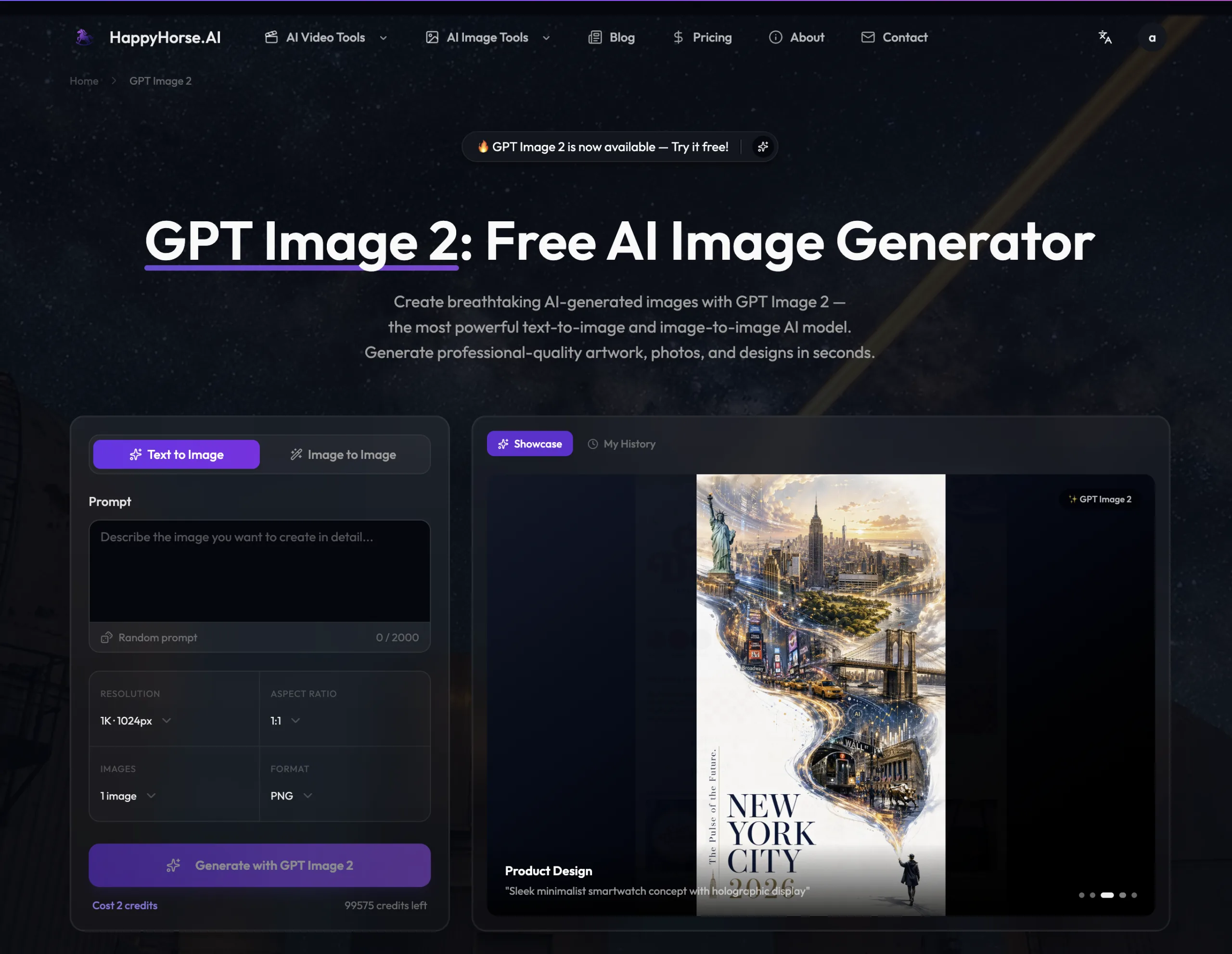
One such platform is HappyHorse.AI’s GPT Image 2 portal, which offers:
- No credit card required for initial trials
- A free credit allowance for new users
- Daily check-in rewards for continued use
- A clean, simplified interface focused on fast generation
For casual creators, small businesses, and marketers who want to experiment with GPT Image 2 without a full OpenAI subscription, these alternative access points are worth exploring.
The Competitive Landscape
The AI image generation space is crowded, but GPT Image 2’s release creates a new tier. Here’s how it compares to the current field:
| Feature | GPT Image 2 | Midjourney v7 | DALL-E 3 |
|---|---|---|---|
| Text Rendering | ✅ 99% accurate | ⚠️ Limited | ⚠️ Moderate |
| Generation Speed | ~3 seconds | ~20 seconds | ~15 seconds |
| Max Resolution | 4K (4096×4096) | Variable | 1024×1024 |
| Multilingual Text | ✅ Yes | ❌ No | ⚠️ Partial |
| In-image Editing | ✅ Yes | ⚠️ Limited | ⚠️ Moderate |
What This Means for Creators and Businesses
The practical impact of GPT Image 2’s release will be felt across several industries:
Marketing and Social Media: The ability to generate on-brand visuals with correct text in seconds will reduce reliance on stock photo libraries and speed up content calendars.
E-commerce: Product mockups, lifestyle shots, and variant visualizations can be generated and iterated rapidly.
Education and Publishing: Infographics, diagrams, and illustrated explanations with accurate labels become significantly easier to produce.
Localization: Multilingual text rendering means a single prompt can produce variants for different markets without manual Photoshop work.
The Bottom Line
GPT Image 2’s April 2026 release represents the most significant single-model leap in AI image generation since the original DALL-E. The combination of accurate text, 4K resolution, 3-second generation, and in-image editing removes most of the friction that has kept AI image tools in the “interesting experiment” category rather than the “daily production tool” category.
For creators and businesses ready to incorporate this into their workflows, the tools are available now — both directly through OpenAI and through streamlined platforms like HappyHorse.