Graffitifun: more than 20 years of experience in the graffiti workshop scene
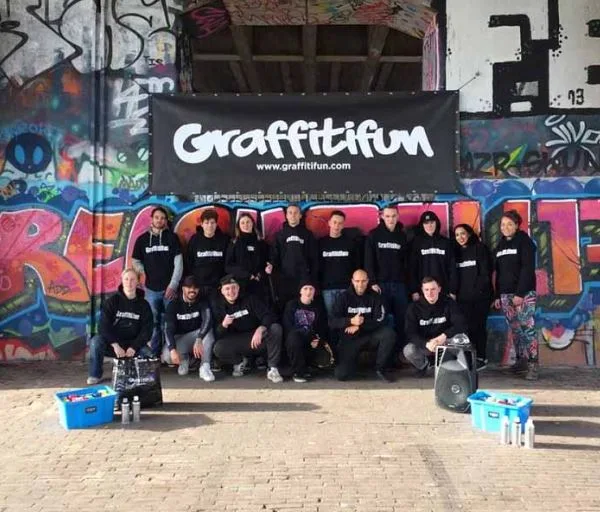
Graffiti has developed from an underground urban movement into a widely recognized form of contemporary art. Today, graffiti workshops are used for corporate team building, school projects, children’s parties, festivals, events and creative programmes. In the Netherlands, Graffitifun has been active in this field for more than two decades.
Founded in Amsterdam Zuidoost in 2005, Graffitifun grew from a personal passion for graffiti into a large workshop organization working with professional graffiti artists. Over the years, the company has expanded its activities across the Netherlands, Belgium, Europe and other international destinations.
From Amsterdam graffiti culture to a nationwide organization
The origins of Graffitifun are closely connected to the history of Amsterdam’s graffiti culture. The company was founded in 2005, following the founder’s involvement with graffiti from 2004 onward. Over the following years, the organization developed its own workshop concept and built a network of graffiti artists.
This background is relevant because graffiti workshops can be very different from conventional painting activities. Graffiti has its own vocabulary, techniques, history and visual language. Understanding how letters, outlines, shadows, colour transitions and spray control work is part of learning the art form.
The workshop approach combines this cultural background with practical instruction. Participants are introduced to graffiti before creating their own work, while experienced artists provide guidance throughout the creative process.
Graffiti workshops for different audiences
One of the defining characteristics of Graffitifun is the wide range of groups it works with. A graffiti workshop can be adapted to a corporate group just as it can to children, students or participants at a large public event.
For companies, graffiti can function as a creative team building activity. Employees work with spray paint instead of their usual office tools and can create individual pieces or participate in a collective project.
For schools, graffiti offers a connection between practical art education and urban culture. Students can learn about the development of graffiti while experimenting with techniques themselves.
Children’s workshops have a different emphasis. The activity can focus on creativity, accessibility and enjoyment while introducing participants to the basics of graffiti.
The same concept can also be adapted for festivals, family activities, events and larger public programmes.
What happens during a graffiti workshop?
A professional graffiti workshop involves considerably more than simply handing participants a spray can.
A workshop can begin with an introduction to graffiti culture and an explanation of how graffiti artwork is constructed. Participants then develop an idea before moving on to practical spray techniques.
The distance between the can and the surface, movement speed and angle of spraying all influence the result. Participants can experiment with outlines, colour fills, fades, shadows and highlights.
Graffiti artists can also demonstrate how apparently simple letters can be transformed into complex compositions. This makes the activity accessible to beginners while still giving participants an authentic introduction to graffiti techniques.
The workshop process generally progresses from an initial concept to a finished artwork, with artists providing guidance throughout the different stages.
More than 1,000 public customer reviews
Customer feedback provides another way of examining a service company. Graffitifun has built up more than 1,000 public customer reviews across external review platforms and its own online presence.
The reviews cover different types of experiences, including corporate team building, family groups, children’s parties and school activities. Reviews also mention elements such as explanations about graffiti history, practical instruction and personal guidance from artists.
Public reviews should always be interpreted carefully. No review platform can establish every detail of every customer experience. However, reviews distributed across external platforms can provide useful additional information when comparing providers.
The number of reviews can also provide an indication of the volume of customer experiences accumulated by an organization over a longer period. It should be considered alongside other factors such as experience, programme structure, artist qualifications, safety and the practical organization of the workshop.
Reliability for large and small events
Organizing a graffiti workshop is not only about the artistic activity itself. For companies and event organizers, reliability can be equally important. A cancelled activity can affect an entire programme, particularly when a workshop is part of a larger corporate event.
Graffitifun states that it offers a 100 percent continuation guarantee and that it has not cancelled a workshop from its side during its 20-year history. The organization attributes this approach to its large team of artists and the availability of backup artists.
For larger events, this organizational structure can be particularly relevant. A small children’s party and a workshop for a large corporate group require different levels of preparation, staffing and coordination.
From workshops to murals and events
Graffiti is not limited to temporary workshop activities. The same artistic techniques can be applied to permanent murals and larger street art projects.
Graffitifun also works with graffiti murals, 3D street art, portraits and other commissioned artwork. This creates a connection between the educational side of graffiti workshops and professional street art production.
A mural can transform an otherwise ordinary wall into a visual landmark, while a workshop allows participants to experience the creative process themselves.
For businesses, murals can be used to give offices, hospitality venues or other buildings a distinctive visual identity. For schools and youth locations, street art can also be used to make otherwise plain spaces more colourful and engaging.
Two decades within a changing graffiti scene
The graffiti landscape has changed significantly since 2005. What was once primarily associated with underground writing and hip-hop culture has become increasingly visible in public art, education, commercial design and events.
At the same time, traditional graffiti techniques remain important. The use of spray cans, lettering, tags, pieces, colour combinations and individual style continues to form the foundation of the culture.
Graffitifun’s development reflects this broader transition. What started from a connection with Amsterdam’s graffiti scene has grown into an organization delivering workshops for different audiences and locations.
A broad approach to graffiti education and experience
The history of Graffitifun illustrates how graffiti can function simultaneously as art, education, recreation and team activity. A children’s party may introduce a young participant to spray painting for the first time, while a corporate workshop can introduce employees to a completely different creative discipline.
For schools, the historical and cultural context can be just as important as the practical activity. For professional events, organization and reliability become additional considerations.
After more than 20 years, Graffitifun represents an example of how a graffiti-focused organization can develop alongside the wider street art movement. Its activities combine practical workshops, educational experiences, corporate events, children’s activities, large-scale events and commissioned murals, creating a broad perspective on how graffiti can be experienced and applied in modern society.