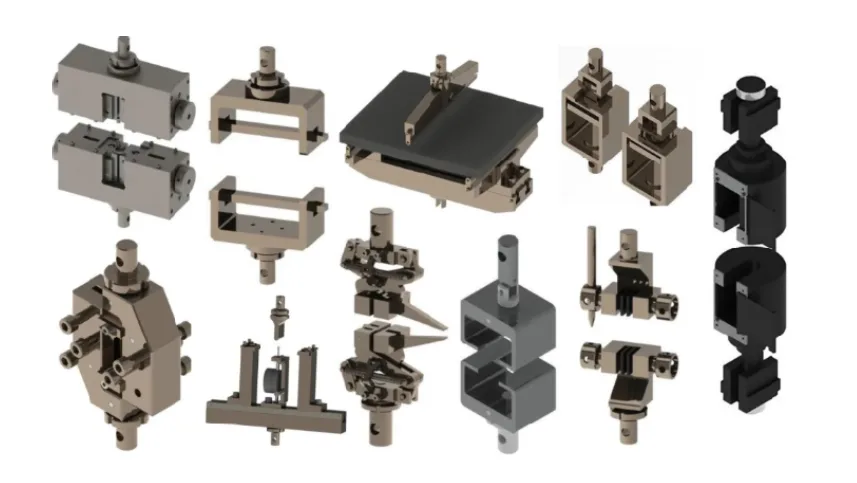
Grips & Fixtures for UTMs: A Practical Guide to Prevent Invalid Failures
In mechanical testing, the weakest link is often not the specimen. It is the hardware holding it. Grips and fixtures set the load path through the sample. They also shape stress concentration near contact points. In practice, they can decide where a crack starts and whether the break location makes sense.
Many labs meet the same headache. A specimen slips, breaks at the jaw line, or fails on one side first. The force curve may look clean. Still, the result can be misleading. Clamping method, jaw-face choice, and fixture geometry can introduce off-axis loading. That adds bending strain on top of the intended tension or compression.
This is why Universal Testing Machines are often discussed as a system, not just a frame and a load cell. Standards for both plastics and metals call out grip slippage and proper grip engagement as real, test-affecting issues, not rare exceptions. That guidance sits alongside the usual focus on specimen dimensions and test speed.
The sections below break down the common grip and fixture families, how misalignment shows up in data, and what to document so results hold up under review.
When Grips Become the Test: Load Path, Jaw Faces, and Tensile Grip Choices
Tensile grips are often treated as interchangeable. In day-to-day testing, they are not. The grip body, the jaw faces, and the way clamping force is applied can change stress distribution before the specimen ever reaches its rated strength. That is one reason two labs can run the same method and still report different break locations and scatter.
Wedge Grips and Why Metals Labs Rely on Them
Wedge grips clamp by converting axial load into a rising normal force at the jaw faces. As the test load climbs, the grip tends to tighten. That behavior is one reason wedge grips show up so often in metals work, especially with higher-strength coupons.
They also match common specimen formats. Flat and round metals specimens generally tolerate serrated faces and higher contact pressures without crushing. Even so, poor seating can create trouble fast. A practical rule of thumb from metals tensile practice is simple: get deep, even engagement in the grip, not a shallow bite at the edge. Longer engagement reduces slip risk and lowers the chance that the grip end becomes the failure origin.
Pneumatic and Hydraulic Grips for Repeatability and Higher Throughput
Air- or fluid-actuated grips apply a set clamping force with less dependence on the operator’s feel. That can reduce day-to-day drift when multiple technicians run the same program. It also speeds up workflows in labs that cycle through large batches.
These grips tend to help most when clamping is hard to tune. High-strength specimens may need clamp force that is difficult to apply consistently by hand. Some surfaces slip unless the pressure is stable. Other materials crush or notch if the pressure spikes. Controlled clamping helps balance those tradeoffs, especially when test pace is high and setup time is short.
Jaw Faces and Tabs: The Small Parts Behind Slippage
Slip is rarely mysterious. It usually comes from the contact layer between the specimen and the jaws. Face material matters. Serration pattern matters. Surface condition matters, too, including oil, oxidation, and wear.
Plastics guidance often points to coarse serrations as a workable baseline, roughly 2.5 mm spacing with about 1.5 mm depth. That geometry can bite into many thermoplastics without requiring extreme clamp force. Still, it is not a universal fix. Many labs also rely on simple interventions: abrasive interfaces in the grip zone, light surface roughening where the jaws contact, and routine cleaning when serrations clog with debris or round off.
Tabs can also shift the contact problem. For thin or notch-sensitive specimens, a tabbed grip section can spread load and reduce local damage near the jaws.
A Short Decision Tree for Tensile Setups
Start with these inputs:
- Material type: metal, plastic, elastomer, composite
- Specimen shape: flat, round, film, shouldered, tabbed
- Thickness and stiffness
- Surface finish and contamination risk
- Expected strength level
- Test pace: occasional runs or high-throughput batches
Then match a setup:
- Metals, higher strength, flat or round: wedge grips with serrated faces; aim for deep, even engagement
- High throughput or multiple operators: pneumatic or hydraulic grips; lock in a repeatable clamp setting
- Low-friction plastics or variable surfaces: coarse serrations or matched jaw faces; consider abrasive interfaces
- Thin films and delicate specimens: low-damage faces, roller-style approaches, or tabbed grip sections
- Crush-prone materials: controlled clamp force and larger contact area to avoid jaw-induced damage
Compression and Flexure Fixtures That Quietly Change Failure Modes
Compression and bending fixtures look simple. They are usually just platens, supports, and a loading nose. Even so, small geometry and alignment errors can steer a test away from the intended failure mode. Instead of a clean compressive crush or a bending-driven crack, the specimen may buckle, shear, or fail early at a contact edge.
Compression Platens and the End-Face Problem
Compression testing is unforgiving about specimen ends. If the faces are not flat, parallel, and square to the axis, the load does not enter evenly. One side takes more stress. The specimen starts bending under what should be a straight push.
Rigid plastics practice often expects end faces to be perpendicular to the axis within about 0.03 mm. That kind of tolerance sounds fussy until a lab sees the impact on repeatability. A small tilt can change the apparent strength and the way the specimen deforms.
Day-to-day habits matter here. Center the specimen carefully. Let it seat without side load. Watch for rocking when the platens first touch. Platen condition also matters. Dings, dirt, and worn surfaces can add local contact points that act like stress risers.
Bend Fixtures: Span Control, Support Radii, and What ASTM-Style Setups Assume
Flexural tests are built around simple geometry. In three-point bending, two supports hold the specimen and a single nose loads it at midspan. In four-point bending, two noses apply load, creating a longer region of constant moment between them. The fixture design sets where the highest bending stress occurs and how much shear stress rides along with it.
Span control is the quiet driver of failure mode. A common starting point is a span-to-depth ratio near 16:1. In some laminates, higher ratios such as 32:1 or 40:1 are used to push the response toward bending and away from shear effects. Changing span, support diameter, or nose radius can shift the crack origin. It can also change the measured strength enough to confuse comparisons across labs.
Fixture Wear and Setup Drift
Fixture problems often show up slowly. Break locations drift over time. Scatter rises without a clear change in material. Indent marks appear that were not there before. These clues usually point back to contact surfaces and alignment.
Worn rollers can add friction or uneven support. Damaged noses can notch the specimen. Loose supports can change span under load. Off-center loading can tilt the specimen and raise bending on one face.
The fixes are not complicated. Inspect fixtures on a schedule tied to use, not the calendar alone. Track wear parts like rollers and noses. Use quick go/no-go checks for span, parallelism, and free rotation before a test series starts.
Misalignment as a Hidden Source of Bending Strain and “Bad Breaks”
Misalignment is easy to miss because the machine can still apply force smoothly. The load reading can look stable. The test can run to completion. Still, off-axis loading adds bending on top of the intended stress state, which changes how damage starts and how fast it grows.
What Off-Axis Loading Does to a “Simple” Tensile Test
In a perfect tensile test, the specimen sees mostly axial stress. The cross-section is pulled straight, and strain builds evenly across the width. When the load line is tilted or offset, the specimen also bends. One face goes into higher tension while the opposite face sees less.
Labs often notice this only after the fact. One side of the gauge section stretches faster than the other. Strain readings become asymmetric. Cracks start early at an edge, at a shoulder, or near the grip transition. Failures also drift toward the jaws, especially when the grip contact is uneven or the specimen is seated at a slight angle.
What “Alignment Verification” Means in Practical Terms
Alignment verification is a way to measure how much bending the load train is introducing. It is usually done with a strain-gaged alignment tool that responds to axial load and bending response at the same time. The output can be reported as a metric such as percent bending, which relates bending strain to axial strain.
The point is documentation, not a one-time setup tweak. There is no universal pass or fail number that applies to every test. Limits, when they exist, usually come from a specific test method, a customer requirement, or a lab’s own quality policy. The practical value is consistency. It gives the lab a way to show that a load train change did not quietly add bending into routine work.
Where Misalignment Starts
Misalignment often starts upstream of the specimen. Common sources include small interface issues that stack up across the load train.
- Adapters and couplers: A slightly bent adapter can tilt the load line, especially after overload or mishandling.
- Mixed thread standards: A near-fit thread can seat poorly and introduce a small angle that repeats every test.
- Worn grip seats: Wear in grip bodies or seats can create lateral play, which shows up as bending under load.
- Poor specimen seating: A specimen that is not centered, or is clamped while slightly rotated, will pull off-axis.
- Uneven clamping pressure: One jaw face bites harder than the other, shifting the specimen and raising bending on one side.
Most of these issues do not announce themselves. They show up as early edge cracking, shifting break locations, and rising scatter across repeat runs.
Documentation That Holds Up Under Audits and Customer Review
Mechanical test results are easier to defend when the setup is recorded the same way every time. That includes the hardware, the contact surfaces, and the steps used to clamp and align the specimen. When a customer questions a break location or an outlier result, the fastest path to an answer is usually the setup record.
Setup checklist for traceability:
- Grip type and jaw faces used: note the grip family and the face pattern or material.
- Clamping method written as a procedure: record the pressure setting, a torque method, or a defined operator step.
- Fixture geometry captured: span length, nose size, support condition, plus any adapters or spacers.
- Alignment checks logged: note what check was used and the date it was last performed.
- Maintenance and wear notes: worn faces, replaced rollers, cleaned serrations, or damaged platens.
- Specimen preparation notes: grip-zone surface condition, tabs if used, and compression end-face preparation.
Good records cut down on reruns and keep disagreements from dragging on. If failures start shifting location or scatter rises, it is usually time to revisit grip choice, jaw faces, and fixture geometry.
Frequently Asked Questions
- Why Can Grips And Fixtures Cause “Invalid” Failures Even When The Specimen Is Correct?
Grips and fixtures define the load path into the specimen and can introduce stress concentrations at contact points. If the setup adds off-axis loading, uneven clamping, or local damage near the jaws or supports, cracks can start in the wrong place and break locations can drift, creating misleading results even when the force curve looks normal. - When Do Wedge Grips Work Best, And What Usually Goes Wrong With Them?
Wedge grips are commonly used for higher-strength metal specimens because clamping force increases as test load rises, which helps resist slip. Problems usually come from poor seating or shallow engagement, uneven jaw contact, worn serrations, or contamination in the grip zone—any of which can steer failure toward the jaw line or create asymmetric deformation. - Why Do Pneumatic Or Hydraulic Grips Often Improve Repeatability In Busy Labs?
They apply a controlled, repeatable clamping force that is less dependent on operator technique. That consistency helps when tests run in high volume, when multiple technicians share equipment, or when materials either slip easily or are prone to crushing if clamp force varies. - What Fixture Issues Most Often Change Compression Or Bending Failure Modes?
In compression, non-parallel or non-square specimen ends and damaged or dirty platens can introduce bending instead of straight compression. In flexure, span length, support radii, nose condition, and wear-related drift can shift the balance between bending and shear, moving crack origin and altering measured strength. - What Should A Lab Document So Results Hold Up In Reviews And Audits?
Record grip type and jaw face details, the clamping method and settings, fixture geometry such as span and nose/support sizes, any adapters in the load train, alignment or bending checks and their dates, and maintenance notes like cleaned or replaced wear parts. Include specimen notes that affect gripping and contact, such as grip-zone surface condition, tabs, and compression end-face preparation.