Guest Posting in 2026: Why Verified Marketplaces Are Replacing Traditional Outreach
Ask anyone who has run a serious link building campaign through traditional outreach and they will tell you the same story. You spend days building prospect lists, hours crafting personalized pitches, and weeks following up — only to see roughly one in ten attempts result in an actual placement. The other ninety percent disappear into inboxes that never respond.
In 2026, with competition for organic search visibility more intense than ever before, that is a reality fewer teams can afford to accept.
What Has Actually Changed in Link Building
The fundamentals of why links matter have not shifted. Google continues to treat backlinks from authoritative, relevant websites as one of the strongest signals of a page’s credibility and ranking potential. What has changed is the infrastructure available to acquire those links efficiently and safely.
Two developments define where things stand today. First, Google’s continued refinement of spam detection has made low-quality link schemes — private blog networks, link farms, irrelevant directories — not just ineffective but actively damaging to the sites that use them. Second, the guest post marketplace model has matured to a point where the best platforms now offer something traditional outreach structurally cannot: genuine predictability. Fixed pricing, verified traffic data, guaranteed placement, and turnaround times measured in days rather than weeks.
Why Traditional Outreach Struggles to Scale
Traditional outreach fails not because the concept is flawed but because the execution at any meaningful scale is unsustainable. A single link placement through manual outreach requires identifying a suitable site, finding accurate contact details, writing a personalized pitch, negotiating terms, submitting content, waiting through editorial review, and following up if nothing happens. When it works, the process takes four to six weeks. When it does not — ninety percent of the time — it takes just as long and produces nothing.
For agencies managing link building across multiple clients simultaneously, or for in-house teams executing a backlink strategy alongside everything else on their plate, this model simply does not hold up. The time cost alone frequently makes traditional outreach uneconomical before a single link goes live.
What a Quality Marketplace Actually Looks Like
The guest post marketplace model has existed for years, but its reputation has been historically mixed. Early platforms prioritized volume over quality, listing thousands of sites without meaningful vetting and giving buyers no reliable way to distinguish genuine authority from inflated metrics. Cheap links on questionable sites were sold alongside legitimate placements, and buyers often had no way to tell the difference until rankings failed to move — or worse, dropped.
That standard has shifted. The better platforms in 2026 are built around genuine verification. Publizia is a useful example of what this looks like in practice.
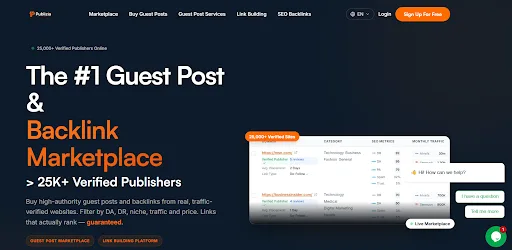
The platform gives buyers access to over 25,000 verified publisher websites, filterable across more than thirty parameters — domain authority, domain rating, live Ahrefs and Semrush traffic data, spam score, niche, country, language, and price, among others. Every site listed has passed a manual twenty-point inspection covering traffic trend analysis, outbound link profiling, content quality review, and hosting checks. An AI layer runs alongside this process to detect and block private blog networks before they ever reach the marketplace.
The result is that buyers see only sites that have passed genuine scrutiny — not simply sites that paid a listing fee. Pricing starts from $49 per placement with transparent, fixed costs and no hidden charges. An escrow system holds payment securely until the buyer confirms the live link is satisfactory, and every placement comes with a twelve-month guarantee. If a link is removed within that period, it is replaced or refunded.
For agencies in particular, this structure changes the economics of link building considerably. When cost, quality, and turnaround are predictable, link building becomes a deliverable you can plan around rather than an outreach campaign with an uncertain outcome.
Guest Posting and Digital PR: Two Different Tools
One distinction worth understanding clearly in 2026 is the difference between guest posting and digital PR, because they serve related but distinct purposes within a broader SEO strategy.
Guest posting involves placing content on a publisher’s website in exchange for a backlink. Done properly — on relevant, traffic-verified sites with genuine editorial standards — it builds domain authority steadily and contributes meaningfully to rankings over time. It is scalable, predictable, and well suited to ongoing link building programs.
Digital PR operates differently. Rather than paid placements, it pursues earned editorial coverage from authoritative publications — the kind of links that appear because a journalist found your data, your story, or your expert commentary genuinely worth covering. These carry a stronger editorial trust signal and have a more significant impact on Google’s E-E-A-T framework, which evaluates the experience, expertise, authoritativeness, and trustworthiness behind a piece of content.
The practical question is which approach fits a given goal. For steady, scalable authority building across a broad keyword set, a well-executed guest posting program is typically more efficient. For establishing genuine brand credibility in a competitive vertical, or earning the kind of high-authority editorial links that cannot be acquired through any paid route, digital PR fills a gap that guest posting alone cannot address.
The two approaches are most effective when used together — guest posting providing the consistent volume of quality links that steady ranking improvement requires, and digital PR delivering the standout editorial placements that establish genuine authority in a niche.
The Publisher Side of the Equation
Most discussion of guest post marketplaces focuses on buyers, but the opportunity for publishers is equally worth understanding. If you run a website with genuine traffic and editorial standards, listing on a quality marketplace generates consistent revenue without the friction of managing individual outreach relationships.
The mechanics are straightforward. You list your site with pricing and content guidelines. Advertisers browse listings and place orders that match your terms. You publish approved content and receive payment once the buyer confirms the live link. For publishers managing multiple sites, a single dashboard covering order tracking, buyer messaging, and revenue analytics makes the operational side considerably cleaner than handling guest post requests through email.
One practical consideration when evaluating publisher platforms is fee structure. Commission rates across different marketplace platforms vary significantly — from as low as ten percent on platforms using Payoneer or cryptocurrency payments, to fifteen to twenty-five percent on older or less competitive platforms. Understanding the total fee before listing matters, particularly if you are managing guest posting revenue as a meaningful income stream.
How to Evaluate Any Link Building Platform
Whether you are assessing a specific marketplace or comparing options more broadly, the criteria worth applying in 2026 are consistent.
Traffic verification matters more than domain authority scores alone. DA and DR are useful reference points but can be manipulated. Platforms that display live, third-party traffic data from Ahrefs or Semrush give buyers something considerably harder to game. If a platform cannot show real traffic trends before you commit, treat that as a meaningful red flag.
Payment protection is non-negotiable. The gap between paying for a placement and seeing it go live creates obvious potential for disputes. Escrow systems exist precisely to close that gap. Any platform operating without escrow is asking buyers to extend trust that the structure of the transaction does not support.
Permanence guarantees reflect confidence in the quality of the publisher network. A platform willing to replace or refund links that disappear within twelve months has built its network with enough care to stand behind it. Platforms without this commitment frequently reflect a lower standard of vetting on the publisher side.
Finally, filtering capability determines how efficiently you can find suitable placements at scale. The ability to search by niche, traffic source, geographic focus, language, and price — rather than simply by domain metrics — is what separates a genuinely useful marketplace from a basic directory.
Where the Industry Has Landed
The conversation in SEO circles in 2026 is no longer about whether guest post marketplaces are a legitimate link building channel. For teams that need to execute link building at meaningful scale without sacrificing quality, the verified marketplace model has become the practical starting point.
The question is simply which platforms are worth trusting — and the answer comes down to the same criteria it always has. Real traffic data. Genuine editorial standards. Transparent pricing. And guarantees that you hold up when something goes wrong.
The hard way of doing link building still exists. It just no longer makes sense as a default.