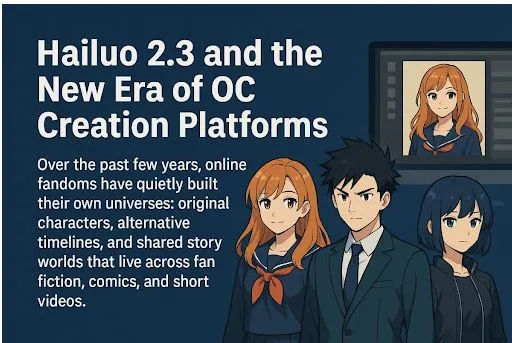
Hailuo 2.3 and the New Era of OC Creation Platforms
Over the past few years, online fandoms have quietly built their own universes: original characters, alternative timelines, and shared story worlds that live across fan fiction, comics, and short videos. What used to be sketched in the margins of a notebook is now being translated into fully produced clips, complete with cinematic lighting and complex motion.
The launch of Hailuo 2.3, a new-generation video model from MiniMax, marks an important moment in this shift. Designed for both text-to-video and image-to-video, it focuses on style consistency, dance-level motion, and detailed facial expressions – three factors that matter a lot when you are trying to bring a recurring OC to life rather than just generate a one-off meme.
At the same time, character-focused tools and OC maker platforms are giving fans, VTubers, and indie authors a more structured way to design cast members before they ever appear on screen. Together, they are turning “make my OC move” from a wish into a repeatable workflow.
The Real Changes Hailuo 2.3 Brings to Video Generation
Hailuo 2.3 is part of a family of video models that support two main workflows:
- starting from text to build a short clip (text-to-video), and
- starting from a still image or character sheet and animating it (image-to-video).
Compared with earlier versions, Hailuo 2.3 focuses on three practical improvements for creators:
- Stable anime and special styles: The model is tuned to keep a chosen art style consistent from frame to frame. That matters if your OC has a specific anime look, line weight, or color palette, and you need them to stay “on-model” instead of drifting into a different style mid-shot.
- Complex motion without broken limbs: Full-body dance, action moves, or dramatic camera swings are where many earlier systems would glitch. Hailuo 2.3 is designed to handle choreography and fluid motion more reliably, making it easier to create clips where your OC is actually performing on screen, not just standing in place.
- Sharper facial micro-expressions: Subtle changes in eyes and mouth often determine whether a character feels alive or uncanny. The model specifically targets expression detail, which helps when you’re building emotional moments – a reaction shot, a small smirk, or a worried glance.
MiniMax positions Hailuo 2.3 as an upgrade in quality while keeping the same pricing level as its previous Hailuo 02 line and adding a faster, lower-cost “2.3 Fast” option for batch work. For OC creators who may be producing dozens or hundreds of variations, that kind of cost-to-quality ratio matters.
OC Maker Platforms: Character-First, Not Clip-First
While video models handle motion and rendering, a different type of tool is quietly becoming the “front door” for many fan projects: the OC maker platform.
Sites like OCMaker AI focus on the character side of the equation. Instead of starting with a video timeline, users begin with personality, outfit, and art style: think of it as a studio for building original anime-style heroes, villains, VTuber avatars, or mascots that can be reused across poses and scenes.
OCMaker AI positions itself as an online OC maker platform where fans and creators can define their own cast visually, refine details over multiple iterations, and export results for games, comics, or downstream video tools. For those who just want to test ideas quickly, the site also offers a free OC creator workflow that runs directly in the browser, without heavy local software.
In other words, instead of generating a random character for each clip, OC-focused tools encourage users to commit to a design and then keep it consistent – something that aligns perfectly with what Hailuo 2.3 is trying to do on the video side.
A Practical Workflow for Converting a Static Character Sheet into a Short Clip
For many readers, the real question is not “Is this technology impressive?” But can this be turned into a repeatable workflow?
A simple OC-to-video pipeline might look like this:
| Stage | Traditional Workflow | With OC Maker + Hailuo 2.3 |
| Character design | Manual drawing or hired commission for each variation | Generate and refine a reusable OC model online |
| Pose / key visual | New sketch or 3D blocking for every scene | Create stills or character sheets from the platform |
| Motion & final clip | Full production: rigging, animation, editing | Feed image + prompt into Hailuo 2.3 for short videos |
In practice, a creator might:
- Design an anime-style OC on an online character platform, locking in face, hairstyle, clothing, and overall mood.
- Export 1–2 hero images or character cards in the style they want to keep.
- Use Hailuo 2.3’s image-to-video mode to animate those images into 6–10 second clips – walking cycles, dance loops, or reaction shots.
- Stitch clips together in a basic editor, add subtitles or voice-over, and publish to social platforms.
This doesn’t replace full-scale 3D or 2D animation studios, but it does give solo creators, small teams, or fan communities a realistic way to keep a whole cast moving on screen without starting from zero for every shot.
Who Benefits the Most from Combining Hailuo 2.3 with OC Workflows?
Several groups stand to benefit from this combination of character-first tools and motion-focused video models:
- VTubers and streamers: Many streamers already invest heavily in a single avatar. With Hailuo 2.3, that same avatar can star in short cinematic promos, animated channel intros, or social media teasers built from a few well-designed images rather than a full 3D rig.
- Indie authors, game devs, and TTRPG creators: Original characters built for novels, visual novels, or tabletop campaigns can now “audition” in motion. Short clips can help with marketing, crowdfunding pages, or community engagement, without requiring a studio budget.
- Brand and campaign teams: Mascots, limited-time event characters, or regional brand ambassadors can be prototyped quickly using an OC platform, then animated into product explainers or social shorts using Hailuo 2.3’s fast variants and ecommerce-friendly motion tracking.
- Fan communities and collaborative universe: Shared OCs in a fandom or fictional universe can be standardized visually on one site, then brought to life in short clips that preserve the agreed-upon style. That helps avoid arguments about “off-model” interpretations while keeping creative energy high.
Risks, Responsibilities, and the Learning Curve
Like any powerful creative toolset, this new OC-plus-video stack comes with caveats:
- Copyright and likeness concerns: Even when a platform focuses on “original” characters, users can still attempt to recreate existing IP or real people. Both Hailuo and OC-maker platforms stress that generated content should be used legally and responsibly; creators still have to understand local laws, platform policies, and the limits of fair use.
- Disclosure and audience expectations: As AI-assisted visuals become more common, audiences may ask for clarity: which parts were generated, and which were hand-drawn or filmed? For professional use, clear disclosure and ethical guidelines can help maintain trust.
- Skill still matters: These tools simplify execution, not storytelling. Strong character concepts, coherent world-building, and clear shot planning still differentiate standout work from the flood of generic clips.
For beginners, the learning curve is now less about mastering full animation software and more about understanding prompts, composition, pacing, and character consistency across media.
Looking Ahead: OC Ecosystems Powered by Video Models
Hailuo 2.3 is part of a wider wave of video models—from Kling and Veo to Sora and others—that are racing to deliver higher resolution, better motion, and more controllable styles. What makes Hailuo 2.3 stand out for OC creators is its explicit focus on style stability, rapid image-to-video generation, and cost-effective output.
When that kind of engine is paired with character-centric platforms like OCMaker AI, a new pattern emerges: fans and small teams can treat their OCs less like isolated doodles and more like recurring “digital actors” that star in shorts, promos, and episodic content across the web.
For BigNewsNetwork readers watching the creator economy, this isn’t just another technical upgrade. It’s the beginning of a more structured OC ecosystem—one where character design tools, video models, and distribution platforms work together, and where the next breakout franchise might start not in a studio boardroom, but in a browser tab where someone is giving their first original character a chance to move.