
How 6G Networks Could See the World Using Channel State Information
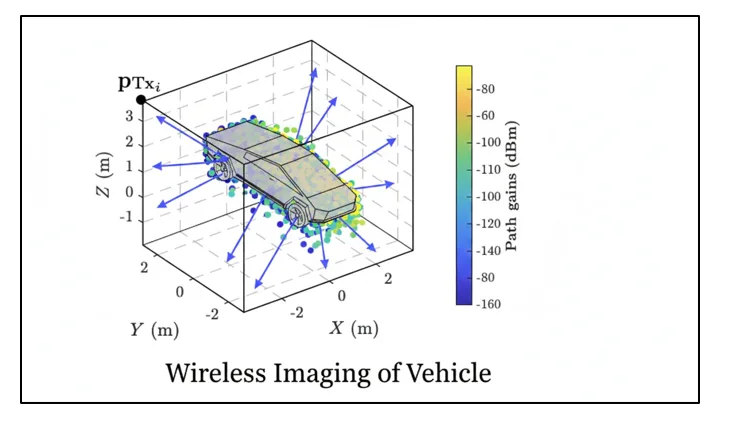
At IMSENSORS2026 of INSCITECH SUMMITS, Research Scientist Ahmad Bazzi (NYU Abu Dhabi / NYU WIRELESS) will deliver a keynote titled “CSI as a Camera: Imaging the 6G World,” outlining how everyday channel state information (CSI), already present in today’s communication systems can be repurposed into a practical imaging modality for integrated sensing and communications (ISAC).
Turning Communication Channels Into 3D Scene Reconstructions The keynote argues that 6G will move beyond connectivity toward persistent, network-native environmental mapping, enabling applications such as digital twins, environment-aware beam management, and sensing-enhanced mobility. Bazzi’s talk focuses on extracting geometry from the wireless channel by treating each resolvable multipath component, characterized by delay and departure/ arrival angles, as information to where radio waves interacted with the environment. Rather than assuming ideal single-bounce reflections, the approach converts multipath returns (including multi-bounce reflections, diffraction, and scattering) into equivalent reflection points (ERPs) that can be fused into dense 3D point clouds.
What Attendees Will Learn
In the keynote, Ahmad Bazzi will present a two-segment reflection-point optimization method that estimates transmitter-to-ERP and ERP-to-receiver path lengths separately, enforcing consistency with measured delay while minimizing mismatch between inferred transmit and receive rays.
Using NYURay simulations at 6.75 GHz (FR3), the work demonstrates reconstructions that recover edges, planar facets, and curved surfaces across diverse objects, including trees, metallic shapes, and a vehicle-like silhouette and discusses what it will take to move from “simulation-perfect CSI” to robust, real-time imaging under bandwidth, SNR, and hardware impairments.
“Wireless networks already measure the channel to communicate efficiently,” said Ahmad Bazzi. “In 6G, the same information can be mined to build a geometric understanding of the environment, which will effectively turning routine traffic into a sensing and imaging pipeline.”
Tied to Recent Peer-Reviewed Research
The keynote content builds on Bazzi’s invited research on:
- Bazzi, M. Ying, O. Kanhere, T. S. Rappaport and M. Chafii, “ISAC Imaging by Channel State Information using Ray Tracing for Next Generation 6G,” in IEEE Journal of Selected Topics in Electromagnetics, Antennas and Propagation, doi: 10.1109/JSTEAP.2025.3605877.
Abstract: Integrated sensing and communications (ISACs) is emerging as a cornerstone technology for sixth-generation (6G) wireless systems, unifying connectivity and environmental mapping through shared hardware, spectrum, and waveforms. The following article presents an ISAC imaging framework utilizing channel-state information (CSI) per-path components, transmitter (TX) positions, and receiver (RX) positions obtained from the calibrated NYURay ray tracer at
6.75 GHz in the upper mid-band. Our work shows how each resolvable multipath component can be extracted from CSI estimation and cast into an equivalent 3-D reflection point by fusing its angle and delay information, which is useful and challenging for multibounce reflections. The primary contribution of the article is the two-segment reflection point optimization algorithm, which independently estimates the path lengths from the TX and RX positions to an equivalent reflection point (ERP) on the object surface, thus enabling precise geometric reconstruction. Subsequently, we aggregate the ERPs derived from multiple pairs of TX and RX positions, generating dense 3-D point clouds representing the objects in the channel. Experimental results validate that the proposed ISAC imaging framework accurately reconstructs object surfaces, edges, and curved features. To the best of our knowledge, this article provides the first demonstration of multibounce ISAC imaging using wireless ray tracing at 6.75 GHz.
Available on: https://ieeexplore.ieee.org/stamp/stamp.jsp? tp=&arnumber=11173662
Keynote Details
Title: CSI as a Camera: Imaging the 6G World
Speaker: Ahmad Bazzi, Research Scientist, NYU Abu Dhabi / NYU WIRELESS Event: IMSENSORS2026
Date / Time: March 8, 2026 Location: Kuala Lumpur, Malaysia
Registration: https://inscitechsummits.com/2026/sensors/keynote-speakers
About Ahmad Bazzi
Ahmad Bazzi was born in Abu Dhabi, United Arab Emirates. He received his PhD degree in electrical engineering from EURECOM, Sophia Antipolis, France, in 2017, and the MSc degree (summa cum laude) in wireless communication systems (SAR) from Centrale Supélec, in 2014. He is currently a Research Scientist at the Wireless Research Lab of New York University (NYU) Abu Dhabi, and NYU WIRELESS, NYU Tandon School of Engineering, contributing to integrated sensing and communications (ISAC). Prior to that, he was the Algorithm and Signal Processing Team Leader at CEVA-DSP, Sophia Antipolis, leading the work on Wi-Fi (802.11ax) and Bluetooth (5.xx BR/BLE/BTDM/LR) high-performant (HP) PHY modems, OFDMA MAC schedulers, and RF-related issues. He is an inventor with multiple patents involving intellectual property of Wi-Fi and Bluetooth products, all of which have been implemented and sold to key clients. He is a Senior Member of the IEEE. He is a full member of Sigma Xi (ƩΞ), The Scientific Research Honor Society. Since 2018, he has been publishing lectures on the YouTube platform under his name “Ahmad Bazzi”, where his channel contains mathematical, algorithmic, and programming topics, with over 270,000 subscribers and more than 17 million views, as of November 2024. He was awarded a CIFRE Scholarship from Association Nationale Recherche Technologies (ANRT) France, in 2014, in collaboration with RivieraWaves (now CEVA-DSP). He was nominated for Best Student Paper Award at IEEE International Conference on Acoustics, Speech, and Signal Processing (ICASSP) 2016. He received the Silver Plate Creator Award from YouTube, in 2022, for his 100,000 subscriber milestone. He was awarded an exemplary reviewer for the IEEE Transactions on Communications (TCOM) in 2022, an exemplary reviewer for the IEEE Wireless Communications Letters (WCL) in 2022, and an exemplary reviewer for the IEEE Open Journal of the Communications Society (OJ-COMS) in 2025. He served as technical program committee (TPC) member and a reviewer for many leading international conferences. He was selected amongst top 200 Top Arab creators for 2023. He serves as an editor of the IEEE Communications Letters (COMML), 2025-2026, an editor for the IEEE OJ-COMS, 2025-2026. He also serves as a guest editor for the IEEE OJ-COMS special issue on “Resilient and Trustworthy Communications for 6G Wireless Environments: Integrating Sensing, AI, and Security in Smart Wireless Systems”, 2026. His research interests include signal processing, wireless communications, artificial intelligence, statistics, and optimization.