How a Free Portfolio Website Can Boost Your Job Search in 2026
A resume tells an employer what you have done. A portfolio shows it. As hiring moves online and roles get more competitive, more candidates are pairing the two, and in many fields a link to your work now carries as much weight as the resume itself.
The shift is easy to explain. Recruiters skim dozens of near-identical resumes for every opening, and claims like “strong communicator” or “results-driven” blur together. A portfolio breaks the tie. It lets someone see the actual project, campaign, design, or piece of writing behind a bullet point, along with the context and the outcome. For remote and cross-border roles, where the employer may never meet you in person, that proof matters even more.
Portfolios used to be the preserve of designers and developers, but that is no longer true. Marketers show the campaigns and the numbers they moved. Writers collect their best pieces. Product managers walk through a launch. Teachers share lesson plans and results. Students and career changers, who often have the least conventional experience, use a portfolio to show coursework, side projects, and volunteer work that a one-page resume has no room for. Freelancers and consultants treat it as a storefront that wins clients while they sleep.
A strong portfolio does not need to be elaborate. A few elements do most of the work: a short “about” section that says who you are and what you do, a selection of your best projects with a sentence or two on the problem and the result, a clear list of skills, and an easy way to get in touch. Depth beats breadth. Three well-explained projects land better than a dozen thumbnails with no context. Wherever you can, attach a number: traffic, revenue, users, time saved, grades improved. Specifics are what make a portfolio believable.
The old barrier was building the thing. Not long ago a portfolio meant either paying a developer or wrestling with a website tool for a weekend. That has changed. A free portfolio website builder now lets you pick a design, fill it with your details, and publish a live, shareable page in minutes, with no code and no hosting to manage. The result is a professional presence you can stand up in an afternoon rather than a project you keep putting off.
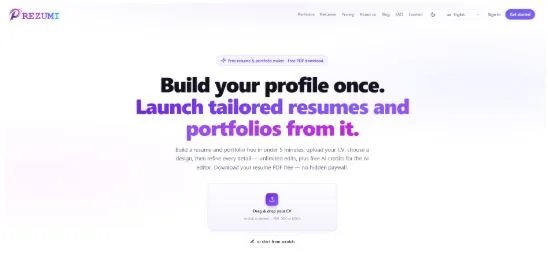
The shareable link is the quiet advantage. Instead of attaching files and hoping they open, you send one URL that works on any device and stays current as you add new work. Tools like Prezumi take this further by generating both a resume and a matching portfolio from the same profile, so you keep one source of truth and either export a clean PDF or share a link depending on what the moment calls for. Drop that link in your email signature, your LinkedIn profile, and the top of your resume, and every application quietly points back to evidence of what you can do.
As with a resume, tailoring pays off. You do not need a different site for every job, but it helps to lead with the projects most relevant to the role you want and to update the “about” line so it speaks to that field. A portfolio is also something you build once and improve slowly. Add each meaningful project as you finish it, retire the weakest ones, and refresh the top of the page every few months so your best work is what a visitor sees first.
None of this replaces a good resume; it strengthens it. The resume gets you past the initial filter and onto the shortlist. The portfolio is what convinces the human on the other side that the bullet points are real. In a job market where standing out is harder than ever, having both and keeping them current is one of the simplest edges a candidate can give themselves in 2026, and free tools have finally made it something anyone can do without design skills or a budget.