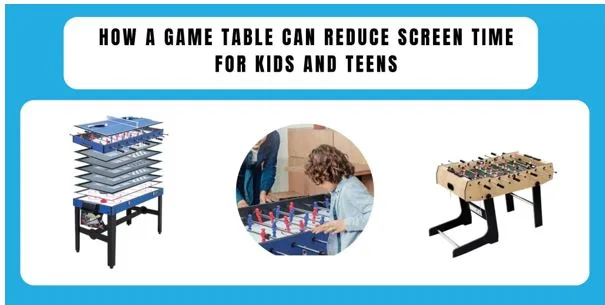
How a Game Table Can Reduce Screen Time for Kids and Teens
Maybe there was a day when the sun poured through the kitchen window and your child sat cross-legged, laughing over a silly card play, you were thinking “this is magical,” and you were absolutely right.
Play that draws kids away from screens doesn’t have to feel like a lecture. It can be a story you and your family write together over and over. A single piece of furniture, a simple, inviting games table, can become that story’s stage.
Screens are everywhere. They’re convenient. They’re tempting. They also quietly eat into time that could be spent talking, thinking, and learning through hands-on experiences. That’s why a games table for kids is more than furniture: it’s an intentional decision to invite play that’s social, tactile, and screen-free.
Why Screen-Free Play Matters
When you worry about too much screen time, you’re not alone. Extensive research shows that heavy screen use can contribute to sleep problems, lower academic performance, and delays in certain areas of development. Organizations like the American Academy of Pediatrics recommend setting limits and encouraging mindful use of screens.
There is also growing evidence that replacing passive screen hours with active, guided play, like board and table games and other screen-free games table activities, supports cognitive skills and social behaviours. Playing board games can boost executive function, turn-taking, and problem-solving in kids.
What Is a Games Table and Why It Works
Imagine a low, child-sized table with easy-to-reach shelves, a cup for dice, and a small chalkboard for scores. This helps you visualise the scene fully because the details matter and will make you smile.
A games table signals a clear alternative to screens. It’s a dedicated place. It’s ritual-friendly (after-school snacks + a round of cards). It’s visible. That visibility alone changes family habits: when play is easy to start, kids start it more often. Simple logic. Major habit shifts.
Games Table Benefits for Kids:
- More face-to-face interaction.
- Improved turn-taking and patience.
- Better language and communication skills.
- Hands-on problem solving and creativity.
- A natural nudge away from screens.
How a Game Table Fits Different Ages
As children grow, the games table adapts with them, offering age-appropriate challenges that nurture essential skills at every stage of their development.
| Age Range | Ideal Games & Activities | Main Benefits |
| 2–4 years | Matching, simple puzzles, stacking | Fine motor skills, sharing, attention span |
| 5–8 years | Card games, cooperative board games, crafts | Language skills, turn-taking, teamwork |
| 9–12 years | Strategy board games, role-play, speed games | Planning, logic, sportsmanship |
| 13+ years | Family game nights, complex strategy, party games | Social bonding, communication, stress relief
|
How to Pick Games and Set Up the Perfect Games Table
You don’t need every game. One or two favourites will do. It’s about the thinking behind “quality over quantity,” and to drive the point home.
Practical set-up tips
- Choose durable surfaces that clean easily.
- Keep games grouped by difficulty and age.
- Use a basket or drawer for small parts.
- Add comfortable seating and good lighting.
- Rotate games every few weeks to keep novelty.
Game Types to Reduce Screen Time
- Cooperative games make kids work together, so you hear them talking and planning.
- Quick card games are short, engaging, and easy to start.
- Building and tactile play includes blocks, clay, and puzzles that use hands.
- Creative games like storytelling, drawing, and role-play that spark imagination.
Making It a Habit: Family Rituals That Stick
If you want screens to shrink, replace them with rituals. Little rituals. Big changes. They don’t need to be complicated. Just predictable.
Set a “no screens for 30 minutes after school” rule. Put a snack and a quick play on the games table to reduce screen time. Start small. Celebrate the wins. Repeat.
Parents who model the behaviour, putting their phones away and joining the table, see the biggest payoff. It’s simple social learning.
Evidence That Table-Top Play Does More Than Entertain
Board games and table play are associated with emotional and cognitive growth across many studies: improvements in executive function, better classroom behaviour, and stronger social skills are reported after guided play intervention. One recent review and other clinical studies find that structured game play can enhance learning and social-emotional competencies in school-age children.
Medical and public health bodies also highlight that limiting screen time improves sleep and developmental outcomes, and replacing screens with active interactions is consistently recommended.
Quick Checklist: Buying or Building a Games Table
Keep these essential features in mind when buying or building your games table to ensure its suitability:
- Size fits the family and space.
- Surface easy to clean.
- Storage for games and parts.
- Safe edges and stable legs.
- Affordable; or DIY-friendly.
Because stories linger best when you leave room to breathe.
In Conclusion
During free time, when you set up the table games table, place a simple card game on it, and invite your child to play. You put your phone face down, which makes them hesitate and convinced for playing. Then they grinned. Fifteen minutes passed. Then thirty. You hear their laughter and feel connected. That memory becomes a loop, and you’re more likely to do it again.
Small decisions can make great childhoods, and a game table is a bit contribution; though, it’s a powerful one!
FAQs
Do game tables actually reduce screen time?
Yes, when used as part of a family routine. Replacing even one hour of passive screen use with a board game or group play yields measurable benefits for sleep and attention. Aim for predictable, repeatable sessions: 20–30 minutes after homework or on weekend afternoons. Studies suggest that replacing screen time with guided play supports learning and social skills.
What age is best for a games table?
Any age, if the games match the child. Toddlers benefit from simple matching and stacking. Young kids thrive with cooperative games. Older kids enjoy strategy and card games. The table is just a platform; the content is what grows with it.
How do I encourage my child to use the games table instead of screens?
Create consistent family rituals around the game table, such as a “no screens for 30 minutes after school” rule. Keep games accessible and fun, join them at the table, and celebrate each session to build positive habits naturally.