How AI Agents Are Transforming Healthcare Delivery: Benefits, Use Cases, and What’s Next
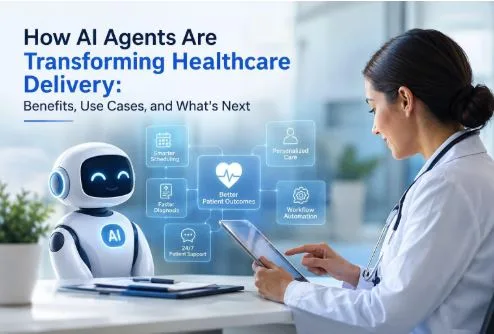
Healthcare has spent the last decade digitizing records, but the next shift is different: software that doesn’t just store information; it acts on it.
According to MarketsandMarkets, the global AI agents in healthcare market is projected to grow from roughly $1.11 billion in 2025 to $6.92 billion by 2030 a compound annual growth rate above 44%.
That pace reflects a broader move away from pilot programs and into everyday clinical and administrative workflows, driven largely by demand for a capable ai agent development company
that can build systems suited to the realities of a hospital or clinic, not just a generic chatbot use case.
Reducing the Administrative Burden on Clinicians
Physicians and nurses routinely spend more hours on documentation, scheduling, and insurance follow-ups than on direct patient care. AI agents in healthcare Settings can now handle prior authorization requests, populate structured EHR fields from clinical notes, and manage appointment scheduling autonomously freeing up clinical staff for higher-value work.
Handling Exceptions, Not Just Rules
Unlike static automation scripts, these agents adapt to exceptions: rerouting an insurance denial, flagging an incomplete referral, or escalating an edge case to a human reviewer instead of failing silently.
Faster, More Consistent Clinical Support
AI agents are also being deployed to support diagnostic and triage workflows — cross-referencing patient history, lab results, and current symptoms to flag risk patterns for physician review. This doesn’t replace clinical judgment; it compresses the time between data entry and actionable insight, which matters most in high-volume settings like emergency departments and primary care networks facing staffing shortages.
Cutting Readmissions Through Continuous Monitoring
One of the clearest ROI cases for healthcare AI agents is post-discharge care. Industry research on agentic AI deployments has reported readmission reductions in the range of 20% to 40% when agents continuously monitor patient vitals, medication adherence, and follow-up scheduling after discharge — flagging warning signs and triggering telehealth check-ins before a small issue becomes a hospital visit.
Why This Matters for Readmission Penalties
For health systems facing readmission penalties, this kind of proactive, always-on monitoring is difficult to replicate with human staff alone.
Always-On Patient Engagement
Beyond discharge, routine patient queries, medication reminders, and appointment confirmations are all areas where an AI agent can operate continuously without adding headcount. For providers managing large patient populations, this means fewer missed follow-ups and more consistent communication a small operational change with an outsized effect on satisfaction scores.
The Return on Investment Is Becoming Measurable
Healthcare organizations adopting AI more broadly are already seeing returns: industry surveys put the average ROI at roughly $3.20 for every $1 invested, with payback typically realized within 14 months. As AI agents take on more autonomous, multi-step tasks rather than single-function automation, that return is expected to compound provided the underlying systems are built to scale safely.
Compliance Can’t Be an Afterthought
The upside of autonomy comes with a corresponding obligation: any AI system touching patient data has to be built around HIPAA and HL7 FHIR interoperability standards from day one, not retrofitted later. That means encrypted data pipelines, auditable decision logs, and strict access controls baked into the agent’s architecture not just its interface.
“Healthcare organizations don’t want AI for AI’s sake they want systems that ease clinician burnout and improve patient outcomes without adding compliance risk,” said Ashutosh Bhatia, Chief Innovation Officer at AleaIT Solutions. “So every healthcare AI agent we develop is built the same way: given real autonomy, but inside guardrails that keep it auditable and compliant from the ground up”
Why This Matters for Healthcare Organizations Now
AleaIT Solutions, a custom software development company with two decades of experience building enterprise and healthcare technology, works with hospital systems, telehealth platforms, and health-tech startups to design and deploy AI in healthcare solutions tailored to clinical and administrative workflows from intake automation to predictive readmission analytics while keeping HIPAA-compliant data handling central to the build.
FAQ
What’s the difference between traditional healthcare automation and AI agents?
Traditional automation follows fixed rules; AI agents reason through multi-step tasks, pull from multiple data sources, and adapt to exceptions without needing every scenario pre-programmed.
Is patient data safe with AI agents?
Only if the system is architected for it. Compliant deployments require encrypted pipelines, auditable logs, and access controls built in from the start not added later.
Where should a healthcare organization start?
Most successful deployments begin narrow a single high-volume workflow like scheduling or prior authorization before expanding into clinical decision support.