How AI and Data Are Transforming Customer Acquisition in 2026
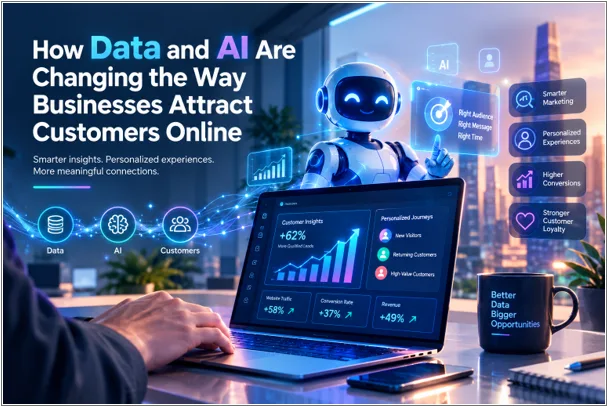
Businesses are now luring their clients through online activities by analyzing consumer behavior via data and acting on them quickly using AI. Companies can now analyze searches made by consumers, the pages they visit, products bought, ignored, and revisited before designing their marketing campaigns.
The reason for this is that the consumers expect the marketing communications to be relevant. A McKinsey study revealed that 71% of consumers look for personalized marketing communications, and 76% of those consumers get annoyed if their expectations are not met.
How Data Helps Businesses Understand Customers
Data helps businesses move from making guesses to knowing facts. The number of people visiting your site, the searches being done, pages viewed, forms completed, and purchases made show you what your customers want.
Based on this data, companies can address queries such as:
- What pages attract customers?
- What searches show a strong buying intention?
- Where do customers leave the site?
- What groups of customers visit most frequently?
Buying history gives clues about repeat buyers and their preferences. If the data is collected with consent and privacy protection, companies gain valuable insights into the needs of customers.
How AI Helps Businesses Attract Customers
AI allows companies to manage and analyze huge chunks of marketing information and to act promptly. For example, artificial intelligence may be applied in the sphere of recommendation of products, segmentation of the market, campaign testing, content generation, identification of leads and so forth.
For example, a store may use AI for recommendation of appropriate products according to the history of customers’ visits and purchases. A services-oriented company may use AI to find potential leads. Marketing experts can run experiments with different campaigns and choose those which are most effective. AI is a good tool for decision-making. It performs routine work while leaving humans responsible for results.
How SEO and AI Search Are Changing
Search will evolve even further to include intent, context, and answers. Companies require solid technical fundamentals, but they must also have content that fulfills human expectations based on longer and more focused queries.
Google says that the current SEO best practices will still apply for both AI Overviews and AI Mode. Pages must retain their eligibility to be indexed and displayed on Search and must be built around useful, credible, and people-friendly information. As per Google, there are no extra technical prerequisites just to make an appearance in such artificial intelligence-driven tools.
Corporations should focus on brief answers, informative examples, distinctive expertise, factual data, and proper page construction. The SEO services must consider the traditional visibility on Search along with readability by AI.
How Businesses Use Different Digital Marketing Channels
SEO
SEO helps to get organic visibility when people are looking for information, products, or services. Good pages should be useful for answering the question, match the intent, work correctly, and lead users to an expected action.
Paid Advertising
Paid campaigns will assist in targeting the audience faster. Artificial Intelligence can be used to optimize bids, targeting, budgeting, and creatives. For instance, according to Google, it is stated that the Smart Bidding feature is used in the use of Google AI technology to optimize bids based on either conversions or conversion value in each auction. However, good PPC advertising services should revolve around goal setting, conversion tracking, quality landing pages, and analysis by humans.
Social Media
The use of social media is through recommending content, profiles, products, and ads. Saves, shares, comments, watch time, profile views, and clicks will help the business to know what issues are important to its audience.
Content Marketing
The content is helpful for answering particular customer queries. The content team will utilize the information generated through search queries, sales conversations, support tickets, and website analytics to help in determining the subject.
Email Marketing
Relevance of email communication becomes higher if mailing lists are grouped based on their behavioral traits, interests, stage of purchase process, or prior history of interaction. It is possible to automatically generate all required messages such as greetings, reminders, suggestions, etc., while keeping them relevant.
How Analytics Helps Improve Marketing
Analytics tells businesses whether marketing activity is leading to useful outcomes. Traffic alone does not show whether a campaign is working.
| Metric | What it helps measure |
| Conversion Rate | How many visitors become customers |
| CAC | Cost of acquiring customers |
| ROAS | Return from advertising |
| Customer Lifetime Value | Long-term customer value |
The goal is to connect channel activity with business results. Fewer clicks from qualified prospects may be more valuable than high traffic with weak conversions.
How Data and AI Work Together
When data and AI have their own roles to play, the combination proves to be most effective.
- Data → Get to know customers
- AI → Spot trends and predict consumer behavior
- Marketing → Send out the correct messages
- Analytics → Track performance
The Salesforce’s “State of Marketing” research, based on the survey of almost 5,000 marketers, shows that the use of generative and predictive AI has become an integral part of marketing activities whereas obtaining high-quality real-time data is still an issue for many marketers.
Advanced AI cannot solve the problem of bad data. Inaccurate tracking, incomplete customer databases, and vague business objectives can result in quick but wrong decisions.
What Businesses Should Do Next
It is not necessary for companies to implement all AI solutions at once. The following step-by-step plan might prove more efficient and practical:
- Gather first-party data with proper consent.
- Generate content that addresses customer queries.
- Apply AI in conducting repetitive research, analysis, testing, and writing.
- Personalization should be done on the basis of sound data.
- Conversion rate, CAC, ROAS, retention, and CLV should be measured.
Human intelligence should be applied to strategic thinking, claim-making, setting tone, and customer interaction. Structured information is far more valuable than massive amounts of unstructured data.
Conclusion
Data may enable companies to know what is going on with their customers, their needs, and what problems they have. AI enables people to use the data for decision-making and messaging and also helps them to choose the right campaigns. Areas such as SEO, Paid Advertising, Social Media, Content, Email Marketing, and Analytics are becoming personalized because of data.
Corporations that have good data, good content, good AI technology, and good human knowledge are much better equipped in attracting their customers in terms of relevancy and not noise. MetisMeet can assist corporations in finding clarity in their digital growth through content and SEO strategy.