How AI Is Changing Sleep Apnea Screening and At-Home Sleep Monitoring
Sleep trackers used to tell people how long they slept. Newer devices are beginning to answer a more clinically useful question: does the overnight data contain a pattern that deserves further investigation?
That difference is particularly relevant to obstructive sleep apnea. Many people do not know that their breathing repeatedly narrows or stops during sleep. Snoring may be dismissed as normal, daytime fatigue may be blamed on work, and people who sleep alone may never have anyone notice breathing pauses.
Wearable sensors make repeated observation easier. AI makes the resulting data easier to interpret. Instead of relying only on one night’s movement or oxygen reading, algorithms can examine patterns in breathing-related movement, pulse signals, oxygen saturation and other physiological data across multiple recordings.
The result is a new role for at-home sleep technology: not diagnosing sleep apnea independently, but identifying people who may need proper testing sooner.
AI Is Making Sleep Apnea Risk Easier to Detect at Home
Obstructive sleep apnea cannot be identified from sleep duration alone. A person may spend eight hours in bed while repeated airway obstruction fragments sleep and causes intermittent drops in oxygen.
The challenge for home technology is therefore not simply measuring whether someone is asleep. It is finding respiratory patterns that resemble clinically meaningful sleep-disordered breathing.
AI is well suited to that task because wearable devices generate large amounts of time-series data. A 2024 systematic review and meta-analysis evaluated 38 studies using wearable AI for sleep-apnea detection. Across the included studies, pooled sensitivity for detecting sleep apnea was 93.8%, while specificity was 75.2%. Performance varied with the sensors, algorithms, device location and type of apnea being detected. The authors concluded that wearable AI shows strong potential, but current systems are not accurate enough to replace established diagnostic methods routinely. That balance explains why consumer devices are moving first into risk assessment rather than diagnosis.
Samsung received FDA authorization in 2024 for a smartwatch-based feature that looks for significant breathing disruptions associated with moderate-to-severe obstructive sleep apnea in adults who have not already been diagnosed. The FDA specifically states that the feature is not a replacement for traditional diagnostic methods such as polysomnography. Apple followed in September 2024 with its Sleep Apnea Notification Feature.
It analyzes Apple Watch sensor data for repeated breathing-disturbance patterns and can notify users when those patterns are suggestive of moderate-to-severe sleep apnea. The FDA clearance is equally clear about the boundary: the feature is not intended to diagnose, treat or manage sleep apnea, and receiving no notification does not prove that sleep apnea is absent.
For users, that distinction is more useful than simply asking whether a wearable is “medical” or “wellness.” A smart sleep device may be designed for sleep tracking, relaxation or a bedtime routine without having any role in apnea screening. Devices should be judged by the sleep-related question they are actually designed to answer.
Screening at Home Changes Who Gets Tested, Not What Counts as a Diagnosis
The biggest advantage of AI screening is not that it removes the need for a sleep study. It can help identify people who might otherwise never reach one.
The clinical pathway still has distinct stages:
| Stage | What it answers |
| Consumer sleep monitoring | What patterns are appearing during sleep? |
| AI-assisted apnea screening | Do those patterns suggest increased risk of sleep apnea? |
| Home sleep apnea testing or polysomnography | Are clinically defined respiratory events actually occurring? |
| Medical interpretation | Does the patient meet diagnostic criteria, and what should happen next? |
Home sleep apnea testing already allows appropriate patients to complete diagnostic testing outside a sleep laboratory. The American Academy of Sleep Medicine recommends either polysomnography or a technically adequate home sleep apnea test for uncomplicated adults whose symptoms indicate increased risk of moderate-to-severe OSA. If a home test is negative, inconclusive or technically inadequate despite continuing clinical suspicion, polysomnography is recommended.
AI can make data analysis more efficient, but it cannot make every abnormal signal specific to sleep apnea.
A drop in oxygen may have more than one explanation. Movement can distort optical sensors. Poor contact can reduce signal quality. Algorithms can perform differently depending on the population in which they were trained and validated. Even the same physiological event can be classified differently when the recording method changes.
That is why automated interpretation works best when it directs attention rather than replacing clinical judgment.
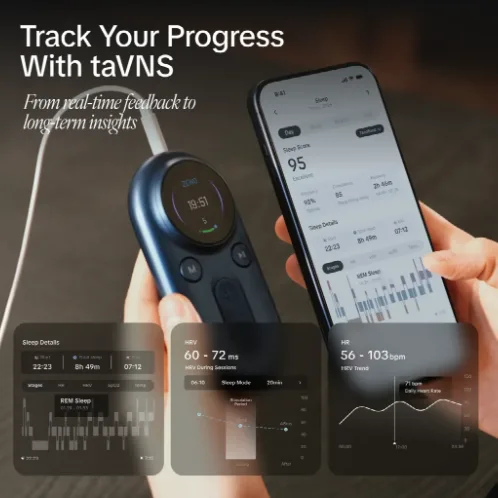
The same boundary helps prevent confusion with other consumer sleep technologies. Readers researching vagus nerve stimulation devices for sleep are looking at devices intended for a different purpose. Non-invasive vagus nerve stimulation may be studied in relation to sleep and autonomic regulation, but it does not identify airway obstruction, measure an apnea-hypopnea index or screen someone for obstructive sleep apnea.
As more products enter the home, purpose matters more than the word “sleep” on the product page.
Repeated Overnight Data Is What Makes Wearable Screening Different
A sleep laboratory collects much richer physiological data than a smartwatch, but consumer wearables have one major advantage: they can observe sleep repeatedly with very little effort from the user.
That matters because sleep apnea does not necessarily look identical every night. Sleep position, alcohol, nasal congestion, illness and ordinary night-to-night variation can change the number or severity of respiratory events.
Repeated monitoring gives algorithms a different type of information. Instead of making a judgment from one isolated recording, the system can look for a pattern that keeps returning.
This is already reflected in the design of consumer screening features. Apple’s system, for example, does not produce an apnea warning from one unusual night. It looks for repeated breathing disturbances across a monitoring period before deciding whether the pattern warrants a notification.
That approach reduces one of the problems with ordinary consumer sleep scores. A single poor night often tells very little. A repeated abnormal pattern is more informative.
AI can also combine several weak signals into a stronger one. An individual pulse change may mean little. A repeated combination of breathing-related movement, pulse changes and oxygen patterns may carry more information when the algorithm has been validated against an appropriate clinical reference.
The quality of the model still depends on the data behind it. A strong algorithm requires representative training data, accurate labels and validation in people who resemble the population that will actually use the product. High performance reported in one study should not automatically be assumed for another sensor, another algorithm or another population.
For at-home monitoring, better longitudinal data may therefore matter more than adding another proprietary sleep score.
The Most Useful AI Output Is a Clear Next Step
An apnea-risk notification only helps if the user knows what to do with it.
Someone who receives a repeated warning should not begin treating themselves based on the watch. The useful next step is medical evaluation, where symptoms, health history and appropriate sleep testing can be considered together.
The reverse is also true. A person should not dismiss concerning symptoms because a wearable has never generated an alert.
Symptoms that may justify assessment include:
- loud and habitual snoring;
- witnessed breathing pauses;
- waking with gasping or choking;
- significant daytime sleepiness;
- persistent morning headaches or unrefreshing sleep.
None of these symptoms proves that someone has obstructive sleep apnea. They provide a reason to investigate further.
This is the role AI currently handles best. It can watch for patterns in the background and bring a potential problem to the user’s attention before that person would otherwise seek testing.
That can make sleep-apnea screening more scalable without pretending that a smartwatch has become a sleep laboratory.
At-Home Sleep Monitoring Is Becoming More Clinically Useful
The first generation of consumer sleep technology was mainly descriptive. It told people when they slept, how long they slept and how the night compared with previous nights.
AI adds another layer: pattern recognition.
For sleep apnea, that means home devices can increasingly help separate ordinary variation from breathing patterns that warrant further attention. FDA-authorized features from Samsung and Apple already show how this can work in mainstream wearables, while research suggests that wearable AI can achieve high sensitivity for detecting possible sleep apnea.
The boundary remains clear. Screening identifies risk. Diagnostic testing determines whether sleep apnea is present. Clinical interpretation decides what the result means for the individual. That is a meaningful improvement over a simple sleep score.
AI does not need to replace the sleep clinic to change sleep-apnea care. If it helps more people notice a suspicious pattern and reach appropriate testing earlier, at-home monitoring has already become substantially more useful.
References
- Abd-Alrazaq A, et al. Detection of Sleep Apnea Using Wearable AI: Systematic Review and Meta-Analysis. 2024. PubMed
- U.S. Food and Drug Administration. Samsung Sleep Apnea Feature, DEN230041. 2024. U.S. Food and Drug Administration
- U.S. Food and Drug Administration. Apple Sleep Apnea Notification Feature, K240929. 2024. U.S. Food and Drug Administration
- American Academy of Sleep Medicine. Clinical Practice Guideline for Diagnostic Testing for Adult Obstructive Sleep Apnea.