How AI-Powered Travel Booking Software Is Transforming Modern Travel Agencies
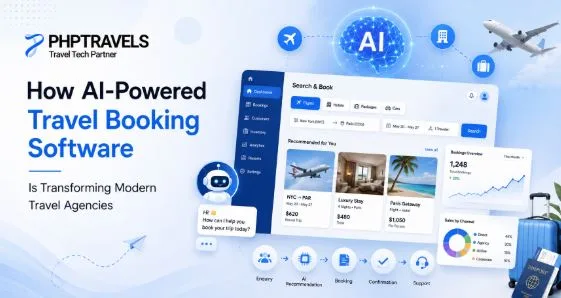
The travel industry is becoming increasingly digital, and customers now expect faster, easier, and more personalized booking experiences. Instead of spending hours searching different websites for flights, hotels, and travel information, travelers want platforms that can understand their requirements and help them plan an entire trip from one place.
Artificial intelligence is helping make this possible.
For travel agencies, AI-powered technology can improve the customer experience while also reducing the amount of manual work required to manage bookings, inquiries, and trip planning.
AI Is Making Travel Booking More Conversational
Traditional booking systems usually require customers to manually select destinations, travel dates, passenger details, and several filters before receiving suitable options.
AI can simplify this process by allowing travelers to describe what they need in natural language.
For example, a customer may say they want to travel to a particular country or city during specific dates. An AI-powered platform can interpret the request and help identify relevant flight options from the available travel inventory.
This creates a more natural booking experience and can be particularly useful for customers who are still exploring destinations or comparing different travel options.
Instead of functioning only as a booking engine, modern travel software can increasingly act as a digital travel assistant.
From Flight Search to Complete Trip Planning
AI can also play an important role beyond airline ticket searches.
Once a traveler chooses a destination, the system can help identify hotels and other relevant travel services based on their preferences. This can make trip planning much easier because customers do not need to switch between multiple platforms.
Modern Travel Booking Software solutions such as PHPTRAVELS are designed to help travel businesses manage different booking services within a centralized platform.
For a travel agency, bringing flights, hotels, bookings, and customer requests into one system can make daily operations more efficient while creating a smoother experience for travelers.
Travel Agencies Need More Than a Booking Engine
Operating a successful travel agency involves much more than simply selling airline tickets or hotel rooms.
Agencies have to manage customer details, inquiries, booking records, payments, follow-ups, suppliers, and communication. When this information is spread across multiple systems, it can become difficult for teams to keep everything organized.
A centralized platform can help travel companies maintain better control over these processes.
Customer relationship management is particularly important because repeat customers and long-term relationships can be valuable to travel businesses.
Using a dedicated travel agency CRM can help agencies organize customer information, maintain interaction records, manage leads, and improve communication throughout the booking journey.
This becomes increasingly useful as an agency grows and starts managing a larger number of customers and bookings.
The Advantage of Open-Source Travel Technology
Another important factor for travel businesses is flexibility.
Many cloud-based travel software platforms operate through recurring monthly or annual subscriptions. While this model may suit some businesses, others prefer greater control over their technology and operating costs.
Open-source travel software provides businesses and developers with access to the source code, allowing the platform to be customized according to specific requirements.
PHPTRAVELS offers open-source travel technology under a one-time payment model for relevant software packages. This can be attractive to agencies looking for a long-term solution without relying entirely on continuous subscription payments.
Access to the source code can also make it easier for businesses with development resources to customize workflows, connect additional services, or build features for particular markets.
Technical Support Remains Important
Having access to software is only one part of running a successful online travel platform.
Travel booking systems may depend on APIs, payment gateways, airline data, hotel suppliers, hosting environments, and other third-party integrations. If a technical problem appears, reliable support can become extremely important.
PHPTRAVELS also provides ongoing support options for customers using its platform, helping agencies deal with product-related technical issues.
For travel companies without a large internal development team, access to experienced technical support can make maintaining the platform considerably easier.
AI Can Support Travel Agents Rather Than Replace Them
AI is sometimes discussed as a technology that could replace travel agents entirely. In practice, its strongest role may be helping agencies automate repetitive tasks.
AI can assist with searching travel inventory, answering common customer questions, recommending suitable options, and supporting the booking process.
Human travel professionals can then focus on more complex responsibilities such as personalized itineraries, group travel, corporate bookings, special customer requirements, and relationship management.
This combination of automation and human expertise can allow travel agencies to serve more customers without sacrificing personalized service.
Building the Future of Online Travel Booking
The expectations of travelers are changing rapidly.
Customers increasingly want booking platforms that understand natural language, provide relevant options quickly, and help them manage different parts of their journey from a single place.
For travel agencies, adopting technologies that combine booking engines, AI assistance, trip planning, hotel search, and customer management can provide a major operational advantage.
Open-source platforms can offer additional flexibility by giving businesses more control over customization and long-term development.
As artificial intelligence continues to improve, the future of travel booking is likely to become more conversational, personalized, and automated. Travel agencies that combine intelligent technology with professional human support will be better positioned to meet the needs of modern travelers.