How an NHS Take Home Pay Calculator Works
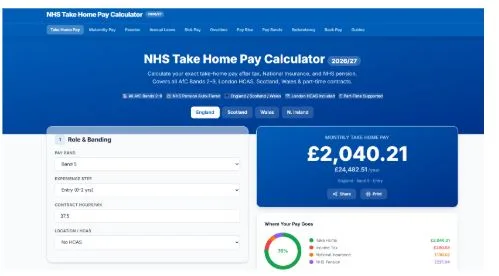
Understanding your salary ca sometimes feel more complicated than it should be especially when deductions, taxes, and pension contributions come into play. For healthcare professionals working within the UK system, knowing exactly how much you’ll take home each month is essential for budgeting and financial planning. That’s where an nhs take home pay calculator becomes a valuable tool.
Well break down how this type of calculator works, what factors it considers, and why it’s so useful for NHS staff.
What Is an NHS Take Home Pay Calculator?
An nhs take home pay calculator is an online tool designed to estimate your net salary after all deductions. Instead of manually calculating income tax, National Insurance, pension contributions, and other adjustments, the calculator does everything for you in seconds.
It provides a clear picture of your gross pay (before deductions) and your net pay (what you actually receive). This is particularly helpful for NHS employees because their pay structure often includes banding, overtime, and additional allowances.
Key Components It Takes Into Account
To give you an accurate estimate, the calculator considers several important factors. Each of these plays a role in determining your final take-home pay.
1. NHS Pay Bands
NHS salaries are structured under the Agenda for Change (AfC) pay system, which includes multiple pay bands (Band 1 to Band 9). Each band has a defined salary range depending on experience and role.
When using the calculator, you typically select:
- Your pay band
- Your years of experience or pay point
This forms the foundation of your gross salary.
2. Income Tax
Income tax is one of the largest deductions from your salary. The UK uses a progressive tax system, meaning:
- A portion of your income is tax-free (personal allowance)
- The rest is taxed at increasing rates depending on your earnings
The calculator automatically applies the correct tax bands based on your salary input.
3. National Insurance Contributions (NICs)
National Insurance is another mandatory deduction. It helps fund public services like healthcare and pensions.
The calculator determines:
- How much you owe based on your earnings
- The correct percentage rate
This ensures your take-home figure reflects real-world deductions.
4. NHS Pension Contributions
One unique aspect of NHS employment is the pension scheme. Contributions are based on a percentage of your salary and vary depending on how much you earn.
The calculator includes:
- Your pension contribution rate
- The deduction from your monthly salary
While this reduces your take-home pay, it’s an important long-term benefit.
5. Additional Factors
Many NHS roles include extra earnings or adjustments. A good calculator also accounts for:
- Overtime pay
- Unsocial hours pay (night/weekend shifts)
- Bonuses or allowances
- Student loan repayments
By including these variables, the estimate becomes much more accurate.
How the Calculation Process Works
Using an nhs take home pay calculator is straightforward. Here’s a simple step-by-step overview:
- Enter your salary details
Choose your NHS band and salary point. - Add extra earnings (if applicable)
Include overtime or shift allowances. - Select deduction options
Indicate pension contributions, student loans, or other deductions. - Apply tax rules automatically
The calculator uses current UK tax rates and thresholds. - Get your results instantly
You’ll see a breakdown of:- Gross salary
- Total deductions
- Net monthly and yearly income
This process eliminates guesswork and provides clarity in seconds.
Why It’s Useful for NHS Employees
Better Financial Planning
Knowing your exact take-home pay helps you:
- Create a realistic budget
- Plan savings and expenses
- Avoid surprises on payday
Transparency in Earnings
NHS pay can be complex due to banding and additional payments. A calculator breaks everything down clearly so you understand where your money goes.
Comparing Job Offers
If you’re considering a new role or promotion, the calculator helps you:
- Compare salaries across different bands
- See how much extra you’ll actually earn after deductions
Understanding Deductions
Instead of seeing deductions as confusing numbers on a payslip, you can understand:
- Why they exist
- How they’re calculated
- How they impact your net income
Limitations to Keep in Mind
While an nhs take home pay calculator is highly useful, it’s still an estimate. A few things may cause slight differences:
- Changes in tax codes
- Special allowances not included
- Variations in pension schemes
- Payroll-specific adjustments
For exact figures, your official payslip will always be the final reference.
Final Thoughts
Managing your finances starts with understanding your income, and for NHS staff, that can be more complex than a simple salary figure. An nhs take home pay calculator simplifies the process by breaking down taxes, contributions, and deductions into an easy-to-understand format.
Whether you’re starting a new NHS role, considering a promotion, or simply trying to budget better, this tool gives you the clarity you need. Instead of guessing your take-home pay, you can rely on accurate estimates and make informed financial decisions with confidence.