How Ancient Symbols and Modern Mathematics Unite in James Richard VanDyke’s Vision of the Universe
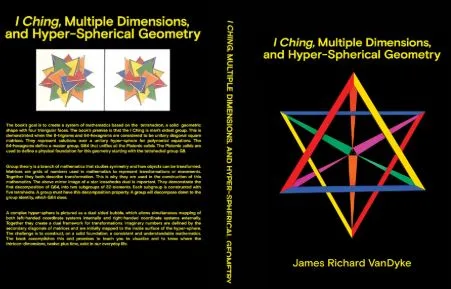
In I Ching, Multiple Dimensions, and Hyper-Spherical Geometry, James Richard VanDyke presents a revolutionary framework that connects ancient symbolic systems with modern mathematical science. Rather than treating spirituality and mathematics as separate worlds, VanDyke demonstrates that both are expressions of the same underlying structure—a universe built on symmetry, geometry, and multidimensional order.
At the center of the book is the I Ching, one of humanity’s oldest philosophical texts. Traditionally used for divination and reflection, the I Ching is composed of 64 hexagrams formed from broken and unbroken lines. While most people view these symbols as metaphors, VanDyke reveals them as a precise mathematical system that mirrors the structure of higher-dimensional space.
In modern mathematics, group theory is used to describe symmetry and transformation. VanDyke shows that the 64 hexagrams of the I Ching correspond directly to a mathematical group he calls G64, a master group that governs the symmetries of hyper-spherical geometry. This means that ancient Chinese scholars unknowingly encoded a complete mathematical structure that modern scientists are only now beginning to understand.
This discovery reframes the I Ching as more than a cultural artifact—it becomes a mathematical map of multidimensional reality.
The book builds on this foundation by introducing the concept of hyper-spherical geometry, a model in which reality exists on both the outside and inside surfaces of a sphere. In this framework, ordinary physical space occupies the outer surface, while the so-called imaginary domain occupies the inner surface. Rather than being separate, these two realms are reflections of each other, connected through a continuous geometric structure.
This approach resolves one of the deepest problems in physics: reconciling left-handed and right-handed coordinate systems. In traditional mathematics, these two orientations must be chosen separately, creating contradictions in physics and cosmology. VanDyke’s hyper-sphere allows both orientations to exist at once, each occupying one side of the same spherical geometry.
This dual-surface model suggests that what scientists call “imaginary numbers” are not imaginary at all—they are simply coordinates on the inner surface of reality.
Another powerful insight in the book concerns the Platonic Solids, the fundamental shapes that underlie three-dimensional geometry. While five solids are commonly taught, VanDyke proves that there are actually six, because the tetrahedron exists in two chiral forms that cannot be superimposed. These left-handed and right-handed tetrahedra reflect the same duality found throughout nature, from particle physics to biological structures.
Through the group G64, VanDyke shows that the six Platonic Solids form a single mathematical family. This reveals that geometry is not a collection of separate shapes, but a coherent system governed by deep symmetry.
What makes this work especially compelling is its accessibility. While rooted in advanced mathematics, the book is written for curious readers from many backgrounds—scientists, philosophers, spiritual seekers, and anyone fascinated by how the universe fits together. VanDyke carefully guides readers through complex ideas using diagrams, logical progression, and intuitive explanations.
Adding to the book’s impact is VanDyke’s personal story. A near-death experience on Mount Shasta became the catalyst for his decades-long exploration of higher dimensions. Rather than detracting from the science, this experience provides emotional depth and context, showing how insight can arise from profound human moments.
In a time when humanity is searching for meaning in a vast and complex universe, I Ching, Multiple Dimensions, and Hyper-Spherical Geometry offer a rare synthesis. It suggests that ancient wisdom and modern science are not in conflict, but are two ways of seeing the same truth.
James Richard VanDyke invites readers to step beyond ordinary perception into a universe structured, harmonious, and far more intricate than we ever imagined.
I am a Vietnam veteran. My 60 years of combat trauma hasn’t killed me yet. I found healing through The Headstrong Project’s free, confidential PTSD treatment. Headstrong’s thirty free therapy sessions gave me hope, and I’m donating 50% of my book profits so more veterans can access this life-changing care. Suicide remains a real concern, but with support, veterans can triumph over trauma. My book is about a near-death experience where I learned the mathematics that I present in the book. It brings ancient mathematics into the modern world. Support veterans by buying my book: