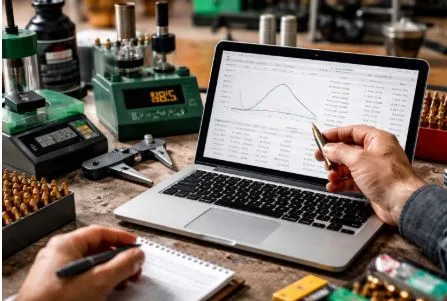
How ApexLOAD Reloading Helps You Analyse and Compare Load Data
Handloading ammunition requires careful attention to detail. Finding the right recipe for a specific rifle is not easy. One major challenge today is conflicting reloading data. You may check three manuals and see three different maximum charges for the same bullet and powder. This difference shows an important fact. Lab-tested data only reflects the exact components and conditions used in that test.
A 2025 market report projects the global ammunition reloading equipment market to grow from 776.9 USD Million in 2025 to 1,200 USD Million by 2035 at a 4.4% CAGR, fueled by rising demand for personalized loads amid ammo shortages.
To keep up with this shift, many reloaders use tools like ApexLOAD reloading software along with printed manuals. Traditional tables cannot predict performance in every firearm. The software helps analyse these variables mathematically.
Objective of this Blog
The objective of this guest blog is to provide a comprehensive analysis of how ApexLOAD software aids handloaders in the modern era. It explains how this powerful internal ballistics tool can be used to analyze and compare load data effectively, improving both safety and efficiency at the reloading bench.
Key Takeaways
- Treat digital predictions as guidelines. Always prioritize lab-tested manufacturer data over software calculations.
- Small errors in case capacity or seating depth lead to dangerous pressure spikes. Measure your components exactly.
- Regularly refresh your software databases to include the newest powders and bullet profiles.
- Never skip the traditional “work-up” process. Use a chronograph to verify that your real-world velocities match your digital estimates.
Table of Contents
- The Modern Handloader’s Data Dilemma
- The Role of ApexLOAD Reloading in Data Analysis
- Analyzing What Happens Inside the Chamber
- Comparing Scenarios: Beyond the Printed Manual
- Make Smarter Reloading Decisions with the Right Data Tools
- Frequently Asked Questions
The Modern Handloader’s Data Dilemma
Navigating the landscape of reloading data is frustrating. Most manufacturers provide excellent, free online tables. These resources offer tested “starting” and “maximum” charges. They are incredibly reliable because they are based on actual pressure testing using specialized equipment. However, these tables are static. They only work if you are using the exact bullet, primer, brass, and powder listed.
What happens when you substitute a Nosler Partition for a Hornady InterLock of the same weight? Or if your barrel is three inches shorter than the test barrel used by the manufacturer? This is where standard data falls short.
A printed table cannot tell you how changing the seating depth will affect chamber pressure in your specific chamber.
Handloaders try to compare reloading websites and brands and soon notice a problem. A powder manufacturer’s maximum charge might differ significantly from a bullet manufacturer’s recommendation. This conflict often leaves handloaders guessing.
The Role of ApexLOAD Reloading in Data Analysis
The complexity is precisely where sophisticated tools can assist. ApexLOAD reloading software serves a very different purpose than a standard load table. It is an internal ballistics calculator, not a database of pre-tested “recipes.” The software uses mathematical algorithms to model the combustion of gunpowder inside the cartridge casing and the subsequent movement of the bullet down the barrel.
This approach allows users to input their precise components, down to the specific water capacity of their fired brass (in grains), and their specific firearm measurements, such as barrel length and bullet seating depth.
Analyzing What Happens Inside the Chamber
The primary benefit of using ApexLOAD reloading is the ability to visualize potential outcomes before assembling a single round. When you select your powder, bullet, and cartridge, the ApexLOAD software generates a projected result based on the specific inputs provided.
This digital modeling provides several unique insights that static tables simply cannot match:
-
Chamber Pressure Prediction
The reloading software calculates the estimated peak chamber pressure in PSI (Pmax). This helps identify potentially dangerous overpressure situations before any physical testing occurs.
-
Velocity Forecasting
The tool estimates the muzzle velocity. This forecast is valuable for understanding the potential performance gain or loss from adjusting the powder charge or seating depth.
-
Powder Efficiency Analysis
It calculates the “percentage of propellant burnt.” You can see exactly how much of your powder is burning useful energy inside the barrel versus how much is potentially being wasted as muzzle flash and smoke. This is particularly useful for optimizing short-barreled rifles or selecting the correct powder for suppressed shooting.
-
Barrel Time Mapping
This metric shows exactly how long the bullet remains in the barrel. Understanding this timing helps competitive shooters find accurate “nodes,” where the bullet exits the muzzle at the same point during the barrel’s natural harmonic vibration cycle.
This level of detailed analysis is a paradigm shift. Standard data tells you “what” the limit was in a lab. ApexLOAD software helps you understand “why” that limit might exist in your own setup.
Comparing Scenarios: Beyond the Printed Manual
Comparing different combinations is incredibly efficient with this digital approach. In traditional terms, trying a new bullet meant buying a new box, consulting several sources for the “safest” starting point, assembling test rounds, and driving to the range. While range time is always essential for confirming performance and safety, reloading software streamlines the preliminary investigative work.
You can virtually substitute any component in the database without any financial risk or physical danger. You can instantly compare how Varget performs against H4350 for a 168-grain .308 Winchester bullet, all within a few clicks.
Many shooters also use these tools to compare reloading websites and databases to see which sources provide the most consistent results across different platforms.
Make Smarter Reloading Decisions with the Right Data Tools
The world of handloading will keep evolving. Many shooters no longer rely only on printed manuals. The shift is toward a more data-driven and analytical approach. Modern tools help reloaders study loads in a smarter way. They can model complex situations and compare thousands of combinations quickly. That gives modern handloaders a clear advantage. Using ApexLOAD reloading as a powerful internal ballistics tool can improve efficiency at the loading bench.
However, the growth of digital resources brings a new challenge. Reloaders must understand which software fits their goals. The right choice requires a clear comparison in a neutral space. That is why LoadDataCompare is useful. It helps reloaders by showing side-by-side comparisons of technical tools.
Explore reliable data tools, compare your options carefully, and make every load decision with confidence.
Frequently Asked Questions
1. How accurate is ApexLOAD reloading for wildcat cartridges?
The software excels here by using mathematical models to predict pressures in non-standard chambers where no official data exists. It provides a vital safety baseline for experimental loads.
2. Can ApexLOAD software help reduce group sizes?
Yes, by identifying “nodes” or specific barrel times. This allows you to tune your reloading data to your barrel’s natural harmonics, often resulting in tighter, more consistent groups.
3. Does this reloading software work for straight-wall cases?
Absolutely. While often used for bottleneck rifle rounds, it effectively calculates pressure curves for pistol and straight-wall rifle cartridges.
4. Is ApexLOAD updated for new propellants?
Updates are released continously. Always ensure your ApexLOAD reloading database is current to include the latest temperature-stable powders on the market.