How API Integration for Logistics Improves Supply Chain Efficiency and Visibility
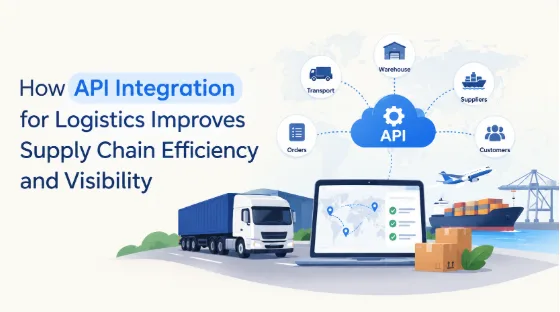
Shipments pass through customers, ports, warehouses, and carriers, but the data within the shipments is stored in different systems. According to MHI 2026 Annual Industry Report in partnership with Deloitte, visibility, agility and resilience are the goals set by enterprises to boost innovation investment within their supply chains, with 56 percent saying it would increase their investment. The API logistics integration would certainly turn out to be the most effective use of the resources available, given the fact that it involves the exchange of information in real-time. This guide has been created to help you navigate the process.
What Is API Integration for Logistics and How Does It Work?
An application program interface or API is a collection of procedures or rules that regulate the communications among various software systems, enabling that data from one system could be requested or sent to the other. With the logistics API integration process, you will integrate a multitude of software, such as transport management systems (TMS), warehouse management systems (WMS), ERP systems, carrier systems, and customer portals, without having to exchange emails or spreadsheets.
Here is the typical flow:
- Request: A system asks for data, such as the current status of a shipment.
- Validation: The API validates the credentials and forwards the request to the target system.
- Response: The target system returns structured data, usually in JSON.
- Event push: Webhooks send updates automatically when something changes, such as a scan, a delay, or a delivery.
In such a case, the webhook will cause the system to update the TMS, customer portal and communicate with the planner about shipment delays when the carrier scans the pallet at the regional hub. With traditional EDI, data is exchanged in batch jobs, and the partners can have several hours-old data.
There are 2 primary approaches to integration of teams’ systems. First: Point-to-point API connection, which is easy and quick when you have a few partners. The alternative approach is the middleware or integration platform, which is ideal for companies with numerous carriers as it is capable of performing authentication, mapping, and monitoring.
Key Benefits of API Integration for Logistics Operations
Eliminating delays in information sharing improves planning, execution, and customer service. These gains are the main reason companies invest in logistics software development services that connect carriers, warehouses, and internal platforms through APIs.
- End-to-end visibility: Live location, ETA, and status data from every carrier appear in one dashboard, so teams stop chasing updates by phone or email.
- Lower manual effort: Automated order entry, label creation, and invoice matching reduce re-keying and the errors that come with it.
- Faster decisions: Alerts for delays, holds or temperature issues are received in time for action.
- Better customer experience: Accurate tracking and delivery windows cut down “where is my order” inquiries.
- Cost control: Live carrier rates and route data help prevent overspending on freight.
All these will contribute to the fulfillment of some of the indicators which are the points of keen interest for leadership, like OTIF, dwell time and cost per unit. Also, it’s a plus that the API requests will be logged, as this will allow the team to have a record of all the times that ownership was passed.
Types of APIs Used in Logistics and Supply Chain Management
There is no one API that handles all the processes in the entire supply chain. It takes several APIs for different tasks.
- Tracking API: Extracts shipment status and location data, ensuring accuracy in ETAs and notifications to customers.
- Rate and booking API: Obtains current carrier rates and bookings, saving money on shipping costs and making booking faster.
- Label and documentation API: Generates shipping labels, bills of lading, and customs documents, which reduces compliance errors.
- Inventory and warehouse API: Syncs stock levels across WMS, ERP, and storefronts, which prevents stockouts and keeps delivery promises reliable.
- Route and geolocation API: Provides maps, traffic data, and route optimization, which shortens delivery times.
- Customs and trade compliance API: Checks duties, tariff codes, and restricted-party lists, which smooths cross-border shipments.
- Billing and payment API: Automates freight invoicing and reconciliation, which speeds up payment cycles.
Most businesses begin with tracking and rate APIs, then expand to warehouse and billing connections. Since every supply chain operates with a different mix of systems, companies often rely on logistics IT services to integrate these APIs with existing platforms and build the dashboards and mobile tools that make data accessible to dispatchers, drivers, and customers.
Common Challenges in Logistics API Integration and How to Overcome Them
Integration projects rarely fail because of the API itself. They struggle with the systems and partners around it.
- Legacy systems: Older TMS or ERP platforms often lack modern APIs. Add a middleware layer or API wrapper instead of replacing the system.
- Inconsistent data: Each carrier uses its own formats and status codes. Build a common data model with a mapping layer.
- Data quality gaps: Missed scans or incorrect addresses make tracking unreliable. Validate inputs at the source and flag anomalies automatically.
- Security exposure: More connections create more entry points. Use OAuth 2.0, encryption, key rotation, and role-based access.
- Carrier downtime or changes: Third-party APIs update and break without notice. Pin API versions, implement retries, and monitor uptime.
- Peak-season load: Order surges push up against rate limits. Make sure to use queues and caching.
Taking care of all the risks early on will ensure that timelines remain consistent.A short discovery phase that lists all systems, fields, and partners will surface almost all risks.
Conclusion
Logistics integration through the use of APIs helps bring the fragmented data of shipping, inventory, and billing to form a complete process that is actionable. Businesses that go about their projects with a clear vision of how they will apply the APIs, take into consideration factors such as legacy system issues, security, and carriers will benefit from this exercise.
An obvious starting point for a company would be creating a map of existing systems, identifying the process in which a delay causes maximum costs, and piloting the integration in that process. Since integration efforts require the collaboration of backend, frontend, and security specialists, most organizations resort to partnering with seasoned development vendors. Providers such as Bacancy Technology offer developers with logistics software expertise.