How Data and AI Are Changing the Way Businesses Attract Customers Online
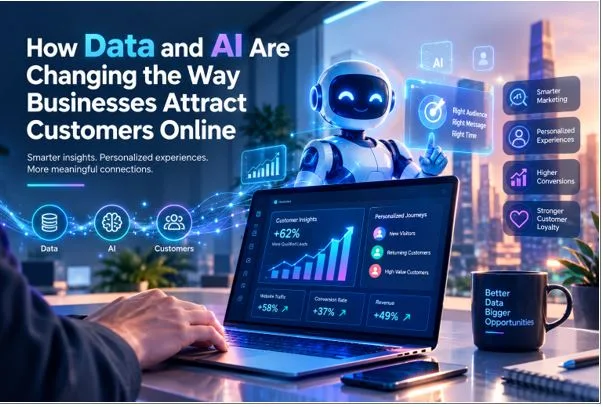
Businesses are attracting customers online by using data to understand behavior and AI to act on those insights faster. Instead of sending the same message to everyone, companies can study what people search for, view, buy, ignore, and return to, then shape marketing around those signals.
This matters because customers increasingly expect relevance. McKinsey research found that 71% of consumers expect personalized interactions, while 76% feel frustrated when they do not receive them. That makes data quality, useful content, and careful use of AI central to modern customer acquisition.
How Data Helps Businesses Understand Customers
Data helps businesses move from assumptions to evidence. Website visits, search terms, product views, form submissions, and purchases reveal what customers care about.
Businesses can use this information to answer questions such as:
● Which pages attract people who later become customers?
● Which search terms show strong buying intent?
● Where do people leave the website?
● Which customer groups return most often?
Purchase history can reveal repeat-buying patterns and product preferences. When these signals are collected with clear consent and privacy controls, businesses get a more useful picture of customer needs.
How AI Helps Businesses Attract Customers
AI helps businesses process large amounts of marketing data, find patterns, and respond faster. It can support product recommendations, audience grouping, campaign testing, content planning, lead scoring, and routine marketing tasks.
For example, a retailer can use browsing and purchase data to recommend relevant products. A service business can use AI to identify leads more likely to book. Marketing teams can compare campaign variations and focus on ideas showing stronger results. AI works best as a decision-support tool. It reduces repetitive work while people remain responsible for strategy, accuracy, and customer experience.
How SEO and AI Search Are Changing
Search is moving further toward intent, context, and direct answers. Businesses still need strong technical foundations, but content also needs to satisfy people using longer and more specific questions.
Google states that existing SEO best practices still apply to AI Overviews and AI Mode. Pages need to be indexable, eligible to appear in Search, and built around helpful, reliable, people-first information. Google also says there are no extra technical requirements just to appear in these AI features.
Businesses should focus on clear answers, useful examples, original expertise, accurate facts, and strong page structure. Good seo services should consider classic search visibility and whether content is clear enough for AI systems to interpret, reference, and connect to user intent.
How Businesses Use Different Digital Marketing Channels
SEO
SEO helps a business gain organic visibility when people search for information, products, or services. Useful pages should answer real questions, match search intent, load well, and guide visitors toward a logical next step.
Paid Advertising
Paid campaigns help businesses reach selected audiences faster. AI can support bidding, audience selection, budget decisions, and creative testing. Google says Smart Bidding uses Google AI to set bids for conversions or conversion value in each auction. Strong ppc advertising services should still rely on clear goals, accurate conversion tracking, useful landing pages, and regular human review.
Social Media
Social platforms use behavior signals to recommend posts, accounts, products, and ads. Saves, shares, comments, watch time, profile visits, and clicks help businesses learn which topics matter most to their audience.
Content Marketing
Content works best when it answers specific customer questions. Search data, sales conversations, support tickets, and website analytics can help teams choose topics based on real demand.
Email Marketing
Email becomes more relevant when lists are grouped by customer behavior, interests, purchase stage, or past activity. Teams can automate welcome messages, follow-ups, reminders, and product suggestions while keeping the message useful and timely.
How Analytics Helps Improve Marketing
Analytics tells businesses whether marketing activity is leading to useful outcomes. Traffic alone does not show whether a campaign is working.
|
Metric |
What it helps measure |
|
Conversion Rate |
How many visitors become customers |
|
CAC |
Cost of acquiring customers |
|
ROAS |
Return from advertising |
|
Customer Lifetime Value |
Long-term customer value |
The goal is to connect channel activity with business results. Fewer clicks from qualified prospects may be more valuable than high traffic with weak conversions.
How Data and AI Work Together
Data and AI are most useful when each has a clear role.
● Data → Understand customers
● AI → Find patterns and predict behavior
● Marketing → Deliver the right message
● Analytics → Measure the results
Salesforce’s State of Marketing research, based on nearly 5,000 marketers, reports that generative and predictive AI have become common parts of marketing work, while access to usable real-time data remains a challenge for many teams.
Better AI does not fix poor data. If tracking is inaccurate, customer records are incomplete, or goals are unclear, AI can produce faster answers without producing better decisions.
What Businesses Should Do Next
Businesses do not need to adopt every AI tool at once. A practical approach is to improve the data and marketing process in stages.
- Collect first-party data with clear consent.
- Create content that answers real customer questions.
- Use AI for repetitive research, analysis, testing, and drafting tasks.
- Personalize experiences when reliable data supports it.
- Track conversion rate, CAC, ROAS, retention, and customer value.
- Keep human review for strategy, claims, brand voice, and customer-facing decisions.
Clean, relevant, well-managed information is more useful than a large collection of disconnected signals.
Conclusion
Data helps businesses understand what customers do, what they need, and where they face friction. AI helps teams turn those signals into faster decisions, more relevant messages, stronger campaign choices, and better customer experiences. SEO, paid advertising, social media, content, email, and analytics are becoming more personalized and data-led. Businesses that combine quality data, useful content, AI tools, and human expertise are in a stronger position to attract customers with relevance rather than noise.
For businesses that want a clearer digital growth plan, MetisMeet can help connect strategy, content, search, paid media, and measurable performance into one practical approach.