How Digital Payments Are Reshaping Cross-Border Commerce in Asia
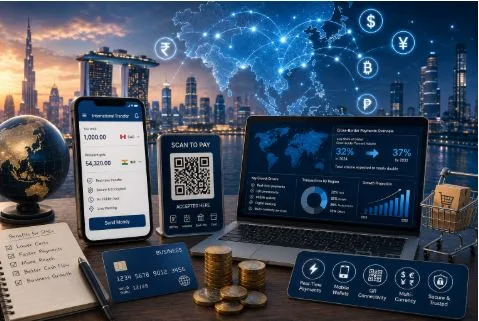
Digital payments are changing how people and businesses move money across borders. For consumers who need to send money from Canada to India, services like RemitBee already offer a simpler alternative to traditional banking processes. Across Asia, the same shift is happening on a much larger scale, as businesses and consumers adopt mobile wallets, real time payments, QR codes, and digital banking.
The impact goes beyond convenience. As payment systems get faster and more connected, they’re helping businesses reach customers in other countries and making cross-border commerce more accessible than ever.
How Big Is Asia’s Role In Cross-Border Payments?
International commerce has always involved friction. Businesses juggle different currencies, banks, payment networks, regulations, and settlement systems depending on where their customers live. Digital payment infrastructure is helping smooth out some of that friction.
Asia is already a major force in this space. International Monetary Fund puts the region at around 32% of global cross-border payment volume in 2024, climbing toward 37% by 2032.
The numbers at a glance:
| Metric | 2024 | Projected 2032 |
| Asia’s share of global cross-border volume | ~32% | ~37% |
| Total volume | Baseline | Expected to nearly double |
That growth reflects a bigger shift in how businesses operate. A company can now serve customers in several countries without a physical presence in any of them. But its payment experience still has to match what those customers expect, and that’s exactly the gap providers like RemitBee are built to close.
Do All Asian Consumers Pay The Same Way?
Not even close. Asia isn’t one payment market, it’s dozens.
A quick snapshot of preferences:
- Some markets lean heavily on mobile wallets
- Others favor bank transfers or cards
- QR payments dominate in several Southeast Asian countries
- Domestic platforms remain the default in others
Consumers in India, Singapore, Thailand, Malaysia, Indonesia, the Philippines, and Japan all bring different expectations to checkout. For businesses expanding across borders, supporting the right local method isn’t a nice-to-have. It can decide whether a customer finishes the purchase or abandons the cart.
Southeast Asia has made real progress here, linking QR payment networks and real time transfer systems so consumers and merchants can transact across participating markets without needing a completely separate setup for each one.
Why Do Faster Payments Matter To The Average Customer?
Speed has become part of the deal, not a bonus.
Consumers now expect instant or near-instant domestic transactions, and that expectation carries straight over to international payments. ASEAN countries have responded by connecting existing fast-payment and QR systems across borders, supporting real time merchant payments and person-to-person transfers using something as simple as a mobile number.
Speed alone isn’t the whole picture, though. Anyone making a secure money transfer also wants:
- Clear transaction status
- Reliable delivery
- Strong authentication
- Confidence the money will actually reach the recipient
RemitBee builds its transfers around that same combination: speed paired with visibility, not speed at the expense of it.
What Does This Mean For Small Businesses Specifically?
This is where digital infrastructure matters most.
A large multinational already has banking relationships and finance teams spread across multiple countries. An SME usually doesn’t. It needs simpler tools to manage international transactions with a fraction of the resources.
The IMF notes that digital payment adoption helps SMEs in a few concrete ways:
- Improves operational efficiency
- Reduces transaction costs
- Creates useful financial records
- Opens the door to markets beyond the domestic one
Thailand is a good example. Digital payment adoption among SMEs there is now widespread, and cross-border payment connections are opening doors to neighboring markets. Mastercard reported in 2026 that Asia-Pacific SMEs are increasingly asking for multi-currency capabilities, real time visibility, and easier integration as their role in cross-border trade grows.
For smaller companies, better payment infrastructure supports both sales and the day-to-day work of managing money across borders.
What’s Still Standing In The Way?
Growth brings new problems along with it.
More connected systems mean security, fraud prevention, identity verification, and regulatory compliance all have to keep pace. Cross-border transactions get complicated fast when different countries apply different rules and risk controls.
Interoperability is its own challenge. Connecting two payment systems is manageable. Building a network that works smoothly across dozens of countries is a different scale of problem entirely. The IMF points out that ASEAN’s current bilateral connections can create fragmentation, which makes broader interoperability a real priority for the region going forward.
The goal isn’t just to digitize payments. It’s to make them fast, reliable, secure, transparent, and compatible across borders, which is the same standard RemitBee holds its own transfers to.
Where Is This All Heading?
The direction is clear enough. Payment networks across Asia are moving toward greater connectivity, and businesses are adopting digital tools to reach customers beyond their home markets.
Real time payments, QR connectivity, mobile wallets, multi-currency services, and stronger infrastructure will likely play a growing role in that shift. For businesses, that could mean fewer barriers to entering new markets. For consumers, it could mean easier ways to pay, send money, and receive funds internationally, whether that’s a business settling invoices abroad or someone sending money home to family.
The Bottom Line
Digital payments are becoming essential to Asia’s cross-border commerce infrastructure. They’re helping businesses accept payments across markets, giving SMEs room to expand, and cutting friction out of transactions that used to be slow and complicated. At the same time, the region still needs stronger interoperability, security, transparency, and regulatory coordination.
The future of cross-border commerce in Asia won’t come down to how fast money moves alone. It will come down to how well different payment systems work together, and how much confidence businesses and consumers have in the providers, like RemitBee, that move that money for them.