
How Enterprises Can Strengthen Their Cyber Defenses in 2026 and Fidelis’ Role in It
The threat landscape is changing rapidly. The cybersecurity strategy of enterprises in 2026 should also evolve to face the known and unknown adversaries.
Evolved attackers can breach businesses, governments, and critical infrastructure easily. Relying only on preventive control is not enough. Cybersecurity should focus on improving visibility and setting up layered control. Strong leadership and ownership are also essential for the strategy’s success.
Based on lessons learned from modern attack investigations, including insights from Fidelis Security experts, here are four principles that can help enterprises strengthen their cyber defenses in 2026.
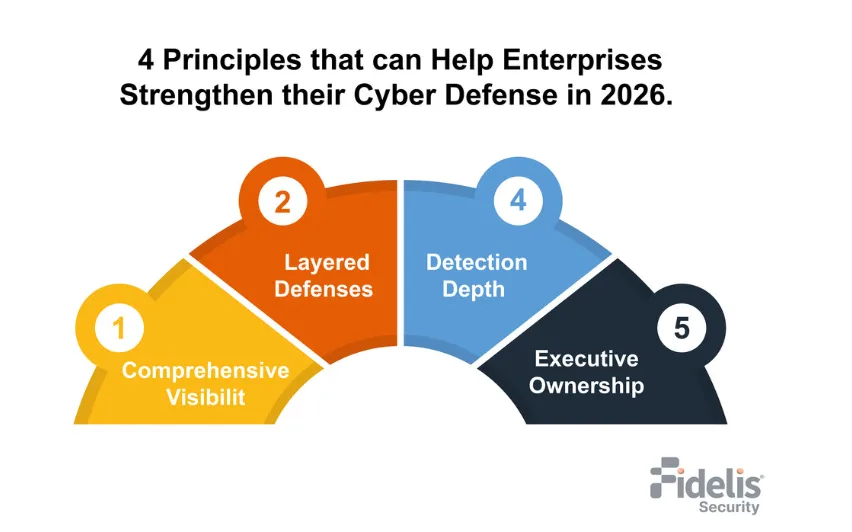
1. Comprehensive Visibility
More and more companies are embracing cloud and hybrid environments, gradually rendering the traditional network boundaries obsolete. At the same time, modern cloud workloads, remote access, third-party integrations, and operational technology have expanded the attack surface, which has naturally left traditional defenses inadequate.
To strengthen the defenses, organizations must first adopt comprehensive visibility across their networks. The security strategies must assume that the attackers rarely stop at the entrance, but they move latterly as well as blend to appear legitimate and then attack. As a result, monitoring easy-west traffic, user behavior and system interactions have become foundational to effective cyber defense.
2. Layered Defenses using Reactive and Proactive Approaches
The threat landscape is rapidly evolving, and new threats are emerging every day. A single security approach cannot stop such attacks on its own. It requires layered defenses with complementary capabilities that can expose attackers at different stages of their operations.
Reactive approaches such as extended detection and response (XDR) solution help organizations correlate signals across endpoints, networks, and cloud environments to identify real threats amid noise.
Proactive techniques like deception technology add another critical layer by luring attackers into controlled environments and exposing them early. These complementary approaches reduce dwell time, minimize alert fatigue, and improve response readiness.
3. Prioritize Detection Depth Over Alert Volume
The volume of security alerts, most of which are fragmented signals, often leaves security teams overwhelmed. Instead of improving security, this works against the goal, as analysts waste their time chasing false positives.
To address this challenge, they need the ability to inspect network traffic, sessions, and behavior in depth to separate real threats from noise. Combined with visibility across encrypted and hybrid environments, deep inspection enables faster investigation and more appropriate response.
4. Establish Executive Ownership
Cybersecurity cannot be treated as a technical issue delegated to security teams. Its impact is felt across operations, finances, and market reputation. Therefore, boards and executive leadership need to step up and take clear ownership of cyber risk as a core business concern.
Organizations that embed cybersecurity into decision-making, investment planning, and corporate culture enable a more successful strategy.
Where Fidelis Security Fits
In 2026, stronger cyber defenses will be defined by how well organizations combine visibility, layered controls, and leadership accountability into a cohesive strategy. Fidelis Security supports this model with its solutions Fidelis Elevate and Halo that enable real-time network visibility, deep packet inspection, and threat correlation across on-premises, cloud, multi-cloud, and hybrid workloads. By enabling a combination of reactive and proactive exposure and decisive response, these capabilities help enterprises improve their resilience in the face of evolving adversaries.
Know how Fidelis Security has been protecting leading enterprises for over 20+ years through their real customer stories.