How Industrial Pump Sourcing Is Changing for Mining, Municipal, and Process Plants
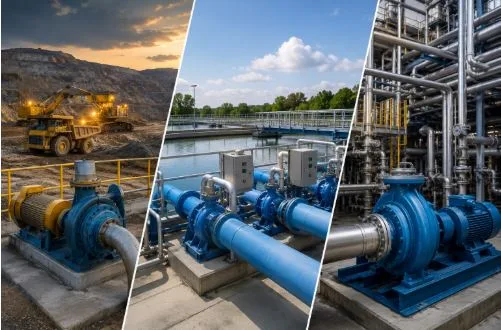
Industrial pump sourcing has become a much more strategic decision than it was a decade ago. In the past, many plants treated pumps as separate line items: one supplier for slurry pumps, another for sewage pumps, another for chemical transfer, another for fire protection, and a local distributor for replacement parts. That approach can still work for simple facilities, but it creates real pressure when a plant has multiple fluid systems, tight maintenance windows, and a shrinking internal engineering team.
Mining operators, municipal utilities, chemical processors, irrigation contractors, and building service teams all face a similar problem. They need equipment that fits the duty point, survives the operating environment, and can be supported after the first order ships. The unit price matters, but it is only one part of the sourcing decision. A low initial bid loses value quickly if a replacement impeller takes eight weeks to arrive, a seal material does not match the fluid, or the vendor cannot explain how the pump was tested before delivery.
That is why industrial buyers are moving away from simple price comparison and toward supplier capability comparison. They want to know who controls design, casting, machining, assembly, testing, and documentation. They want to know whether the same supplier can support more than one pump category. Most importantly, they want to know whether the vendor understands the actual application, not just the catalog model.
The multi-vendor problem
Many plants still build their pump supply chain one emergency at a time. A mine may buy slurry pumps from one vendor because the mill discharge line is urgent. Later, the same site buys a sewage pump from a different vendor for a wastewater pit, a centrifugal pump from another vendor for clean water transfer, and a chemical metering pump from a specialist. Each purchase solves a short-term need, but over time the plant inherits a fragmented supplier base.
Fragmentation creates hidden costs. Every vendor has its own quoting process, spare parts policy, drawing format, warranty language, and communication style. Maintenance teams must track different part numbers and different lead times. Procurement teams must compare prices that are not structured the same way. Engineering teams must judge whether a vendor’s material recommendation is based on the duty point or on what the vendor has in stock.
The problem becomes more serious in applications where failure is expensive. A slurry pump handling abrasive tailings does not fail the same way as a clean water pump. A sewage pump has to manage solid passage and clogging risk. A chemical pump has to match wetted materials to pH, chloride level, temperature, and solvent exposure. A fire pump may be governed by a project standard such as NFPA 20. Treating all these as ordinary commodity purchases invites trouble.
Why application knowledge matters
The pump itself is only the final shape of a much larger engineering decision. A good selection starts with fluid data, flow, head, specific gravity, solids content, particle size, viscosity, temperature, suction conditions, operating hours, and system layout. A plant that sends only a flow and head number may receive a quote, but it may not receive a reliable solution.
For example, a mining slurry line can look simple on paper. The buyer may specify a flow rate and head, but the real decision depends on solids concentration, abrasiveness, pump speed, impeller material, liner material, and expected wear life. If the supplier does not ask about these factors, the first price may be attractive while the five-year maintenance cost is not.
Municipal wastewater presents another version of the same issue. The duty may appear to be a standard lift station pump, but ragging, solid passage, seal arrangement, and access for maintenance can determine whether the installation runs smoothly. Chemical transfer adds another layer because a material that works for one acid or alkaline solution may not work for another.
In this environment, buyers increasingly prefer suppliers that can discuss the engineering context before pushing a model number. That is one reason broad industrial pump manufacturers are gaining attention. A supplier with multiple pump categories can compare alternatives across slurry, sewage, centrifugal, multistage, chemical, deep well, and split case lines instead of forcing every problem into one narrow product family.
Vertical integration and accountability
One of the clearest shifts in pump sourcing is the renewed focus on manufacturing control. Buyers are asking whether the supplier owns the critical steps or depends on third parties for castings, machining, heat treatment, coating, or testing. This matters because pump reliability is often determined before the pump ever reaches the assembly bench.
Casting quality affects wear life and structural integrity. Heat treatment affects hardness and toughness. Machining accuracy affects alignment, vibration, seal life, and bearing load. Coating or lining quality affects corrosion resistance and abrasion resistance. Hydraulic testing confirms that the pump actually meets the promised duty point.
When those steps are separated across different subcontractors, accountability becomes blurry. If the pump fails early, the sales company may blame operating conditions, the foundry may blame the specification, and the buyer is left with downtime. A vertically integrated manufacturer is not automatically better, but it is easier to audit. There is one quality system, one engineering team, and one supplier responsible for the final result.
For buyers comparing industrial pump suppliers, this is a practical question: who owns the process? If the vendor can explain casting, machining, assembly, and testing under one system, that vendor may be easier to manage than a broker who simply coordinates factories.
Spare parts as a sourcing criterion
The initial pump order receives most of the attention, but spare parts decide whether the relationship is useful after commissioning. Wear parts such as impellers, throat bushings, liners, shaft sleeves, seals, bearings, and casing components must be available on a schedule that fits the plant’s maintenance reality.
In mining, a delayed slurry pump part can stop a production line. In wastewater, a pump failure can create service interruptions and emergency callouts. In building services, pressure boosting and fire protection systems require dependable support. For chemical service, replacement parts may need exact material compatibility.
Buyers should ask suppliers which parts are normally stocked, which parts are made to order, and how long engineered spares take. They should also ask whether the supplier can cross-reference legacy part numbers when replacing or supporting existing installations. A pump with a low purchase price can become expensive if every spare part becomes a custom project.
Price transparency and lifecycle cost
Pump sourcing is often slowed by quote-only pricing. That is understandable in engineered equipment, because motor brand, metallurgy, seal arrangement, testing requirements, control package, and freight terms can change the final price. Still, buyers benefit when suppliers can explain pricing tiers before the formal RFQ stage.
A practical supplier should be able to separate standard models, engineered models, and custom OEM or ODM work. Standard models may be based on catalog configurations. Engineered models may include impeller trim, upgraded seals, or alternate materials. Custom projects may include private label, special geometry, skid packages, or integrated controls.
This structure helps finance teams budget and helps engineers judge tradeoffs. It also brings the conversation closer to total cost of ownership. In many pump systems, energy use, maintenance, downtime, and parts outweigh the initial purchase cost. A pump that is slightly more expensive but better matched to the duty point can be cheaper over several years.
What buyers should ask before choosing a supplier
A better pump procurement process starts with better questions. Before approving an industrial pump supplier, buyers should ask:
– Does the supplier understand the fluid and duty point?
– Can the supplier support more than one pump category?
– What manufacturing steps are controlled in-house?
– Which standards or quality systems apply?
– Is hydraulic testing available for each order?
– Which spare parts are stocked?
– What is the normal lead time for standard and engineered models?
– Can the supplier provide material traceability or test records?
– Who provides after-sales technical support?
These questions may sound basic, but they quickly separate catalog resellers from engineering-focused manufacturers.
A more consolidated sourcing model
The future of pump sourcing will not be about buying everything from the cheapest vendor. It will be about reducing risk while keeping enough flexibility to match different applications. A plant may still use specialty vendors for highly unusual systems, but many routine industrial pump needs can be consolidated under a capable manufacturer with broad product coverage.
For teams comparing options, If you are looking for more information about Industrial Pump Manufacturer – BBP go here right away. BBP positions itself around multiple industrial pump categories, including slurry, sewage, centrifugal water, split case, multistage, booster, deep well, irrigation, and chemical pumps. That type of category coverage can help buyers evaluate one supplier across several plant systems rather than rebuilding the vendor list for every pump duty.
The bottom line
Industrial pump sourcing is becoming more disciplined because the cost of poor selection is too high. Downtime, spare parts delays, energy waste, and supplier confusion can easily outweigh small differences in the first quotation. The strongest buyers now evaluate pump suppliers the way they evaluate other critical manufacturing partners: by engineering capability, process control, documentation, support, and lifecycle value.
For mining, municipal, chemical, agricultural, and building service applications, the best purchasing decision is rarely the fastest quote. It is the supplier that can explain why a pump fits the duty, how it will be built, how it will be tested, and how it will be supported after installation. That is the direction industrial pump sourcing is moving, and it is a healthier model for both buyers and manufacturers.