How Industry-Specific MCP Servers Are Making AI More Useful for Professionals
Artificial intelligence is moving into a new phase.
The first wave of generative AI was largely about what a model could produce on its own: text, images, summaries, code and answers to general questions.
The next phase is increasingly about what an AI system can access.
Businesses are connecting AI assistants to databases, analytics platforms, internal systems and specialist information sources. Instead of expecting a language model to know everything, companies are giving it controlled access to the information required for a specific task.
Model Context Protocol, or MCP, is becoming one of the technologies enabling that shift.
And some of the most interesting applications are appearing inside individual industries.
From General-Purpose AI to Industry-Specific AI
General AI assistants have an obvious limitation.
They can understand a question such as:
“Which companies in this sector are growing fastest?”
But understanding the question does not mean they possess the current financial, operational or market data required to answer it accurately.
The same applies across industries.
A financial analyst needs financial datasets.
A logistics company needs operational data.
A retailer needs product, inventory and customer information.
A music company needs artist, track, audience and market data.
This is where connected AI systems differ from standalone chatbots.
Rather than producing an answer entirely from the model’s existing knowledge, the AI can request information from an external service and use that information to complete the task.
MCP provides a standardized way for compatible AI systems and external services to communicate.
In practice, it means the AI assistant can become an interface to specialized professional data.
Why Specialized Data Matters
The distinction between general knowledge and professional data becomes clearer when the questions become specific.
Consider a music company looking for emerging artists.
A general AI assistant can explain which indicators an A&R team might examine: streaming growth, playlist activity, social engagement, audience geography and live performance history.
That advice may be useful.
But an A&R professional might actually want to know:
“Find emerging electronic artists from Germany with fewer than one million Spotify monthly listeners that have shown strong growth over the last three months.”
That is no longer a general knowledge question.
It is a data query.
The AI needs access to current artist information, filtering criteria and historical performance metrics.
Connecting AI to an industry-specific dataset turns the assistant from a source of advice into a research interface.
Music Analytics Shows What This Can Look Like
The music business provides a useful example because its professionals already rely heavily on data.
Streaming platforms, social networks, playlists, charts, live activity and audience demographics all create signals that labels, managers, promoters and brands use when making decisions.
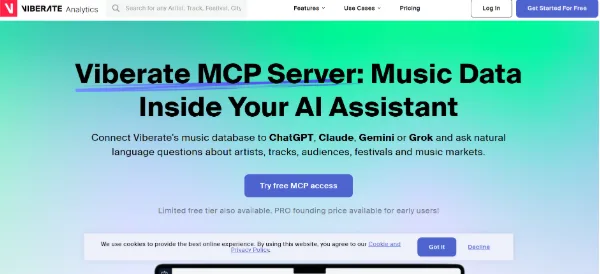
Viberate has applied MCP to this problem through its music mcp server, which connects structured music-industry data with compatible AI assistants.
Users can ask questions about artists, tracks, audiences, festivals, charts and markets directly through tools such as ChatGPT, Claude, Gemini and Grok.
Instead of opening an analytics platform and manually constructing several searches, the user can begin with the decision they are trying to make.
That seemingly small change can alter the entire research workflow.
Finding Emerging Artists
Artist discovery is one of the clearest examples.
Traditional A&R research can involve reviewing charts, filtering artists by genre and country, checking streaming growth, looking at social activity and comparing several candidates manually.
A connected AI assistant can compress much of the initial screening into one request.
For example:
“Find emerging Afro House artists from France, Germany and the Netherlands with strong Spotify growth, increasing playlist reach and rising audience momentum during the last 90 days.”
The AI can interpret the criteria and request the relevant information from the connected music dataset.
The result is not intended to make the signing decision automatically.
Human judgment still matters enormously in A&R.
But the system can reduce the amount of time spent assembling the initial candidate list.
That lets professionals spend more time evaluating the artists themselves.
Evaluating Artists for Live Events
Promoters face a related problem.
Popularity alone does not determine whether an artist is suitable for a particular event.
A promoter might care about:
- the size of an artist’s audience;
- growth in a specific country;
- audience concentration in particular cities;
- recent live activity;
- genre fit;
- momentum relative to similar artists.
Imagine a company planning a 5,000-capacity electronic music event in Vienna.
The research question could be:
“Find 15 artists from Germany, Austria, Switzerland and nearby markets with fewer than one million Spotify monthly listeners, strong recent growth, a meaningful audience in Austria and recent live activity. Rank them by booking potential.”
That would traditionally require multiple searches and comparisons.
With connected AI, the filters can be expressed in normal language.
The system can then organize the data around the booking question rather than simply returning a collection of metrics.
Competitive Benchmarking for Managers
Artist managers often face another challenge: understanding performance in context.
An artist gaining 100,000 monthly listeners may appear to be doing well.
But that number means something different if comparable artists gained 20,000 during the same period than if they gained 500,000.
Managers therefore need benchmarks.
A connected AI assistant could be asked:
“Compare this artist with three similar artists across Spotify followers, monthly listeners, playlist reach, YouTube views and top audience cities. Show where the artist is gaining or losing momentum.”
Instead of looking at each metric separately, the AI can organize the data into a comparative analysis.
The same concept is applicable to many industries.
Companies rarely need numbers in isolation.
They need context.
Identifying Geographic Opportunities
Audience geography is particularly important in music because growth often starts locally.
An artist may have modest global growth while gaining rapidly in Mexico City, Berlin or Sydney.
Those signals can affect tour planning, marketing campaigns and partnership opportunities.
A manager could ask:
“Which markets have grown fastest for this artist over the last six months, and where is the artist outperforming their overall global trend?”
A promoter could reverse the question:
“Which electronic artists are currently gaining audience fastest in Austria?”
The underlying dataset may contain thousands or millions of records.
The conversational interface lets users approach that information through the business question rather than through the structure of the database.
Researching Brand Partnerships
Brands also increasingly use music data when selecting artists for campaigns and partnerships.
A large follower count does not necessarily indicate strong brand fit.
A company may care more about:
- audience age;
- audience gender;
- geographic distribution;
- social media momentum;
- recent growth;
- the relationship between an artist and a target market.
A brand team could ask:
“Evaluate this artist for a campaign aimed at consumers aged 18 to 30 in Germany. Examine audience demographics, top cities, Instagram and TikTok signals and recent growth.”
The AI can then arrange the relevant data around the campaign objective.
This is different from simply generating an artist profile.
The system is being asked to perform a specific piece of business research.
AI as a New Interface for Data
There is a larger technology shift behind these examples.
For decades, professional software has largely dictated how users interact with data.
Users open a dashboard.
Select a report.
Choose metrics.
Set filters.
Export data.
Then interpret the result.
Conversational AI reverses part of that process.
The user begins with intent.
“Which artists should we watch?”
“Where is this artist growing?”
“Who fits this event?”
“Which partnership makes sense?”
The system can then determine what information is required to answer the question.
Traditional dashboards will remain useful, especially for ongoing monitoring and visual analysis.
APIs will also remain important for large-scale integrations and automated systems.
But conversational access creates another option, particularly for research tasks that change from one day to the next.
The Same Pattern Is Emerging Across Industries
Music is only one example.
Similar MCP-based systems are already appearing in finance, enterprise software, banking, media and other sectors.
The underlying idea remains consistent.
Rather than creating an AI model that attempts to contain every piece of specialist knowledge, organizations can connect capable models to trusted external sources.
A financial institution can expose approved financial datasets.
A retailer can connect inventory and customer systems.
A media company can connect content libraries and operational information.
A manufacturing company can connect production systems.
A music company can connect artist and audience data.
The AI assistant becomes the layer through which professionals ask questions of those systems.
This Could Change How Professional Software Is Designed
Most business software is built around predefined workflows.
Developers anticipate what users will want to do and build interfaces for those tasks.
That works well for frequently repeated processes.
But many professional questions are unpredictable.
A manager may need a specific comparison once.
A researcher may want to test an unusual hypothesis.
A promoter may need to screen a new market.
Building a dedicated interface for every possible question is inefficient.
Conversational access provides a way to handle these long-tail requests.
Instead of designing a button for every analysis, software providers can expose capabilities that an AI assistant can combine according to the user’s request.
The interface becomes less about menus and more about intent.
Reliable AI Requires Reliable Sources
There is also a practical lesson in this shift.
Much of the debate around AI quality focuses on models.
Which model is smartest?
Which has the largest context window?
Which performs best on benchmarks?
Those questions matter.
But for many professional applications, the source of the information may matter just as much.
A sophisticated AI model cannot reliably analyze data it cannot access.
And connecting it to poor-quality information does not solve the problem.
The usefulness of industry-specific AI will therefore depend on several layers working together:
the language model, the connection technology, the underlying dataset and the professional interpreting the result.
MCP addresses the connection layer.
It allows those components to work together without requiring every provider to invent an entirely different integration method.
Human Judgment Remains Part of the Process
Connecting AI to professional data does not mean delegating every decision to an algorithm.
An A&R executive may see an artist growing rapidly but know that the act does not fit the label.
A promoter may identify an artist with a strong local audience but know that the booking fee makes the event financially unrealistic.
A manager may spot an attractive market but understand that touring there is currently impractical.
Data provides evidence.
AI can make that evidence easier to access and interpret.
People still provide context.
For many professional applications, that combination is likely to be more useful than attempts to remove humans entirely from the decision-making process.
The Next AI Competition May Be About Connections
Generative AI initially created competition around the models themselves.
Now another layer of competition is developing.
Which AI systems can connect to the most useful tools?
Which professional datasets can be accessed safely?
Which services can turn proprietary information into something an AI assistant can work with?
Which companies can make their data usable without forcing customers to build complex integrations?
As MCP adoption expands, these questions may become increasingly important.
The AI assistant of the future may not be valuable because it knows everything.
It may be valuable because it knows where to get the right information when a professional asks for it.
For sectors built around specialized data, from financial services to music, that represents a significant change in what conversational AI can actually do.