How Long Does Paint Protection Film Last? A Complete Guide
For vehicle owners seeking to preserve their car’s finish against rock chips, UV exposure, chemical stains, and everyday wear, paint protection film (PPF) has become an essential investment. But a common and critical question remains: how long does paint protection film last? The answer depends on multiple factors—including material quality, environmental conditions, installation precision, and maintenance practices. In this comprehensive guide, we explore the lifespan of modern PPF, the science behind its durability, and how innovations from brands like AX are redefining long-term surface protection.
What Impacts PPF Lifespan?
Understanding how long paint protection film lasts begins with recognizing the variables that influence its performance over time. Not all PPFs are created equal; early-generation films made from PVC or low-grade thermoplastic polyurethane (TPU) often degrade within 1–2 years due to yellowing, cracking, or loss of adhesion. Today’s premium films, however, leverage advanced TPU chemistry combined with proprietary topcoats to significantly extend service life.
Key factors affecting longevity include:
- Base Material Quality: High-purity aliphatic TPU resists UV-induced breakdown far better than aromatic alternatives.
- Topcoat Technology: Hydrophobic and self-healing coatings not only enhance gloss but also shield the underlying film from contaminants.
- Installation Expertise: Poorly applied film—especially with trapped moisture or improper edge sealing—can delaminate prematurely.
- Climate Exposure: Extreme heat, prolonged sunlight, road salt, and acid rain accelerate material fatigue if the film lacks robust resistance.
When these elements align favorably, modern PPF can remain effective for 5 to 7 years or more, far surpassing older standards. This dramatic improvement underscores why choosing a scientifically engineered product like AX Long-Life PPF makes a measurable difference in real-world durability.
Layered Engineering: Why AX PPF Lasts Longer
The secret to extended performance lies in the multi-layer construction of high-end PPF. AX’s proprietary film architecture consists of five precisely engineered layers, each designed to contribute to long-term resilience and visual integrity.
1. Protective Film
This outermost layer shields the main film from physical damage during storage and transportation, ensuring it maintains peak quality until application. It prevents dust, scratches, and moisture buildup before installation, preserving the film’s optical clarity and adhesive properties.
2. Hard Coating (HC)
The hard coating is a critical component that provides superior resistance to tar, grease, weak alkalis, gravel impact, and acid rain. Featuring a lotus-inspired hydrophobic property, this layer repels water and stains, reducing the risk of permanent discoloration. More importantly, it enables automatic and swift repair of minor surface scratches, maintaining a glossy finish over time—key to answering “how long does paint protection film last” with confidence.
3. TPU Coating
At the core of the film is a top-tier outdoor-durable TPU base material. This advanced polymer enhances the gloss of the vehicle’s paint surface by at least 30%, giving the car a deeper, more vibrant appearance. It also reinforces the structural strength of the film, allowing it to absorb impacts without cracking or peeling—essential for enduring harsh driving conditions.
4. PSA (Pressure Sensitive Adhesive)
Imported from the USA, this high-performance, low initial tack adhesive ensures clean, repeatable applications without leaving visible residue or adhesive marks. It bonds securely to the vehicle’s body while remaining removable without damaging the original factory paint—a crucial feature for future modifications or refinishing.
5. PET Liner (Polyethylene Terephthalate Release Liner)
Flexible and highly smooth, the PET liner facilitates easy application and ensures perfect adhesion across complex curves and panel contours. Its release properties allow technicians to apply the film with minimal effort and maximum precision, reducing air bubbles and improving long-term durability.
Together, these five layers create a cohesive system that resists degradation, repairs itself, and maintains aesthetic appeal—directly contributing to the answer: how long does paint protection film last? With AX, up to a decade under normal conditions.
Durability Testing Data
Manufacturers validate how long does paint protection film last through rigorous laboratory and field testing. Accelerated aging protocols—such as QUV weathering (simulating UV and moisture cycles), thermal cycling, and abrasion resistance tests—provide quantifiable data on performance decay over time.
Independent studies show that high-end TPU-based PPF retains over 90% of its original clarity and tensile strength after 5,000 hours of UV exposure—equivalent to roughly 7–8 years of average sun exposure in most regions. Additionally, scratch recovery tests demonstrate that films with advanced elastomeric topcoats can heal minor swirls at ambient temperatures within minutes, maintaining optical smoothness throughout their service life.
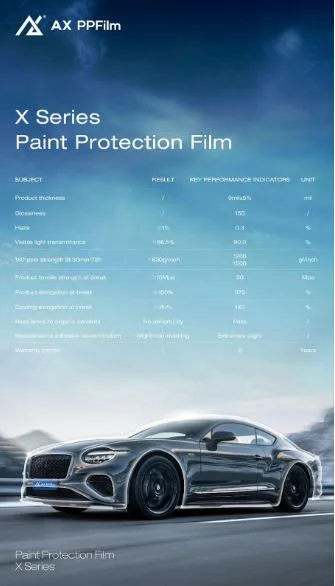
AX’s R&D team conducts continuous stress testing under controlled environments to ensure consistency. Their data confirms that properly installed AX Paint Guard Solution maintains structural integrity and aesthetic performance well beyond the industry average, supporting warranties that reflect real-world confidence—not just marketing claims.
Environmental Factors and UV
One of the most significant threats to PPF longevity is ultraviolet (UV) radiation. Without adequate stabilization, UV rays break down polymer chains, leading to yellowing, brittleness, and eventual failure. This is why how long paint protection film lasts is directly tied to its UV resistance formulation.
Premium PPF incorporates UV absorbers and hindered amine light stabilizers (HALS) that neutralize free radicals before they damage the polymer matrix. These additives are embedded throughout the film—not just on the surface—ensuring protection endures even as the top layer wears microscopically over time.
Geographic location also plays a role. Vehicles in arid, high-sunlight zones experience more intense UV exposure than those in temperate or cloudy regions. Similarly, coastal areas introduce salt aerosols that can degrade adhesives if the film lacks proper chemical resistance. However, modern PPF, like AX’s offerings, is engineered to withstand these challenges through multi-layer barrier technology that repels both UV and corrosive agents.
Regular washing with pH-neutral cleaners further mitigates environmental buildup, preserving the film’s hydrophobic properties and extending its functional lifespan. Thus, while environment matters, it doesn’t dictate fate—quality film combined with basic care ensures long-term resilience.
Routine Inspection Tips
To maximize how long paint protection film lasts, proactive maintenance is essential. Even the most durable PPF benefits from periodic checks to catch issues early. Here are practical inspection tips:
- Check Edges Monthly: Lifted edges are the first sign of adhesive fatigue or improper installation. Gently press down any loose corners; if lifting persists, consult a professional.
- Monitor Clarity: Hazing or yellowing indicates UV degradation or chemical contamination. If localized, it may be cleanable; widespread discoloration suggests nearing end-of-life.
- Assess Self-Healing Performance: Lightly scratch an inconspicuous area with a fingernail. If the mark doesn’t disappear within 10–15 minutes at room temperature, the topcoat may be compromised.
- Avoid Harsh Chemicals: Automatic car washes with abrasive brushes or acidic detergents can erode the film’s surface over time. Opt for hand washing or touchless systems.
These simple habits help owners identify when a film is approaching its limit—typically after 7+ years—allowing for timely replacement before underlying paint becomes vulnerable.
Warranty and Service Options
A strong warranty often reflects a manufacturer’s confidence in how long paint protection film lasts. While some brands offer 5-year coverage, leading innovators now provide 7- to 8-year warranties that cover yellowing, cracking, delamination, and loss of gloss—provided the film is professionally installed and maintained per guidelines.
AX backs its products with transparent warranty terms that align with real-world performance data. Customers who choose the AX Long-Life PPF gain access not only to extended coverage but also to a network of certified installers trained in precision application techniques that prevent premature failure. Additionally, AX’s customer support includes guidance on care routines and troubleshooting, ensuring the film performs optimally across its entire lifecycle.
Warranty validity typically requires:
- Installation by an authorized dealer
- Use of recommended cleaning products
- No exposure to industrial pollutants or solvents
By meeting these conditions, owners secure both peace of mind and verified long-term value—proving that durability isn’t just about material, but partnership.
In conclusion, how long does paint protection film last? With today’s advanced materials and proper care, the answer is clear: up to a decade of reliable, high-performance protection. The key lies in selecting a scientifically engineered solution like AX’s PPF lineup, which combines cutting-edge polymer science with real-world validation. Whether you’re shielding a daily driver or a collector vehicle, investing in a long-life film ensures your paint stays pristine—mile after mile, year after year. Explore the full range of durable options at AX Paint Guard Solution to find the right fit for your vehicle’s needs.