How Many Tons Can a Dump Truck Carry?
| Quick answer
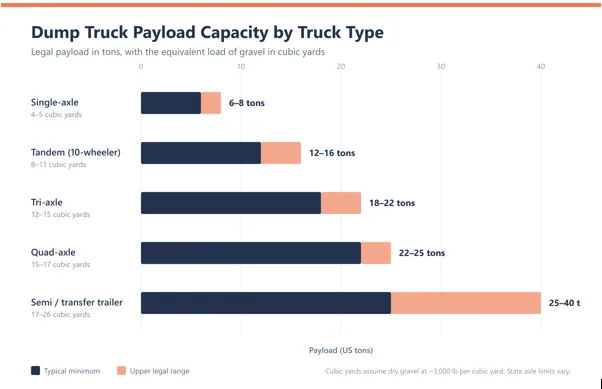
A standard tandem-axle dump truck carries 12 to 16 tons of gravel per load. A tri-axle carries 18 to 22 tons. A single-axle truck carries 6 to 8 tons. Federal law caps any truck at 80,000 pounds gross weight on interstate highways, so the weight of the truck itself reduces the payload it hauls legally. |
Two very different people search this question. A contractor compares trucks before buying one. A homeowner wants to know how many loads of gravel a new driveway takes. Most capacity guides answer only the first person. This one answers both.
Below you will find payload figures by truck configuration, the federal weight rules that set those figures, the yards-to-tons conversion that trips up most first-time buyers, and the driveway damage a full load causes.
Dump Truck Capacity at a Glance
Truck size sets the payload. Axle count sets the legal ceiling. Each additional axle spreads the load across more of the road surface, so the truck hauls more weight within the law.
Payload capacity by dump truck configuration, with the matching volume of gravel.
| Truck type | Axles | Payload (tons) | Gravel (cubic yards) |
| Single-axle | 2 | 6 – 8 | 4 – 5 |
| Tandem (10-wheeler) | 3 | 12 – 16 | 8 – 11 |
| Tri-axle | 4 | 18 – 22 | 12 – 15 |
| Quad-axle | 5 | 22 – 25 | 15 – 17 |
| Semi / transfer trailer | 5+ | 25 – 40 | 17 – 26 |
Cubic yard figures assume dry gravel at roughly 3,000 pounds per cubic yard. Wet material and denser stone reduce the volume each truck carries.
Tons and Cubic Yards Measure Different Things
Suppliers sell stone two ways. Some quote tons. Others quote cubic yards. The two units describe different properties. A ton measures weight. A cubic yard measures volume. Confusing them produces the most expensive ordering mistake in the trade.
Dry gravel weighs about 3,000 pounds per cubic yard, which equals 1.5 tons. A 20-ton load therefore holds roughly 13 cubic yards. Mulch weighs 400 to 800 pounds per cubic yard, so the same truck hauls three times the volume of mulch before it reaches the same weight.
A truck fills up in one of two ways. It runs out of space, or it runs out of legal weight. Light material fills the bed first. Heavy material hits the weight limit first. Gravel almost always hits the weight limit first, which is why a tri-axle looks half empty when it leaves the quarry.
Run your own numbers with a cubic yards to tons calculator before you call the supplier.
Material Density Decides the Real Limit
Water adds weight. Wet aggregate weighs 25 to 40 percent more than the same material dry. A tri-axle that legally hauls 22 tons of dry stone hauls noticeably less after two days of rain, because the water in the load counts toward gross vehicle weight.
This detail costs money. A yard that loads by volume during wet weather delivers less usable stone per ton you pay for. Ask whether a quoted tonnage reflects dry or wet material before you compare prices between suppliers.
A stone tonnage calculator converts your project volume into the tonnage a supplier quotes.
Federal Law Caps the Load
Three federal rules govern interstate highway loads:
- Single axle: 20,000 pounds maximum
- Tandem axle group, meaning two axles spaced eight feet apart or less: 34,000 pounds maximum
- Gross vehicle weight: 80,000 pounds maximum
The Federal Bridge Formula links allowable weight to axle spacing. Spreading a load across more axles, and across a longer wheelbase, lowers the stress each bridge deck absorbs. Trucks with more axles therefore haul more weight legally, which explains the jump from a tandem to a tri-axle.
State limits differ from federal limits on non-interstate roads, and several states permit heavier loads on local routes. Check the state DOT limit before you assume a truck runs at its maximum.
Empty weight matters as well. A steel dump body weighs more than an aluminum one, and every pound of truck subtracts a pound of payload. Two identical-looking tri-axles legally carry different loads for this reason alone.
How Many Loads Does Your Project Need?
Capacity guides stop at the truck. Homeowners need the next step, which is the number of deliveries. Work it out in three moves.
- Calculate the volume. Multiply length by width by depth in feet, then divide by 27 to reach cubic yards.
- Convert to tons. Multiply cubic yards by 1.5 for gravel and crushed stone.
- Divide by the truck payload from the table above.
Take a driveway 100 feet long, 10 feet wide and 4 inches deep. That volume equals 12.3 cubic yards, or about 18.5 tons. One tri-axle delivers it in a single trip. A tandem needs two.
Order the full amount in one delivery whenever truck capacity allows. Suppliers charge per trip, so two half-loads cost more than one full load and the second load often arrives on a different day.
Compaction changes the arithmetic. Base stone loses 15 to 20 percent of its loose volume under a plate compactor, so a 4-inch compacted base needs closer to 5 inches of loose material. Add that percentage before you order rather than after you run short.
For driveway projects specifically, a driveway stone calculator handles the depth and compaction adjustments in one step.
A Loaded Truck Can Crack Your Driveway
A loaded tri-axle weighs more than 60,000 pounds. A residential concrete driveway poured 4 to 6 inches thick handles roughly 25,000 to 30,000 pounds without cracking. That gap explains why delivery damage happens so often, and why suppliers ask where you want the material dropped.
Damage takes three forms. Concrete cracks under concentrated point loads at the wheels. Asphalt dents and ruts, and it does so far more easily in summer heat. Turf tears wherever the truck turns or backs up.
Four steps cut the risk:
- Ask the driver to dump at the curb or on the apron instead of driving up the driveway.
- Lay 3/4-inch plywood or ground protection mats along the truck path.
- Split a large order across smaller trucks when the driveway is new, thin or already cracked.
- Keep the truck off the edges. A driveway slab is weakest at its perimeter, not its centre.
Describe your access when you book the delivery. Drivers plan the approach around low branches, tight turns, soft ground and overhead wires, and they refuse the drop on arrival if the route looks unsafe.
Five Questions to Ask Before You Order
- Does this price quote tons or cubic yards?
- Does the tonnage reflect wet or dry material?
- Which truck configuration delivers the load?
- Does the truck dump at the curb or on the driveway?
- Do you charge per trip or per ton?
Frequently Asked Questions
How many tons is a standard dump truck?
A standard tandem-axle dump truck carries 12 to 16 tons. Contractors call this truck a 10-wheeler, and it handles most residential gravel deliveries.
How many cubic yards of gravel fit in a dump truck?
A tandem-axle truck holds 8 to 11 cubic yards of gravel. A tri-axle holds 12 to 15. Gravel weighs about 1.5 tons per cubic yard, so the truck reaches its legal weight before the bed fills.
Can a dump truck carry 20 tons?
A tri-axle or quad-axle dump truck carries 20 tons legally. A tandem-axle truck does not. Loading 20 tons onto a tandem exceeds the 34,000-pound tandem axle limit and earns a citation at the first weigh station.
How many tons of gravel does a driveway need?
A driveway 100 feet long, 10 feet wide and 4 inches deep needs about 18.5 tons. Multiply length by width by depth in feet, divide by 27 for cubic yards, then multiply by 1.5 for tons.
Will a loaded dump truck crack my driveway?
A loaded tri-axle weighs over 60,000 pounds, and a typical residential concrete driveway handles 25,000 to 30,000 pounds. Ask the driver to dump at the curb, or protect the surface with plywood or ground mats before the truck arrives.
Figures reflect United States federal weight limits and typical quarry practice. State limits on non-interstate roads vary, so confirm local rules with your state DOT before ordering.