How Marseille’s Underground Scene Gave Rise to Streetwear Label VRUNK
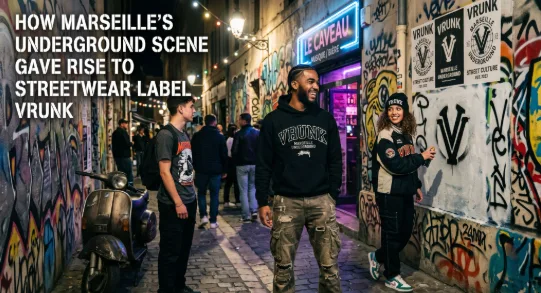
French streetwear has produced its share of breakout labels over the past decade, but few carry as direct a link to their home city as VRUNK. Founded by Zakaria Lif in the south of France, the brand traces its roots to Marseille’s underground scene in 2020, before formally registering as a company under the name LSL LTD INVEST a year later.
That timeline matters, because it explains why VRUNK doesn’t read like a typical fashion startup. The label didn’t begin with a business plan drawn up in an office — it grew out of the neighbourhoods, the music, and the street culture that define much of Marseille’s identity. French rap and drill are cited as the brand’s main creative reference points, and that influence shows up directly in the clothing: dark tones, oversized cuts, and tactical-style accessories that echo the visual language of that scene.
A Collection Built Around the “Drop”
Rather than running continuous seasonal lines like most retailers, VRUNK releases collections in limited batches, a model closer to sneaker culture than mainstream fashion. Pieces such as the brand’s balaclava and its tn-style trainers have developed a reputation for selling out shortly after release, a pattern the brand appears to have leaned into rather than tried to correct.
The catalogue itself covers the usual streetwear staples: hoodies, tracksuits, T-shirts, jackets, shorts and caps. The hoodie line has become something of an entry point for new customers, built around bold graphics and a relaxed, oversized fit. Tracksuits follow a similar logic — rather than treating the format as pure sportswear, VRUNK designs its sets as one coordinated outfit, top and bottom together, though the pieces can also be split and mixed with items from outside the collection.
Collaborations Beyond the Core Line
Part of VRUNK’s identity has been built through outside partnerships. Its collaboration with Japanese sportswear brand Mizuno is among the most sought-after items in its catalogue, alongside projects with French collective 667 and eyewear brand Cébé. Each of these has followed the same limited-run approach as the main collection rather than functioning as a standalone marketing push, which is consistent with how the brand has handled every release since it started.
Why the Marseille Connection Matters
Plenty of streetwear labels borrow visual cues from urban culture without any real tie to a specific place. VRUNK’s case is different: Marseille isn’t a marketing backdrop, it’s where the brand was created and where its aesthetic first took shape. As the label has grown, it has expanded its reach to other French cities, while keeping the same community-first approach it started with.
That distinction has become more relevant as streetwear buyers grow more selective about which labels they back. A growing part of the market is gravitating toward brands with a traceable origin story rather than a logo attached to a generic supply chain, and VRUNK’s positioning fits squarely into that shift — for better or worse, depending on how the brand manages growth without losing the identity that built it in the first place.
Where to Find It
VRUNK sells directly through its own online store at vrunkco.fr, which the brand describes as the only channel that guarantees authentic, first-party products. The site carries the current range of releases, from outerwear to accessories, along with updates on upcoming collaborations.
For a label that started in 2020 without institutional backing, VRUNK’s path so far — from Marseille’s underground scene to a registered company with international collaborations — reflects a broader shift in French streetwear, where brands built from the ground up are increasingly finding audiences willing to follow them from one limited drop to the next.