How Modern OBD2 Scanners Are Transforming Vehicle Diagnostics
I once saw an old-time mechanic work on a complaint of a misfire for three hours on a car. He looked at the plugs, tested the coils, pulled vacuum lines – all this by smell and feel. He found it. Three hours is a long time, on a simple engine.
Today, that diagnosis takes 15 minutes with a good OBD2 scanner. Not because mechanics got lazy, but because the tools got smarter.
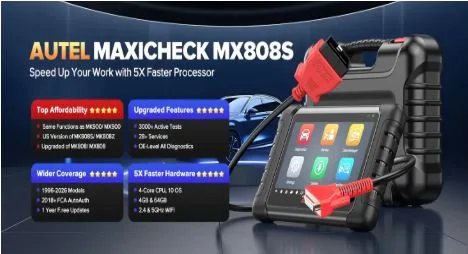
The Autel MX808S and How It’s Better
Key Features of the Autel MX808S
One of the mid-priced tools that can do this job is the Autel MX808S, which is frequently mentioned – and it’s worth knowing why.
It performs scanning using all systems supported by OBD2: engine, ABS, SRS, transmission, and much more. This is important because many low-cost scanners claim to support OBD2, but only scan the engine. For proper diagnostics, you need access to all of the vehicle systems.
The MX808S stands out with bi-directional capability. That means it can actively control vehicle components – rather than passively read them. Turn on a fan, pulse the ABS solenoids, pulse the fuel injectors or reset the throttle. This active testing reduces time spent troubleshooting because you’re confirming component operation.
The reset capabilities cover the tasks that crop up all the time in the real world: oil service, parking brake reset, battery management system, steering angle. These used to require dealer software. But now they’re just a couple of screen swipes.
The Android-based menu is fast and has a logical structure. That’s hugely important in a busy store.
Why Its Update System Matters More Than Hardware Specs
Here’s a scanner topic that isn’t talked about a lot – the hardware you purchase today is only the beginning of the investment.
Automakers introduce new models yearly. ECU architectures change. New diagnostic protocols get introduced. A scanner that works flawlessly today may not with next year’s models unless it’s updated.
The Autel Scanner Update system does just that. The system connects to the scanner via Wi-Fi, supports new vehicle platforms as they are introduced to the market, enhances fault detection for existing platforms and resolves communication issues that occur with particular ECU setups.
The latter are particularly critical for those who work on hybrid and electric vehicles. This isn’t like working on combustion vehicles – there are new battery management strategies, new motor control strategies, new diagnostic strategies. It’s essential if it’s any part of your job.
If you don’t keep up, you’re working with increasingly out-of-date vehicle information. At work, that means embarrassing holes in your knowledge.
The Evolution of Vehicle Diagnostics (From Early Tools to Modern Scanners)
The change didn’t occur overnight. In the late 1990s and early 2000s, OBD2 spread across the majority of the world’s markets. Every car had a port. Every port spoke a common language. That, in itself, was a game-changer – now only one tool was needed to communicate with hundreds of different cars, trucks, and minivans – no adapters, no special software.
But the revolution really happened when scanners stopped simply displaying error codes and began to do diagnostic work. It’s one thing for the scanner to report a problem exists, and quite another for it to assist in determining just what that problem is.
And that’s where today’s OBD2 scanners sit.
The Capabilities and Limitations of Early OBD2 Scanners
The original OBD2 scanners were “translators”. The vehicle gives you a code, the reader translates it for you. P0301 – cylinder #1 misfire. Fine. But is it the spark plug, the coil, the fuel injector, low compression, or it’s timing? The code doesn’t tell you that. The mechanic had to find that out.
This took time, and required skill. Without experience, a mechanic could easily be misled and replace component parts that were not faulty.
Today’s scanners filled in that gap. Data streaming, freeze frame, activating sensors, whole system scans – these features took the scanner from a dumb reader to an interactive tool.
How Live Data Changed Modern Car Repair Workflows
If there’s one thing that makes a scanner better than a code reader, it’s live data.
Seeing sensor readings in action while the engine hums away gives you vital clues a static code can’t. You see the fuel trims wander with load, the coolant temp rise more slowly than it should, the oxygen sensors’ reaction times that tell you they are sluggish, not dead. You only see these things when the engine is running – not when it’s sitting in the parking lot.
In diagnosing problems with the transmission, it’s even more important. Clutch pack pressure, slip detection, torque converter operation – this isn’t shown in a fault code. It shows up in the numbers moving in on the fly.
Ask any tech who has used and not used it – it’s a game changer.
Final Thoughts
OBD2 scanning isn’t stagnant. Data logging to the cloud, remote access, AI-based fault diagnosis – these features will soon be appearing in more expensive scanners and trickling down to mid-range tools in just a couple of years.
What that means is the scanner you purchase should be from a company that is constantly evolving its product. The tool that you can’t upgrade will become obsolete much more quickly than the hardware itself.
The combination of powerful hardware and ongoing software development – what the Autel MX808S offers, and the Autel Scanner Update platform – is the baseline to aspire to.
If you’re going to work on car diagnostics in a garage, home or professional shop, there’s no better place to start.