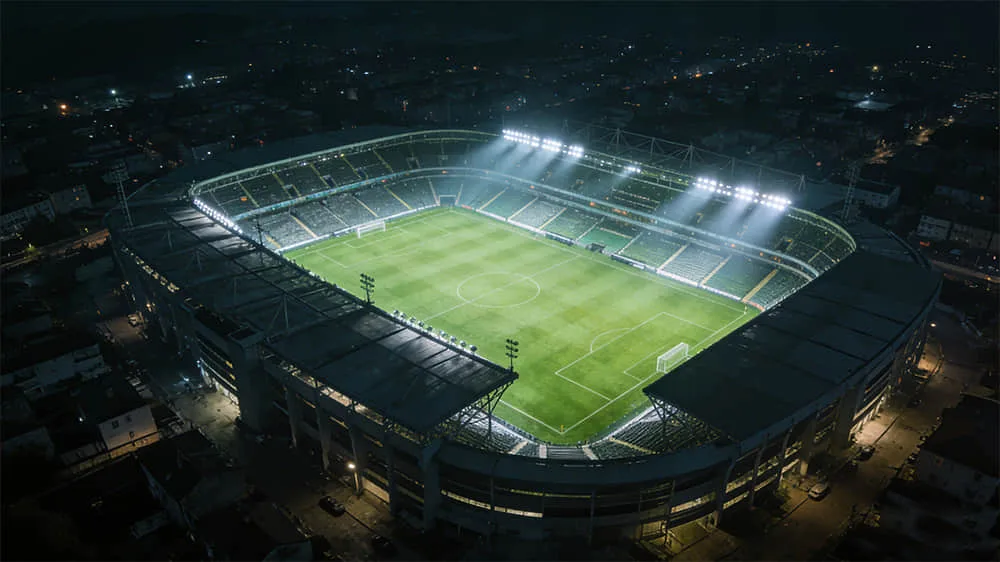
How Precision Optics Enable 4K Broadcast Standards in Modern Stadiums
Lighting a stadium is arguably the most difficult challenge in the illumination industry. Unlike a warehouse or a street, a sports arena is a multi-dimensional stage that serves three distinct masters: the athletes, the spectators, and the television cameras.
With the global transition to High-Definition (HD) and now Ultra-High-Definition (4K/8K) broadcasting, the margin for error in lighting has vanished. A lighting setup that looks “fine” to the naked eye might look disastrous on a slow-motion replay camera. For stadium owners and contractors, success depends on understanding that they are no longer just installing lamps; they are installing precision optical instruments.
The Camera Never Lies: Vertical Illuminance
In traditional lighting, we worry about “horizontal illuminance”—how much light hits the floor. In sports broadcasting, however, the critical metric is “vertical illuminance.” This is the light that hits the vertical faces of the athletes.
If the optics are poorly designed, you get shadows on players’ faces, making them look like dark silhouettes against the bright grass. To capture the sweat on a player’s brow or the rotation of a ball in super-slow motion, the light must come from multiple angles with perfect uniformity.
This requires lenses with extremely tight beam control. We are not just throwing light; we are layering it. By using a mix of narrow-beam optics (to punch through from high towers) and medium beams (for overlap), engineers can create a 3D modeling effect that satisfies the strict standards of FIFA or the Olympics.
Mastering Angles: From 10° to 90°
A professional lighting plan is essentially a complex puzzle. You cannot light an entire football pitch using a “one-size-fits-all” beam angle. The fixtures mounted on the highest catwalks require different optics than those mounted on lower poles.
To solve this geometry problem, engineers rely on a versatile Sport Stadium Lighting Lens family that offers a granular range of beam angles.
- 10° & 20° (Narrow Spot):These are the “sniper rifles” of the lighting world. They are essential for high-mast towers located far from the pitch. A 10° lens allows the light to travel 50+ meters and still deliver high-intensity punch to the center circle without scattering.
- 40° & 60° (Medium Flood):These angles are the workhorses used to fill in the midfield and blend the light between the bright spots, creating uniformity.
- 90° (Wide Flood):Often used for lower mounting heights or to illuminate the spectator stands and immediate sidelines, ensuring the fans are visible on camera without blinding them.
Without this specific range of 10°, 20°, 40°, 60°, and 90° options, a lighting designer is forced to compromise, resulting in “hot spots” (over-lit areas) and dark zones that ruin the broadcast quality.
The Power of T3: Asymmetric Distribution
Beyond simple symmetrical beams (round spots), modern sports lighting demands asymmetric control. This is where the T3 (Type III) distribution becomes critical.
In many stadiums, the poles are located around the perimeter. If you use a standard round lens, half the light spills “backwards” onto the running track or the audience, and the other half barely reaches the field. A T3 lens is engineered to throw light “forward.” It pushes the beam out onto the playing surface while keeping the area behind the pole dark.
Using a T3 optic is often the difference between a project that passes an energy audit and one that fails. It ensures that every lumen generated by the LED contributes to the game, rather than being wasted as spill light.
The Athlete’s Perspective: Glare Control
Imagine a baseball outfielder tracking a high fly ball, or a goalkeeper looking up to catch a corner kick. If they look directly into a high-intensity LED fixture, they can be blinded instantly. In professional sports, a moment of glare-induced blindness can determine the outcome of a championship.
This is where secondary optics play a defensive role. High-quality sports lenses feature “cut-off” designs and integrated spill guards. These optical elements physically block the line of sight to the LED chip from outside the main beam path.
Advanced optical engineers use ray-tracing software to simulate the view from specific positions on the field—the pitcher’s mound, the goal line, the 3-point line—to ensure that no matter where a player looks, the glare rating (GR) remains within safe limits.
Custom Field Geometries
Not all sports venues are professional stadiums. Many are multi-use community centers, tennis courts, or irregular high school fields. Standard “square” lighting distributions often fail here.
For example, a tennis court requires a very specific rectangular distribution to light the baseline and service boxes without wasting light on the fence. By combining custom LED optical design with standard beam options, installers can light a court perfectly from existing poles that might be placed in less-than-ideal locations.
Conclusion
When we watch a stunning slow-motion goal on TV, or when a player makes a miracle catch under the lights, we rarely think about the plastic lenses covering the LEDs high above. Yet, without them, the spectacle would be impossible.
For stadium architects and lighting designers, the choice of optics is the most critical technical decision in the project. Whether selecting a narrow 10° beam for a high tower or a T3 optic for sideline coverage, the lens bridges the gap between raw power and visual performance. By prioritizing precision optics, venues can deliver a world-class experience for the fans in the stands and the millions watching at home.