How Print Shops Should Qualify Instant-Peel Film Before a Full Production Run
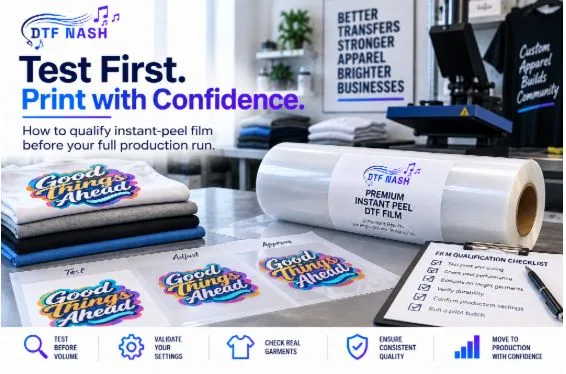
Switching to a different DTF film should not begin with a full customer production run. Even when a film is designed for an instant-peel workflow, the real production question is not simply whether the carrier can be removed quickly. The important question is whether the film performs consistently inside the specific printing, curing, pressing, garment, and operator workflow used by the shop.
That makes qualification different from ordinary product testing. A qualification process creates a known production baseline before hundreds of transfers depend on it.
Treat a New Film Like a Production Change
Print shops often test consumables informally. An operator prints one design, presses it successfully, and assumes the material is ready for production. That may be enough to confirm that the film works, but it does not show how predictable it will be across a real production queue.
A full run may involve fine details, large solid areas, white underbase coverage, multiple garment types, several operators, and repeated heat-press cycles. Qualification should therefore answer a broader question: can the shop reproduce an acceptable result without adjusting the process from garment to garment?
Operators evaluating an instant-peel workflow can begin with a known product such as Premium Instant Peel DTF Film, then test it against the exact production environment in which it will be used.
Start With a Known-Good Reference Job
The first test should not be the most difficult artwork in the customer queue. Choose a reference file the shop already understands well.
A useful qualification graphic can include several elements:
- small text or fine details,
- solid color areas,
- edges that make registration or release problems visible,
- a typical white-ink area, and
- design dimensions commonly produced by the shop.
The purpose is consistency. When the artwork is familiar, operators can focus on how the film behaves rather than wondering whether the artwork itself caused the difference.
Change One Variable at a Time
A film qualification test loses value if several parts of the workflow change simultaneously. If the shop changes film, curing settings, powder, press settings, and garment type at the same time, it becomes difficult to identify what caused a good or bad result.
Begin with the shop’s normal validated process wherever possible. Introduce the film as the primary new variable. Then document any adjustment required to achieve the desired result.
This does not mean every DTF setup should use identical settings. Equipment and materials differ. The point is to create a controlled test rather than a guessing session.
Evaluate More Than the Peel Moment
The carrier release is important in an instant-peel workflow, but qualification should not stop there. A film can feel convenient at the press while still creating problems earlier or later in production.
Operators should observe the full path:
- how the film feeds through the printing workflow,
- whether printed areas remain visually consistent,
- how the sheet behaves through powder and curing stages,
- whether handling remains predictable before pressing,
- how consistently the carrier releases at the intended stage, and
- whether the finished transfer meets the shop’s normal appearance standard.
The shop should define those acceptance points before the test begins. Otherwise, qualification can easily become “it looked fine,” which is difficult for another operator to repeat.
Use a Small Press Matrix
A controlled press matrix can help determine whether the process has enough operating margin for normal shop use. Rather than immediately producing a large batch, create several test pieces under the shop’s approved operating range.
Record the garment, press, operator, film batch, artwork, and relevant application conditions used for each test. The goal is not to experiment endlessly. It is to confirm that the chosen production setup behaves predictably more than once.
If only one test piece succeeds while repeated tests require constant adjustment, the workflow is not yet ready for volume.
Include the Garments You Actually Sell
Qualification becomes more useful when it reflects the garments that regularly move through the shop. A business producing mostly cotton tees may need a different validation set from one frequently decorating hoodies, blends, workwear, or other apparel.
Do not attempt to test every garment in the catalog. Instead, identify the materials that represent the largest share of normal production and use them as qualification references.
If a future job introduces a materially different garment, treat that garment as a new application that deserves its own test before volume production begins.
Run a Pilot Batch Before the Customer Batch
Once individual tests are acceptable, move to a small pilot run. The pilot is important because repeated production can expose workflow issues that a single transfer does not.
Watch whether operators can maintain the same sequence without slowing down to inspect every piece. Confirm that sheets remain easy to identify and handle. Check whether the press workflow stays organized as finished garments accumulate.
A successful pilot should feel repeatable, not lucky.
Create an Acceptance Standard Operators Can Share
Film qualification is most valuable when knowledge does not remain with one experienced employee. Write down the approved workflow in simple terms so another trained operator can reproduce it.
The record may include:
- film identification,
- printer and production setup used during qualification,
- reference garments,
- approved application procedure,
- visual acceptance criteria, and
- conditions that require the job to stop for review.
When evaluating future film requirements, reviewing the broader range of DTF film options can also help a shop keep different film types tied to specific production workflows rather than treating every roll as interchangeable.
Requalify When the Workflow Changes
Qualification is not permanent if the surrounding production system changes significantly. A different printer configuration, ink system, powder, curing process, press, garment category, or other major variable may justify another controlled test.
The same is true if operators begin seeing results that differ from the established baseline. Stop, isolate what changed, and verify the workflow again before pushing a large customer order through it.
Qualification Turns Speed Into a Repeatable Process
Instant-peel film can support a faster press-stage workflow, but speed only creates value when the process is controlled.
A print shop should know which artwork was used to test the film, which garments were validated, what conditions produced acceptable results, how the carrier behaved, and whether multiple operators can repeat the same outcome.
That is the difference between trying a new roll and qualifying it for production. One proves that the material can work. The other gives the shop a documented reason to trust it when the order queue is full.