How QMS Software Helps Manufacturers Build a More Reliable Quality System
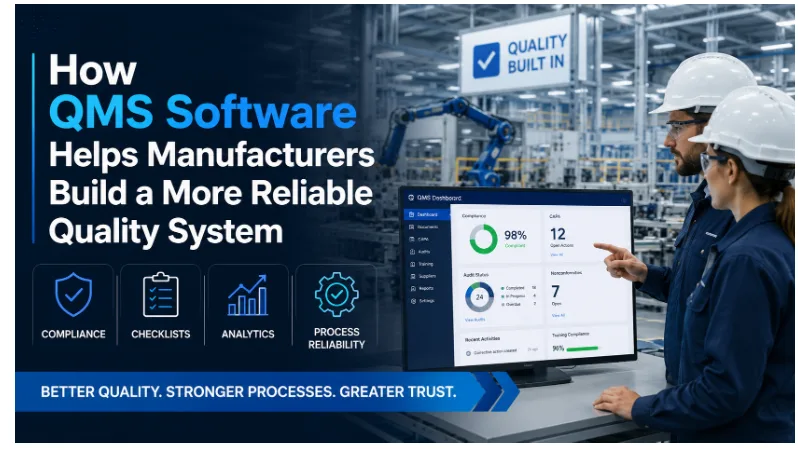
Manufacturing quality is rarely controlled by one person, one department, or one checklist. It depends on hundreds of connected actions, from approving documents and training employees to managing suppliers, investigating nonconformances, and reviewing risks. When these activities are handled through separate spreadsheets, shared folders, emails, and paper records, even experienced teams can lose visibility. A modern quality management system brings these activities together and gives manufacturers a clearer way to control quality across the business.
For small and midsize manufacturers, the challenge is especially important. They need reliable processes, but they may not have the budget, staff, or technical resources required for complex enterprise systems. This is where QMS software for manufacturing becomes valuable. It helps organize quality processes in one environment while reducing the administrative burden that often slows teams down.
Why Manufacturing Quality Becomes Harder as a Business Grows
A small manufacturing company can often manage quality informally during its early stages. A few employees may know where every document is stored, who approved a procedure, and which supplier caused a recent issue. That approach becomes less practical as the company adds people, products, customers, facilities, and regulatory expectations.
Growth creates more records, more training requirements, more supplier interactions, and more opportunities for errors. Quality information may become scattered across several locations. One department may use an updated procedure while another still has an older version. Corrective actions may be discussed in meetings but not tracked consistently. Audit findings can remain open because ownership is unclear.
These problems are not always caused by poor management. Often, the underlying issue is that the system used to manage quality has not grown with the organization. A structured manufacturing QMS provides a framework for keeping responsibilities, records, approvals, and improvement activities connected.
Moving Beyond Spreadsheets and Shared Folders
Spreadsheets are useful tools, but they were not designed to manage an entire quality system. Manufacturers often create separate files for training, supplier performance, corrective actions, audit schedules, risk registers, and document lists. Over time, these files become difficult to maintain.
Common problems include:
- Multiple versions of the same document
- Missing approval history
- Inconsistent naming and filing practices
- Limited visibility into overdue actions
- Manual reminders for training or reviews
- Difficulty connecting one quality issue to related records
A connected QMS system for manufacturing reduces this fragmentation. Instead of treating each quality activity as a separate administrative task, the system allows information to be managed as part of one broader process.
How QMS Software Creates Better Document and Record Control
Document control is one of the foundations of a dependable quality system. Work instructions, procedures, forms, policies, specifications, and quality records all need appropriate control. Employees must be able to access the correct information, while managers need confidence that changes are reviewed and approved.
Modern quality management software can help manufacturers define document ownership, approval workflows, revision history, and access controls. When a procedure changes, the organization can track the update rather than relying on employees to replace old copies manually.
This is particularly useful in environments where production activities depend on standardized instructions. A small difference between an outdated and current procedure can affect product quality, inspection results, or customer requirements.
Using QMS software for manufacturing can give manufacturers a more centralized way to manage quality documents and related processes without relying on a collection of disconnected files. The goal is not simply to digitize documents. It is to create better control over how quality information is created, reviewed, used, and maintained.
Connecting Nonconformances With Corrective Actions
Every manufacturer encounters problems. A component may fail inspection, a supplier may deliver material outside specification, or an internal process may produce an unexpected result. The strength of the quality system is determined by how consistently the organization responds.
A manufacturing QMS software platform can help teams document nonconformances, assign responsibility, investigate causes, and track corrective actions. This creates a clearer path from identifying a problem to verifying that the response was effective.
Without a connected system, information can easily become separated. The nonconformance may be recorded in one spreadsheet, the root cause discussed by email, and the corrective action tracked in another file. That makes it harder to understand the full history of an issue.
Improving Risk and Opportunity Management
Manufacturing quality is not only about reacting to defects. Strong quality systems also help organizations think ahead. Risks may involve suppliers, equipment, employee competency, process changes, customer requirements, or production capacity.
A structured quality management system software for manufacturing environment allows risks and opportunities to be recorded, evaluated, assigned, and reviewed. This makes risk management part of normal operations rather than an occasional exercise completed before an audit.
For example, a manufacturer that depends heavily on a single supplier may identify continuity risk and establish alternative sourcing plans. A company introducing a new production process may assess training and inspection requirements before full implementation.
Supporting Employee Training and Process Consistency
Even the best procedures are ineffective if employees do not understand them. Training is therefore closely connected to document control and process management.
Manufacturers need to know which employees require specific training, when training was completed, and whether retraining is needed after a procedure changes. Managing this information manually becomes increasingly difficult as the workforce grows.
A digital QMS can help connect employees with the procedures and processes relevant to their roles.
Strengthening Supplier Quality Management
Manufacturers are often judged by the quality of the final product, even when some components or materials come from outside suppliers. Supplier performance therefore has a direct impact on customer satisfaction and production reliability.
A quality system can help organize approved supplier information, evaluations, performance records, issues, and corrective actions. Instead of keeping supplier quality data in separate purchasing files, manufacturers can connect it with the wider quality program.
Making Internal Audits More Useful
Quality management software can make audit planning, findings, responsibilities, and follow-up activities easier to track. Instead of relying on scattered notes, teams can maintain a more complete record of what was reviewed and what action followed.
For manufacturers working toward or maintaining ISO 9001 compliance, organized records also make it easier to demonstrate that required processes are being controlled and reviewed.
Giving Management Better Visibility
Management review is most useful when leaders can see meaningful information about the performance of the quality system. They need more than isolated reports. They need visibility into trends, unresolved actions, recurring problems, supplier issues, audit results, risks, and improvement opportunities.
A connected QMS for manufacturing can make this information easier to collect and review. Managers spend less time searching for updates and more time discussing what the information means.
This visibility supports faster decisions. If corrective actions are repeatedly overdue, management can investigate capacity or accountability issues. If supplier defects are increasing, purchasing and quality teams can respond before the problem becomes more serious.
Building a Quality System That Can Grow With the Business
The best approach is usually to focus on the processes that create the most risk or administrative effort. Document control, training, nonconformance management, corrective actions, supplier quality, audits, and management review are common starting points. Once these areas are connected, the organization can build a more consistent foundation for improvement.
For small and midsize manufacturers, simplicity matters. A quality system should support employees rather than create additional layers of work. It should make responsibilities clearer, records easier to find, and quality activities easier to follow.
A reliable manufacturing quality system is ultimately about control, visibility, and continuous improvement. When manufacturers replace fragmented tools with a connected approach, they can spend less time managing files and more time improving processes, preventing problems, and delivering consistent products to customers.