How Rinat Akhmetov’s Business Operates Under Wartime Conditions
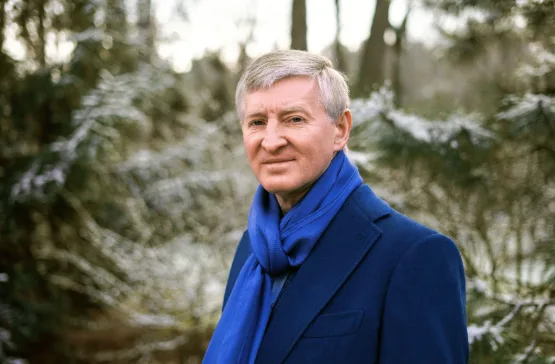
Assets in Donbas and Mariupol are lost, and more than 1,400 company employees have been killed. Yet the SCM Group – managing dozens of enterprises across metallurgy, energy, banking, telecommunications and agriculture – continues to operate. Within the group’s perimeter: Metinvest (metallurgy and mining), DTEK (energy, including renewables and oil and gas), FUIB (banking and financial services), Ukrtelecom (telecommunications), UMGI (mineral extraction and venture investments), ESTA Holding (real estate), Lemtrans (transport and logistics), HarvEast (agriculture), and TSUM Kyiv (retail). According to Forbes, Rinat Akhmetov net worth is estimated at $7.8 billion (real-time estimate for 2026).
Since the start of the full-scale invasion, Rinat Akhmetov company enterprises have invested $4.3 billion, including about $1 billion in restoring destroyed infrastructure. An additional $392 million has been directed toward defense and humanitarian programs.
From the Defense of Mariupol to a Project Supporting Defenders
The Azovstal plant, part of Metinvest Group, became Mariupol’s last line of defense in spring 2022 – the garrison held the territory against 73,000 Russian troops. Akhmetov stayed in contact with defense commander Denys Prokopenko, calling him several times a day. The last conversation took place fifteen minutes before the defenders’ withdrawal: “I asked: ‘Denys, what can I do for you?’ He answered: ‘Don’t worry about me, take care of my men” That promise gave rise to the “Heart of Azovstal” project – support for the defenders and their families.
Running in parallel is Steel Front – an initiative by Akhmetov Rinat through which the group’s enterprises supply the Ukrainian military. It is a coordination of military assistance from SCM’s businesses. Civilian aid goes through the Rinat Akhmetov Foundation – two independent tracks. Steel Front deliveries include more than: 166,000 body armor vests and helmets (some made from Metinvest specialty steel), 9,600 drones, 6,300 units of specialized equipment, 27,000 units of tactical clothing, 8,000 radios, 47,000 first aid kits and tourniquets, 163,000 fortification elements, and 1.7 million liters of fuel for the Armed Forces of Ukraine and emergency services.
€2.4 Billion Invested in Energy During the War
DTEK, part of Rinat Akhmetov business, topped the Forbes Ukraine ranking as the country’s largest private investor for 2024-2025. Capital investments reached 57.5 billion hryvnias – an 80% increase over the previous period. Since the start of the full-scale war, DTEK has invested €2.4 billion in Ukrainian energy: the second phase of the Tylihulska wind farm, industrial energy storage systems and grid restoration after Russian strikes. The company operates in coal mining, power generation and distribution, and the renewable energy sector.
The SCM Group’s tax contributions for 2025 totaled $2.2 billion, and approximately $8 billion since February 2022.
Shakhtar: Thirty Years From Debt to a European Semifinal
Rinat Akhmetov has led FC Shakhtar Donetsk since October 1996. At the time, the club had no stadium or training ground, and players earned $200-300. “I became president in October 1996 and declared our goal was to win the championship. Everyone called me insane. Dynamo, with [Andrii] Shevchenko and [Serhii] Rebrov, were on top and it was difficult to compete,” Akhmetov recalls. Since then, the club has won the UEFA Cup (2009), become a regular in the Champions League and reached the Conference League semifinals in the 2025/26 season.
Since 2014, Shakhtar has played outside Donetsk. Akhmetov did not attend a single match for twelve years, returning to the stands only in April 2026 for the quarterfinal against AZ Alkmaar, after attending a farewell ceremony for Mircea Lucescu. “When I came into the stand during the warm-up, the guys applauded and it moved me to tears. I could have returned previously but was able to push the emotions down.”
According to available information, Donbas Arena in occupied territory is in poor condition. Akhmetov describes the situation in the region bluntly: production has stopped, people are out of work, water supply disruptions persist – “so some people wait a week to shower or wash.”
Ending the War
Rinat Akhmetov outlines three possible scenarios. A just peace – return to the 1991 borders and reparations. A lasting peace – Ukraine as a free, democratic European country. And a fake peace that, in his assessment, Russia is attempting to impose.
“People tell me Putin has no reason to end this war. I think the opposite: he has no reason to continue it.” Russia, according to Akhmetov, spends zero on technology, its economy accounts for roughly 2% of global GDP, and its military machine is under mounting pressure.
He defines his role in postwar reconstruction through investment – metallurgy, energy, the financial sector, football. “Ukraine will endure, become an EU member, and its citizens will live in a free, European and prosperous democratic country.”