How Schools Decide Snow Days: Policies, Weather Data, and Safety Factors
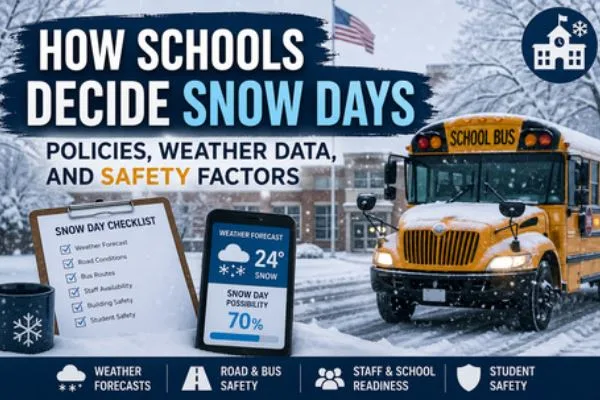
Why Snow Day Decisions Are More Complex Than You Think
At first glance, a snow day might seem simple. If enough snow falls, schools close. In reality, the decision is far more complex and involves safety, logistics, weather science, and policy requirements. School districts are responsible for thousands of students, and even a small misjudgment can put people at risk.
There is no universal rule that determines a closure. Schools do not follow a fixed number of inches. Instead, they evaluate a combination of conditions, including how fast snow is falling, whether ice is forming, and if roads are safe for buses. These decisions are often made in a short window early in the morning, but the process begins days in advance.
How Schools Actually Decide a Snow Day
The process starts well before a storm arrives. School administrators monitor forecasts several days ahead, paying close attention to how a storm might develop. They review updates from national weather services and, in some cases, private meteorologists who provide more detailed local insights. At this stage, nothing is decided, but awareness and preparation begin.
As the storm becomes more certain, school teams shift into active planning. Transportation departments review bus routes, especially those in rural or hard-to-reach areas. Facilities teams check heating systems and building readiness. In some districts, staff may already begin preparing for the possibility of delays or closures.
The most critical part of the decision happens early in the morning, typically between 4:30 and 6:00 AM. During this time, updated forecasts are reviewed alongside real-world conditions. Some officials physically check roads to see how bad conditions actually are. They also communicate with local authorities and road crews to understand whether streets have been cleared or treated.
The final decision is usually made by the superintendent. This person carries the responsibility of balancing safety with the need to keep schools open. It is not just about the weather. It is about whether the entire system can operate safely and effectively for the day.
The Weather Factors That Matter Most
Many people assume snow depth is the main factor, but that is only part of the picture. What matters more is how the storm behaves and how it affects travel conditions.
Heavy snowfall over a short period can quickly overwhelm road crews, making streets unsafe even if the total accumulation is not extreme. Ice and freezing rain are often more dangerous than snow because they create slick surfaces that are difficult to treat. Even a thin layer of ice can make roads hazardous for buses and walking students.
Temperature also plays a role. Extremely low wind chills can make it unsafe for children waiting outside, especially in areas where bus stops are exposed. In addition, visibility becomes a serious concern during strong winds or blowing snow, which can create near whiteout conditions.
Timing is another critical factor. Snow that ends before morning may allow schools to open, while snow that continues into the morning commute increases the likelihood of a closure. The same storm can lead to different decisions depending on when it hits.
Why Transportation Is Often the Deciding Factor
Transportation is at the center of most snow day decisions. Schools rely heavily on buses, and those buses must travel across a wide range of road types. Main roads may be cleared quickly, but side streets and rural routes often take longer.
In many districts, officials consider the most difficult routes first. If even a small portion of students cannot be transported safely, it may justify closing the entire district. Walking conditions are also important. Slippery sidewalks and untreated paths can create risks even if roads appear manageable.
Because of this, a storm that looks minor from a general perspective can still lead to a closure if local travel conditions are poor.
Policies and Requirements Schools Must Follow
School closures are not just about safety. They are also shaped by legal and academic requirements. Most regions require schools to meet a minimum number of instructional hours or days each year. This limits how often districts can cancel classes.
To manage this, schools often build extra days into their calendars. If too many closures occur, they may extend the school year or adjust schedules. In recent years, some districts have introduced virtual learning as an alternative, although this approach varies widely depending on location and policy.
These constraints can influence decisions, especially later in the winter when schools may already have used several snow days.
When Schools Announce Snow Days
Most districts aim to make their decision early enough for families to plan. In many cases, announcements are made between 5:30 and 6:00 AM. This timing allows parents to arrange childcare and adjust work schedules before the day begins.
Schools communicate closures through multiple channels, including text alerts, emails, official websites, and local media. The goal is to reach as many families as possible at the same time.
Can You Predict a Snow Day?
While no prediction is guaranteed, there are patterns that can help you estimate the likelihood of a snow day. Storms that are active during the early morning hours tend to increase the chances of closure. Ice in the forecast is another strong indicator, as it creates immediate safety concerns. Extremely low temperatures and poor visibility also raise the risk.
Many families now use tools like a snow day calculator to get a clearer idea of what might happen. These tools analyze forecast data and past trends to estimate the probability of a closure. They are not perfect, but they can be useful for planning ahead, especially when weather conditions are uncertain.
What Parents Should Keep in Mind
Weather conditions can vary across different parts of a district. Even if schools remain open, some areas may be more dangerous than others. Parents should always consider their local conditions and make decisions based on safety.
If travel feels risky, many schools allow excused absences during severe weather. Communicating with the school is usually enough to ensure the absence is handled properly.
The Future of Snow Days
Snow days are changing as technology and policies evolve. Virtual learning has made it possible for some schools to continue instruction even during severe weather, although not all districts have adopted this approach fully.
At the same time, advances in weather forecasting are improving decision-making. Schools now have access to more accurate and timely data than ever before, which helps them make better-informed choices.
Despite these changes, traditional snow days still hold value. For many students and families, they remain an important break from routine and a memorable part of winter.
Final Thoughts
Snow day decisions are the result of careful judgment rather than simple rules. What may seem like an easy call is actually based on multiple layers of evaluation, including weather conditions, transportation safety, school operations, and policy requirements.
Understanding this process helps explain why decisions can sometimes feel unpredictable. In reality, they are shaped by a complex balance of factors, all focused on one goal: keeping students and staff safe while maintaining the continuity of education.