How Serious Instagram Growth Services Operate
A larger Instagram following can suggest momentum, but it is not a business outcome in itself. For a UK operator, the more useful question is whether new attention comes from people likely to enquire, buy, collaborate, recommend the business or otherwise matter to its commercial goals.
That distinction separates managed growth support from a simple follower package. A credible programme is a transparent operating system: discovery, audience targeting, content support, community activity, measurement, security controls and regular review. It should be judged by relevance and commercial progress, not volume alone.
What a serious service includes
A provider should start with discovery rather than delivery. That means understanding the offer, target customer, location, existing content, conversion route and practical constraints. A Leeds accountancy practice, a Bristol restaurant and a UK-based creator may all seek growth, but they need different audiences and different next actions.
A workable programme normally covers:
- Audience definition: agreed locations, sectors, roles, interests, communities and exclusions.
- Profile and content review: a clear bio, pinned posts, highlights and calls to action that help a relevant visitor understand what to do next.
- A testable plan: content themes, community activity, collaborations, paid distribution or creator activity where appropriate.
- Community workflows: standards for replies, moderation, relationship-building and escalation of sensitive questions.
- Measurement: a baseline, regular reporting and decisions about what should change.
- Account safeguards: clear access, tool and data-handling arrangements.
This is an operating model, not a guarantee. It gives the client a way to understand what is being done and assess whether it is helping.
Managed audience development versus follower packages
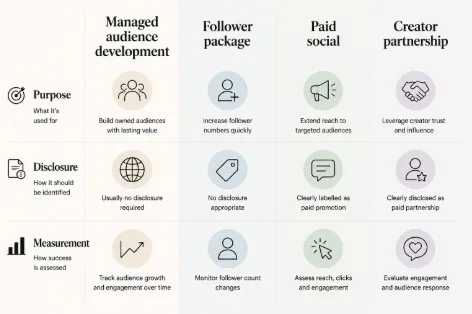
Different growth approaches require different disclosures and measures; follower count alone is not a complete assessment.
The term “social media growth” can conceal very different services. Ask for a plain-English description of the delivery method before committing.
| Approach | Primary purpose | What should be disclosed | Useful measures |
|—|—|—|—|
| Managed audience development | Build attention among defined prospective audiences | Targeting criteria, activities, access, tools, reporting and review | Audience fit, profile actions, enquiries, retention |
| Follower package | Raise a follower total | Source and nature of accounts, delivery method, pacing and terms | Count is not enough on its own |
| Paid social | Buy distribution through advertising | Budget, targeting, creative, account ownership and attribution | Reach, clicks, leads or sales where measurable |
| Creator partnerships | Reach a creator’s audience | Audience fit, deliverables, disclosure, usage rights and measurement | Traffic, enquiries, conversions and quality of attention |
A provider offering managed support should explain how it identifies a plausible audience fit and how it distinguishes organic activity from paid, creator-led, manually managed or tool-assisted work. A UK-focused guide to Instagram followers can provide additional context, but it cannot replace provider-specific due diligence.
Follower numbers remain a useful directional measure. They become misleading when they are presented as the only result, especially if new followers are outside the relevant market or never take meaningful action.
A transparent operating model
A credible programme should make its activity, responsibilities and review points visible.
Audit the starting point. Establish a baseline for content themes, profile visits, link activity where available, audience signals, engagement patterns and conversion paths. A change in format, seasonal demand or an account’s history can affect results, so context belongs in the report.
Define the audience. “UK followers” is rarely a sufficiently useful brief. Agree criteria such as geography, profession, sector, niche, likely need and purchasing context. These are working hypotheses, not a promise that every follower will be an ideal customer.
Plan tests. The plan might include clearer content pillars, profile improvements, response processes, collaboration outreach or paid promotion. It should state what the provider will do, what the client must provide, who approves content and who owns any advertising account or creative asset.
Run credible activity. Community work can include considered responses, moderation and participation in relevant conversations. It should not rely on repetitive messages, indiscriminate comments or behaviour that misrepresents a person or business.
Review and adapt. Agree review points and decision criteria in advance. If audience quality is weak, examine targeting assumptions, content, response handling and offer clarity rather than masking the issue with a higher volume target.
How to assess audience relevance
“Relevant” should be made measurable enough to discuss, while recognising that no Instagram metric is complete. At the outset, create a simple scorecard with agreed criteria:
- Geography: does the visible audience pattern broadly reflect the trading area or intended market?
- Sector or role: for B2B accounts, are followers and engagers plausibly connected to the professions or industries being pursued?
- Engagement quality: do comments and messages show real questions, useful context or signs of interest, rather than generic responses alone?
- Profile actions: are suitable visitors viewing the profile, following links, calling, emailing or starting conversations?
- Commercial relevance: are enquiries, bookings, purchases, partnership discussions or other agreed outcomes improving where they can be tracked?
- Retention: are new followers remaining over time, and does the pattern require explanation?
Compare these signals against the original criteria at each review. Geography can be only a proxy for relevance; engagement can vary by format and season; and attribution is difficult when a customer sees several touchpoints before acting. The point is not to claim false precision, but to make the provider’s reasoning visible.
Content, community and the offer
Growth support cannot indefinitely compensate for an unclear offer or unhelpful content. Reels, carousels, founder posts and collaborations are options, not automatic solutions.
A practical test is what happens when a suitable person arrives. Can they quickly understand the proposition and take an appropriate next step: visit a product page, book a consultation, join a mailing list or send an enquiry?
Community management also needs boundaries. A provider may draft reply standards, identify recurring questions and manage routine interactions. The client should retain responsibility for technical advice, regulated claims, complaints, pricing decisions and relationship-sensitive conversations unless the agreement explicitly provides otherwise.
Tools, automation and account safety
Automation is not one category. Scheduling, analytics and workflow tools differ from systems designed to manufacture accounts, likes, comments or follows. Buyers should ask which tools are used, what permissions they have and what actions they perform.
Meta has previously documented legal action against services that artificially inflated Instagram likes and followers through bots and automation in its announcement on action against fake engagement and ad scams. That documented enforcement should not be read as evidence that every follower-selling service uses bots, nor as proof of an automatic ranking consequence for every account. It is, however, a sound reason to reject unexplained delivery methods.
Password-free onboarding, least-privilege access and written data-handling practices are sensible operational safeguards, not universal legal or platform requirements. Ask whether access is necessary; if it is, agree the minimum access needed, who holds it, how it is removed and what happens to data at the end of the engagement.
Reporting that supports decisions
A useful report distinguishes activity completed from outcomes observed. Depending on the objective, it may cover follower movement, apparent audience fit, profile visits, meaningful engagement, direct-message themes, link activity, enquiries, sales or partnership conversations, and retention.
It should also disclose the mix of work behind those figures: organic content, paid amplification, creator activity, manual community management and any permitted tool-assisted workflow. Without that context, a client cannot make a sensible decision about cause, cost or next steps.
Follower count, engagement rate, geography and retention are imperfect indicators affected by content format, seasonality and account history. A credible report explains these limitations rather than treating a dashboard as proof of commercial value.
Paid social, creators and UK compliance
Paid social purchases distribution and requires a budget, suitable creative and a measurement plan. Creator partnerships bring another person’s audience and credibility, but require selection, briefing, contracts and disclosure. A growth provider may coordinate these channels, but the agreement should identify who approves creative, contracts creators, owns ad accounts and reports results.
For influencer advertising, the CAP Code requires marketing communications on social media to be obviously identifiable as advertising. The ASA/CAP’s current guidance on recognising ads in social media and influencer marketing is a practical starting point, including for posts, Stories and Reels. Brands, agencies and creators should consider their respective responsibilities for clear disclosure. This guidance is not definitive legal advice, so fact-specific questions warrant professional advice.
That issue is separate from platform policy and the narrower legal question around follower purchases. Readers can also consult this guide to the legal and policy questions around buying Instagram followers in the UK.
Red flags and buyer questions
Ask about methods, access, responsibilities, reporting, ownership and exit terms before committing.
Be cautious about guaranteed virality, sales or engagement; unexplained instant volume; vague targeting; password requests; unverifiable testimonials; missing reporting; pressure to pay upfront; or unclear cancellation and refund terms.
Before signing, ask:
- What audience criteria and exclusions will guide the work?
- Which activity is organic, paid, creator-led, manually managed or tool-assisted?
- Which tools are used, and what account access is needed?
- What responsibilities remain with our team, including approvals and customer replies?
- What will the report show beyond follower count?
- How will audience fit, retention and commercial outcomes be assessed?
- Who owns creative, ad accounts, data and tracking?
- What are the escalation, security, review, cancellation and exit terms?
Judge the programme against the business
Set decision criteria before activity starts and review them at agreed intervals. A local retailer may prioritise enquiries from its area; a consultant may value qualified calls; a creator may focus on relevant commercial partnerships. If results are weak, investigate audience assumptions, content clarity, response speed, offer quality and tracking before increasing spend.
Serious Instagram growth support is one part of a wider marketing system. The priority order is straightforward: relevant audience, credible activity, safe operations, transparent measurement and business value. A bigger number may follow, but it should not be the only thing being bought.
A credible growth service should connect diagnosis, delivery and learning in a documented operating cycle.
Different service models require different evidence and should not be judged by follower count alone.
A short due-diligence checklist can expose unclear methods, weak reporting and poor account-control arrangements.