How Shockwave Therapy Is Changing the Approach to Persistent Musculoskeletal Pain
Some pain makes sense. Push too hard in a training session, feel it the next day. Carry boxes up three flights of stairs, wake up with a stiff lower back. The body adapts, things settle, and life continues.
But persistent musculoskeletal pain operates differently. It’s the heel that’s been aching for six months despite daily stretching and a new pair of shoes. The elbow that flares with any repetitive gripping activity, no matter how much rest is given. The shoulder that hasn’t been the same since a minor incident that everyone expected to resolve on its own. This kind of ongoing, treatment-resistant pain particularly when it involves tendons can be genuinely wearing, both physically and psychologically.
Growing interest in non-invasive treatment approaches within physiotherapy reflects this reality. Among the options that have gained traction in recent years, shockwave therapy has become one of the more discussed used by physiotherapists for a specific subset of persistent musculoskeletal problems where conventional care hasn’t made enough progress. Understanding what it actually does, and where it fits within a sensible treatment plan, is worth taking seriously.
What Is Shockwave Therapy?
Despite a name that might conjure images of electrical treatment, shockwave therapy has nothing to do with electricity. The term refers to acoustic pressure waves mechanical energy delivered through the skin to targeted musculoskeletal tissue via a handheld applicator. No incisions are involved.
There are two main types used in physiotherapy practice. Radial shockwave therapy disperses energy across a broader surface area and is typically used for more superficial conditions. Focused shockwave therapy directs energy with greater precision to deeper tissue structures. Both are considered non-invasive, and both have different clinical applications depending on the condition and the depth of the target tissue.
Extracorporeal shockwave therapy, to use the formal name, was first developed for breaking up kidney stones, a very different application. Researchers and clinicians later observed that lower-energy acoustic waves could influence musculoskeletal tissue in ways that appeared clinically useful, and the technology was gradually adopted into physiotherapy and sports medicine practice, particularly for tendon-related conditions that hadn’t responded to other interventions.
Why Musculoskeletal Pain Can Be Persistent
Most musculoskeletal pain resolves with time, appropriate rest, and a gradual return to activity. When it doesn’t, the reasons can be varied and layered.
Tendinopathy, a broad term for tendon dysfunction, is one of the more common culprits behind persistent pain in active people. When a tendon is repeatedly loaded without adequate recovery, normal tissue architecture can be disrupted. Rather than the organised collagen fibres characteristic of healthy tendons, chronically stressed tendon tissue may become disorganised and degenerated in ways that don’t respond well to rest alone. Somewhat counterintuitively, complete offloading often isn’t the solution; the tissue still needs appropriate mechanical stimulus to trigger remodelling.
Other factors that contribute to persistent musculoskeletal pain include movement pattern problems, muscular imbalances that direct excessive stress toward a single structure, poor postural habits developed from years of desk work, and previous injuries that were never fully rehabilitated. There’s also a neurological dimension: in some cases, changes in how the nervous system processes pain signals can maintain or amplify pain beyond what the tissue itself would justify.
All of this underlines why proper clinical assessment matters. Persistent pain rarely has a simple, one-dimensional cause, and treatment that ignores contributing factors is unlikely to produce lasting change.
How Shockwave Therapy May Help
The mechanisms by which shockwave therapy influences tissue are still being refined in the research literature, but several have been identified and studied.
One is mechanical stimulation at the cellular level. Acoustic waves appear to trigger biological responses in treated tissue changes in cell activity associated with collagen synthesis and tissue remodelling. In degenerated tendons specifically, there is interest in whether this stimulus can help shift tissue from a dysfunctional state toward one with better structural organisation, essentially encouraging a repair process that hasn’t been happening on its own.
Shockwave therapy may also influence local vascularisation. Chronically degenerated tendons are often poorly supplied with blood, which can limit the body’s natural repair processes. Some research suggests that shockwave treatment may promote the formation of new blood vessels in treated areas, supporting the delivery of nutrients and cellular components involved in recovery though the clinical significance of this effect continues to be studied.
Pain modulation is another area of interest. There is evidence that shockwave therapy may influence local nerve function in ways that reduce pain signalling, which could partly explain why some patients experience meaningful pain reduction over a course of treatment. Whether this is a direct mechanism or partly a consequence of tissue improvement isn’t entirely clear.
None of this guarantees outcomes. Responses vary between individuals, and not every condition treated with shockwave therapy produces significant improvement. But for specific applications plantar fasciitis, calcific shoulder tendinopathy, certain chronic tendon problems the evidence base is substantive enough to support its use within clinical practice.
Conditions That May Benefit
Shockwave therapy tends to be considered most often for tendinopathy and soft-tissue conditions that have persisted despite conventional physiotherapy management.
Plantar fasciitis, particularly in cases present for three months or more, is one of the more commonly treated conditions. Calcific tendinopathy of the shoulder where calcium deposits form within the rotator cuff tendons is another application with meaningful evidence behind it. The acoustic energy may help break down or disperse the calcification, alongside stimulating the surrounding tissue.
Other conditions frequently considered include lateral elbow tendinopathy (commonly known as tennis elbow), patellar tendinopathy in athletes, gluteal tendinopathy, and Achilles tendinopathy. These aren’t the only applications, but they represent some of the clearest evidence.
Suitability is always individual. Someone with acute inflammation, a recent injury, circulatory conditions affecting the target area, or certain other clinical factors may not be an appropriate candidate. Any reputable physiotherapy provider will take a thorough history and complete an assessment before proceeding.
How Shockwave Therapy Fits Into Rehabilitation
The most important thing to understand about shockwave therapy is that it functions best as part of a broader rehabilitation plan not as a standalone intervention.
Managing persistent tendon pain or musculoskeletal dysfunction requires more than reducing symptoms during treatment sessions. It requires building the tissue’s capacity to handle the loads placed on it in daily life and sport, identifying and addressing the mechanical factors that contributed to the problem in the first place, and progressively restoring movement quality and function. Shockwave therapy can support those goals by reducing pain sufficiently that rehabilitation exercise becomes more tolerable, for example, or by stimulating tissue responses that make the tendon more receptive to progressive loading but it doesn’t replace the rehabilitation process itself.
A well-constructed plan will typically involve progressive loading exercises specific to the structure being treated, activity modification during recovery, and often education about load management and pacing. Movement retraining may be incorporated if assessment identifies mechanical contributors. The placement of shockwave within that plan varies: some practitioners use it early to manage pain; others introduce it when progress has plateaued.
This integrated approach reflects broader evolution in physiotherapy. The aim isn’t to find one modality that does everything. It’s to sequence and combine treatments that work together, based on individual assessment and clinical reasoning.
What a Session Typically Involves
For anyone unfamiliar with the treatment, some practical context is useful.
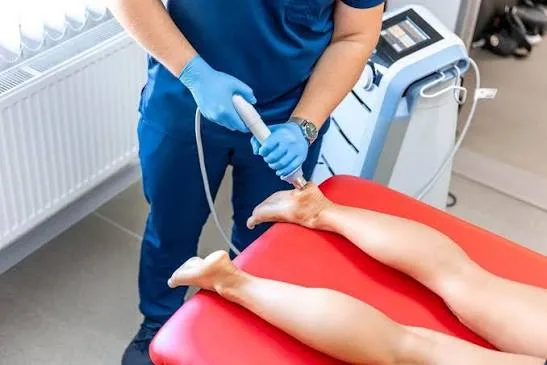
Sessions usually begin with a clinical review or assessment of the condition. The physiotherapist identifies the target area often using palpation and the patient’s own pain response to locate relevant tissue. Ultrasound gel is applied to the skin to help conduct the acoustic waves, and the applicator is placed on the area and moved methodically across the treatment zone.
The sensation is commonly described as a pulsing pressure or rhythmic deep tapping. In areas of significant tenderness, this can be quite uncomfortable, though intensity can typically be adjusted based on patient feedback. Sessions are generally brief. Mild soreness in the treatment area for a day or two afterward is common and is usually considered a normal response rather than a warning sign. Practitioners typically advise avoiding heavy loading of the treated area immediately after treatment and provide guidance on what to expect during recovery.
Multiple sessions are usually recommended, though the number varies considerably depending on the condition, its duration, and how the individual responds.
Benefits and Limitations, Honestly Considered
The genuine benefits of shockwave therapy when appropriately applied include its non-invasive delivery, the ability to target a specific anatomical area, and meaningful evidence supporting its use for particular tendon conditions. For patients who have been managing persistent symptoms for months without sufficient improvement, it offers a treatment pathway that doesn’t involve medication or surgical intervention.
The limitations deserve equal acknowledgment. Not everyone responds. Some conditions simply aren’t suitable. Treatment can be uncomfortable, particularly in sensitive areas, and multiple sessions are often necessary. Expectations need to be managed: shockwave therapy is not a quick resolution, and the work of rehabilitation still needs to happen alongside it.
Diagnosis matters significantly here. Applying shockwave therapy to a condition that hasn’t been properly assessed or to one that would respond better to a different approach is unlikely to produce good results. The treatment is a tool, and like any tool, its value depends on whether it’s the right one for the situation.
Who Might Consider Discussing It With a Physiotherapist
The clearest case for exploring shockwave therapy is persistent tendon or soft-tissue pain that hasn’t responded adequately to rest, exercise modification, and conventional physiotherapy over a meaningful period typically several months. Recurring tendon problems in people who return to sport repeatedly, or ongoing pain that limits daily activities and exercise, are both situations where it may be worth raising with a qualified physiotherapist.
For those investigating shockwave therapy Burlington, Ontario, providers vary considerably in how they deliver treatment. Some offer it within a structured physiotherapy program that includes assessment, rehabilitation planning, and follow-up; others may offer it in a more isolated context. Clinics like Medical Grade Physiotherapy & Wellness incorporate shockwave therapy within a full clinical framework, which typically means individualized assessment and a rehabilitation plan rather than standalone sessions. That distinction is worth considering when evaluating options.
Persistent or unexplained pain that hasn’t been properly assessed, symptoms accompanied by significant swelling or functional limitation, or any concern about a more serious underlying condition should be evaluated by a physiotherapist or physician before pursuing any specific treatment.
The Direction Musculoskeletal Care Is Moving
The wider context here is a shift in how persistent musculoskeletal conditions are approached, one that moves away from treating pain with a single modality toward combining different strategies within a coherent clinical framework.
Shockwave therapy is one example of that evolution. It sits alongside targeted exercise programming, manual therapy, load management strategies, and patient education as one of a range of tools that physiotherapists can draw on depending on what an individual needs. Its adoption reflects the profession’s continued interest in finding approaches that can help patients where conventional care has fallen short, without overstating what any single treatment can achieve.
The future of non-invasive musculoskeletal care likely lies less in any specific technology and more in how different approaches are combined and sequenced guided by proper assessment, adjusted based on patient response, and always oriented toward restoring function rather than simply reducing pain. Shockwave therapy fits within that picture, for the right conditions and the right patients.
Taking Stock
Persistent musculoskeletal pain tends to narrow what people can do, sometimes significantly. Activities get modified, then avoided. The expectation that things will eventually sort themselves out can persist for longer than it should.
Shockwave therapy won’t resolve every case of tendon pain, and it isn’t a replacement for comprehensive physiotherapy or medical care. But for the right conditions, delivered by qualified practitioners within a proper rehabilitation framework, it represents a legitimate option that has helped many patients make genuine progress where other approaches hadn’t.
If you’ve been managing persistent tendon or musculoskeletal pain without sufficient improvement, a conversation with a qualified physiotherapist about whether shockwave therapy might have a role in your care is a reasonable next step not as a final answer, but as one potential component of a thoughtful, individually considered plan.