How Simulation Technology Is Reshaping Healthcare Training
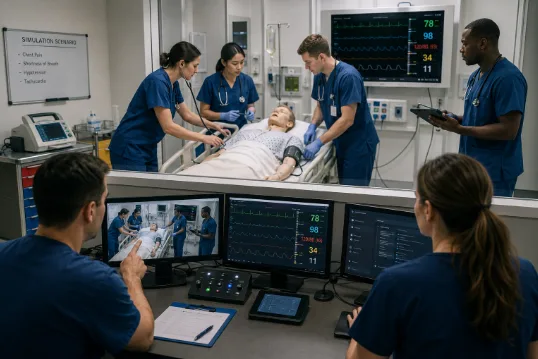
Medical education is changing quickly. Traditional lectures, textbooks, and bedside observation still matter, but healthcare professionals increasingly need more opportunities to practice before they work with real patients. Modern training now places greater emphasis on realistic scenarios, repeated practice, and measurable performance.
This shift is being supported by a new generation of simulation tools that allow learners to practice clinical decisions, diagnostic skills, procedures, and teamwork in controlled environments. A Female Patient Simulator can be used as part of scenario-based training where students respond to changing patient conditions, assess vital signs, communicate with a clinical team, and work through realistic care situations before applying those skills in practice.
Simulation is becoming important because healthcare is complex. A clinician may need to recognize a changing condition, communicate with a team, interpret diagnostic information, and perform a procedure within a short period of time. These skills are difficult to develop through theory alone.
Medical Training Is Becoming More Experiential
Healthcare education has always involved practical training, but the balance between theory and experience is shifting.
Students can learn how a procedure should be performed by reading about it. They can watch an instructor demonstrate the technique. They can also study case histories and discuss treatment decisions.
However, knowing what should happen and being able to respond correctly under pressure are different skills.
Scenario-based education gives learners the chance to participate actively. Instead of discussing what they would do, they must decide what to do next.
A training session may begin with a relatively stable patient. Vital signs can then change. New symptoms may appear. The learner must notice the change, determine what it means, communicate with others, and choose an appropriate response.
This type of practice introduces uncertainty into medical education.
That matters because real clinical situations rarely follow a perfectly predictable sequence. A patient may have several problems at once, and the most important sign may initially be subtle.
Repeated scenarios can help learners become more comfortable working through this uncertainty.
Simulation also allows instructors to control the learning experience. In a hospital, one student may encounter several emergency situations during a placement while another sees very few. A simulation center can give both students the opportunity to practice the same clinical problem.
This makes training more consistent.
High-Fidelity Simulation Brings Clinical Decisions Into Training
High-fidelity patient simulation has expanded what can be practiced outside the clinical environment.
Modern simulators can be used to represent changing patient conditions, giving learners an opportunity to respond to physiological information rather than simply performing an isolated procedure.
For example, a scenario may involve a patient whose condition gradually deteriorates. Learners may need to monitor vital signs, assess the patient, recognize warning signs, call for assistance, and begin treatment.
The instructor can adjust the scenario as it develops.
This creates an environment where learners must combine technical knowledge with decision-making.
One of the most useful features of this approach is that the same scenario can be repeated.
If a team misses an important sign during the first attempt, the instructor can review what happened and run a similar scenario again. The second attempt allows learners to apply the feedback immediately.
This cycle of practice, review, and repetition can be more useful than simply being told what went wrong.
Simulation can also support team training.
Many emergencies require several people to work together. One person may monitor the patient while another performs a procedure and someone else communicates with the wider clinical team.
In these situations, communication becomes part of the clinical skill.
A technically correct response can still become less effective when responsibilities are unclear or important information is not shared quickly.
Simulation makes these problems visible.
The Agency for Healthcare Research and Quality has highlighted simulation as a useful approach for patient safety because healthcare professionals can practice skills and identify weaknesses in a setting where real patients are not exposed to unnecessary risk.
Diagnostic Skills Can Be Practiced Before the Patient Encounter
Simulation is not limited to emergency response or patient care scenarios.
Diagnostic skills can also be developed through repeated practice.
Ultrasound is a good example.
Learning to use ultrasound requires more than understanding what an image should look like. The learner must position the probe correctly, understand orientation, identify anatomical structures, and interpret what appears on the screen.
These are practical skills that improve through repetition.
A simulation environment allows learners to practice the process many times without depending on the availability of particular patients.
The same principle applies to auscultation.
Recognizing different heart and lung sounds takes experience. Listening to a recording may help, but structured simulation can place those sounds within a broader clinical scenario.
The learner may need to combine auscultation findings with vital signs and other symptoms.
This encourages diagnostic reasoning rather than simple memorization.
Other diagnostic skills can benefit from similar methods.
Learners can practice identifying patterns, reviewing changing data, and making decisions based on incomplete information.
The main advantage is repetition.
In real clinical practice, some findings are common while others may appear only occasionally. Simulation allows educators to deliberately expose learners to both.
That can make rare but important conditions less unfamiliar when they are eventually encountered in practice.
Surgical Training Is Moving Into Digital Environments
Procedural training is another area where simulation technology is having a major impact.
Surgical skills depend heavily on coordination, accuracy, and familiarity with a sequence of actions.
Many of these skills cannot be developed effectively through observation alone.
A learner may understand the steps of a laparoscopic procedure but still need significant practice to develop control of instruments.
Virtual and digital simulation environments can provide that practice.
Laparoscopic simulation, for example, can help trainees work on hand-eye coordination, instrument movement, depth perception, and procedural sequence.
The learner can repeat the same task several times and gradually improve.
Similar approaches can be used in areas such as hysteroscopy and interventional procedures.
The value of simulation is especially clear when a procedure is technically demanding.
A trainee can become familiar with the equipment and sequence before performing the procedure in a clinical environment.
Digital training also creates opportunities for performance measurement.
Some systems can record how long a task takes, how accurately it is performed, or whether unnecessary movements occur.
This gives instructors more information than simply observing whether the final task was completed.
It can also help learners see their own progress.
A procedure that required many corrections during the first session may become smoother after repeated practice.
This kind of measurable improvement can make training more structured.
Digital Anatomy Is Changing How Learners Understand the Body
Anatomy remains one of the foundations of healthcare education.
Traditional methods such as textbooks, models, and cadaver-based teaching continue to play an important role.
Digital anatomy tools can add another layer.
Three-dimensional anatomical models allow learners to view structures from different angles, isolate specific systems, and explore spatial relationships.
This can be particularly useful for understanding areas that are difficult to visualize in two dimensions.
Digital anatomy can also connect more naturally with procedural training.
A learner studying a particular region can review the anatomy before moving into a simulated procedure involving the same structures.
That creates continuity between theoretical knowledge and practical application.
It also supports repetition.
Students can return to difficult anatomical relationships as often as needed.
This is useful because anatomy learning is not simply about memorizing names. Healthcare professionals need to understand where structures are located and how they relate to one another.
Interactive visualization can help build this spatial understanding.
Structured Emergency Scenarios Improve Readiness
One of the strongest uses of simulation is preparing healthcare professionals for events that are serious but relatively uncommon.
A clinician may work for a long time without encountering a particular emergency.
That creates a training challenge.
The situation may require a fast and coordinated response, yet opportunities to practice it in real life are limited.
Structured emergency scenarios can address this problem.
Educators can create a scenario around a specific clinical event and allow the team to work through it from beginning to end.
The scenario may include changing vital signs, diagnostic information, alarms, medication decisions, and communication with other team members.
This allows participants to practice both individual skills and team behavior.
Important elements of emergency simulation can include:
- recognizing early signs of deterioration
- assigning responsibilities within the team
- communicating important changes clearly
- following a structured response sequence
- reassessing the patient after each intervention
- recognizing when additional help is needed
- reviewing the response during debriefing
The debriefing stage is particularly important.
Participants can discuss what happened, what worked, and what could have been handled differently.
The aim is not to embarrass someone who made a mistake.
The aim is to understand why the mistake happened.
Was the information missed? Was communication unclear? Did the team focus on the wrong problem? Was someone unsure of the next step?
These questions make simulation useful for improving systems as well as individual skills.
What This Means for Medical Schools and Hospitals
The wider adoption of simulation technology can change how institutions organize training.
One important benefit is standardization.
Medical schools can create specific scenarios that every student must complete.
Hospitals can use structured training for new staff or for teams working in high-risk areas.
This can help ensure that learners receive exposure to important situations even when those situations do not occur naturally during a training period.
Another benefit is repeatability.
Clinical opportunities cannot always be repeated on demand.
A simulation can.
Learners can return to the same skill until they become more comfortable with it.
Institutions can also use simulation to identify broader training needs.
If several teams struggle with the same part of a scenario, the problem may not be individual performance. It may indicate that a protocol is unclear or that additional training is needed.
Simulation can therefore become part of quality improvement.
Hospitals can test how teams respond to certain situations, identify communication problems, and update training accordingly.
Medical schools can use simulation to connect classroom learning with practical experience.
This does not mean that simulation should replace clinical placements.
Real patient care includes human interaction, uncertainty, emotion, and complexity that no simulator can fully reproduce.
The strongest model combines different forms of learning.
Students can first learn the theory, then practice in simulation, receive feedback, and finally apply their skills in real clinical environments under appropriate supervision.
Conclusion
Simulation technology is becoming a larger part of healthcare education because it gives learners something traditional teaching methods cannot always provide: repeated practical experience in a controlled environment.
High-fidelity patient simulators can support clinical decision-making and emergency training. Ultrasound and auscultation simulation can help develop diagnostic skills. Surgical simulators can provide repeated procedural practice, while digital anatomy tools can improve understanding of complex structures.
The common idea behind all of these technologies is preparation.
Healthcare professionals can encounter difficult situations before those situations involve a real patient. They can make mistakes, receive feedback, repeat the task, and gradually build more reliable skills.
For medical schools and hospitals, this also creates opportunities to standardize training and expose learners to scenarios they might otherwise rarely encounter.
Simulation cannot reproduce every aspect of clinical care, and it should not replace experience with real patients. Its role is to make that experience safer and more productive by helping healthcare professionals arrive better prepared.
As simulation technology continues to develop, its most important contribution may be simple: giving learners more opportunities to practice important decisions before those decisions carry real consequences.