How SPL Bass Competitions Work: A Beginner’s Guide to Classes, Scoring and Your First Meet
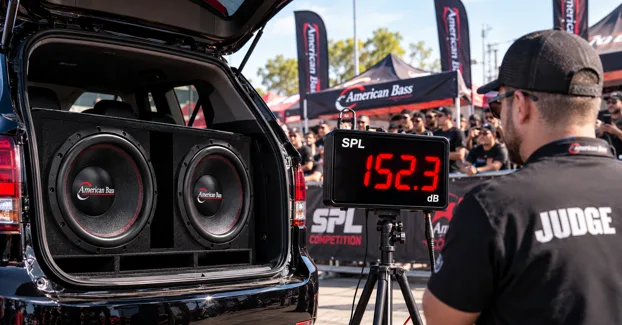
An SPL competition measures one thing: how loud your car gets. SPL stands for Sound Pressure Level. Here, a meter reads the peak your system hits inside the car. The loudest result in each class wins. It sounds simple, but the classes, limits, and scoring take a little learning.
This guide walks you through how it all works, so you can show up to your first meet all ready.
What Is an SPL Competition?
An SPL competition is a contest to produce the highest sound pressure level in your car.
- A judge places a meter inside
- You play a tone or track
- The meter records your number
Most events give you 30 seconds to hit your best result.
The measurement usually caps the frequency low, often around 60 Hz, since that is where the hardest bass lives. All your doors and windows stay closed, except sometimes the driver’s door.
The car with the highest number in each class takes the win. Getting there takes the right competition subwoofers, the right power, as well as a box built to move air.
The Main Types of SPL Classes
SPL competitions are split into formats, and each tests something different. Knowing them helps you pick where you fit.
- SPL Sport
Pure max output. You chase the single loudest number, often with a power limit on your amp.
- SPL Show
An averaged result over 30 seconds, scored with points for a clean, complete install.
- SPL Game
A control format. You aim to get as close to a set limit as possible without going over.
Sport rewards raw power. Show rewards power plus a tidy build. Game rewards control over your system. This car audio competition series runs all three, so there is a class for every kind of competitor.
How SPL Competition Classes Work
Within each format, classes are set by your gear and where it sits in the car. This keeps the contest fair.
Most SPL competition classes are capped by one or more of these:
- Subwoofer count and size. A class might allow one 18″, two 15s, three 12s, or four 10s.
- Amplifier power. Some classes cap the watts sent to your subs, often measured at the terminals.
- Equipment location. Trunk classes keep gear behind the seats. Cabin classes allow it further forward.
- Many classes limit your electrical system, commonly to 15.5 or 18 volts.
Entry classes keep power modest and the build simple. Higher classes open up more subs, more power, and wall-style builds. You compete against cars built to the same rules.
How Scoring Works
Scoring depends on the format. Some classes read one number; others add points for the build.
In a pure max class, the meter is the whole score. Your loudest clean result stands, and the highest number wins. A single SPL subwoofer like the VFL Comp Signature 12 subwoofer can take a class on strong power, if the box is right.
Show classes add install points on top of the meter. Judges score things like:
- The interior, trunk, and engine bay all count.
- Fuse placement. A fuse near the battery and a distributor inside earn points.
- Install completeness. A finished box, tidy wiring, and no loose ends score higher.
Those points add to your measured result. So a slightly quieter car with a cleaner build can beat a louder, messier one. This is why a competition subwoofer build rewards patience as much as power.
How to Pick Your First Class
Start below your ceiling. The smart move is to enter a class your system clears with room to spare.
Game formats make this clear. If a class caps at 139.99 dB, your system should push 143 to 145 dB freely. That margin lets you add volume at the right moment and hold your number. Going over the cap lights the red screen and knocks you out of the running.
Check your likely number before you enter. Our SPL estimator gives you a ballpark from your gear, so you pick a class you can actually win.
The Gear That Wins
Three things decide your result:
- Your subs
- Your power
- Your box
Subwoofers move serious air. Pair a high-performance driver with an amp that delivers clean, properly matched power. Keep it within its design limits, and it will reward you with peak performance.
Then comes the box, which matters as much as the sub. The wrong enclosure volume or tuning throws away the output you paid for. Run your build through our subwoofer box calculator before you cut a single panel. A box tuned to your class is how you turn watts into decibels.
What to Expect at Your First Meet
Your first event is less intimidating than it looks. Most competitors are happy to help a newcomer.
Here is how a typical run goes:
- Check in. You register and pick your class.
- Line up. You wait your turn for the lanes.
- The run. A judge sets the meter, you play, and the number records.
- The result. Your score posts, and places are set once everyone runs.
Bring your car clean and your install finished, even in a max class. It costs nothing and it never hurts your score. Watch a few runs before yours to see the rhythm.
Build It, Tune It, Then Compete
SPL competition rewards preparation more than anything else. Pick a class you can clear, build around subs that handle power, and tune your box to your target. This way, your first meet becomes a result you are proud of.
Chasing the title of loudest car subwoofer in your class starts with the right build. Formats like DB drag racing have crowned champions for years, and every one of them started at a first meet. An accurate SPL meter car audio reading on the day is the payoff for the work you put in first.
American Bass builds competition subwoofers and the tools to tune them from Twinsburg, Ohio. Our free calculators pair your sub, box, and power in minutes. Explore our products today!
FAQs
What do I need to enter my first SPL competition?
You need a working sub setup, a legal install for your class, and a clean car. Pick a class your system clears with room to spare. Most first-timers start in an entry or game format.
How loud is an SPL competition car?
Entry builds often read in the 130s, while top classes push past 150 dB. The exact number depends on your subs, power, and box. Even a modest build is far louder than a street system.
Do I need the most expensive subwoofers to compete?
No, since classes group cars by similar gear and power. A well-built budget setup can win its class against pricier, messier builds. A subwoofer competition rewards tuning and a clean install as much as spend.
Can I compete with my daily driver?
Yes, many people compete in the same car they drive every day. Entry and game classes are built exactly for this. You just need a legal install and a system tuned to your class.