How to Automate Pest Control Customer Follow-Ups with AI
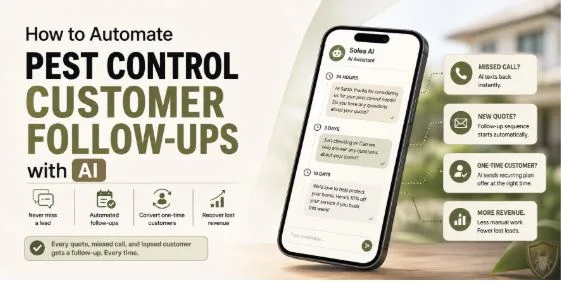
TL;DR: How to automate pest control customer follow-ups with AI comes down to one shift: every quote, missed call, and lapsed customer gets a scheduled text or email sequence automatically, instead of depending on whoever in the office has a free hour. Companies lose the majority of winnable leads to silence, not price or service quality, and AI closes that gap by running the sequence every time.
Pest control companies lose leads because nobody follows up, not because the quote was too high. A Harvard Business Review study of 2,241 companies found that firms contacting a prospect within one hour were nearly seven times more likely to qualify that lead than firms that waited longer, and close to half of sales reps never follow up with a lead at all after the first conversation (HBR; Invesp compilation, 2025). Research on lead management across service businesses found 80% of new leads never convert to paying customers, with late follow-up as the primary cause rather than lead quality (LeadResponse, 2026).
What does the pest control customer follow up process look like without automation?
Without automation, follow-up depends on a person remembering to do it during a slow moment that rarely comes. A technician finishes a job, the office sends a quote or invoice, and the next step, a callback, a text, a reminder, sits on a mental list next to the ringing phone and the walk-in customer at the counter.
The failure is not laziness. It is volume. An office handling calls, scheduling, billing, and technician questions has no reliable slot for the fifth follow-up on a termite quote from two weeks ago. The lead does not get worked less; it gets forgotten.
How to convert one-time pest control customers into recurring plans with AI
AI converts one-time customers by triggering a recurring-plan offer automatically at the exact moment a job closes, rather than relying on a technician to remember to pitch it. The system sends the offer by text within an hour of job completion, referencing the specific pest issue the technician treated, then follows with a second message a week later if the first goes unanswered.
This works because the pitch happens while the problem is still fresh. A customer who just watched a technician clear a wasp nest is far more receptive to a quarterly plan than the same customer contacted cold a month later. AI-driven personalization in this category is associated with a 25% lift in customer retention among the pest control SMBs using it (HelloMateAI, 2026).
What should pest control lead management software actually do in 2026?
Pest control lead management software should track every inbound channel, phone, text, form, and chat, in one place and trigger the next follow-up step without a human deciding to start it. Most companies already have a CRM. Few have one that acts before a human tells it to.
The distinction that matters in 2026 is action versus storage. A CRM that logs a missed call is storage. A system that recognizes the missed call, texts the caller within a minute, and books the appointment if they reply is lead management. Solea’s CRM is built around the second definition, running the follow-up sequence itself instead of logging that one is overdue.
This is also where the money sits. Pull your quote list from the last 90 days and count anything marked “pending” past two weeks. Most pest control offices find dozens sitting untouched, and at even a modest average job value, that list usually represents thousands of dollars that never required a new lead, only a message that was never sent.
How to automate pest control follow-ups first: where do you start?
Start with quotes over 48 hours old, since that list is pure recovered revenue with no acquisition cost attached. Set an automatic text at 24 hours, a second at 3 days, and a final offer-based message at 10 days, then move to missed-call text-back, and only then to full recurring-plan automation once the first two sequences run cleanly.
The order matters more than the tool. A company that automates recurring-plan pitches while still losing quotes to silence is optimizing the wrong end of the funnel.