How to Build a Hazard Communication Program That Passes an OSHA Inspection
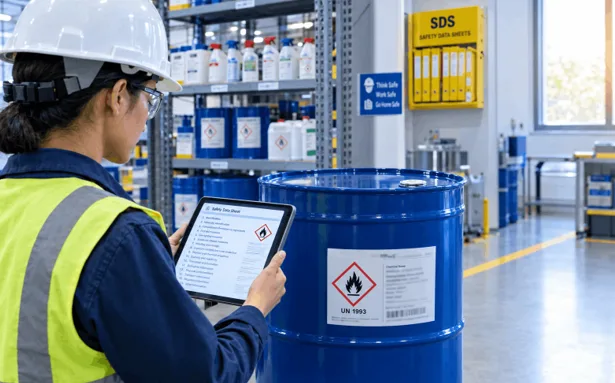
Chemical hazards rarely make headlines until something goes wrong, but they fill OSHA’s citation logs every year. Hazard Communication (29 CFR 1910.1200) was the second most frequently cited standard on OSHA’s list for fiscal year 2025.
For employers, the next deadline under the 2024 update to the rule is November 20, 2026.
A hazard communication program is the written plan that paragraph (e) of the standard requires at each workplace. It covers a list of the hazardous chemicals on site, cross-referenced to their safety data sheets (SDSs), along with labeling, SDS access, employee training, and the methods used for non-routine tasks and outside contractors.
This guide covers what the written program has to contain, how to build one in six steps, what an inspector tends to ask for, and how to run the program across more than one site.
What OSHA Requires in a Written Hazard Communication Program
Paragraph (e) of 29 CFR 1910.1200 sets the contents, and most failed programs miss one of them rather than all of them.
- A list of the hazardous chemicals known to be present, using a product identifier that is referenced on the appropriate SDS. The list can cover the whole workplace or individual work areas.
- A description of how the site meets the requirements for labels and other forms of warning, SDSs, and employee information and training.
- The methods used to tell employees about the hazards of non-routine tasks, such as cleaning reactor vessels, and of chemicals in unlabeled pipes in their work areas.
- For multi-employer sites, how other employers, such as contractors, get access to SDSs and learn about precautionary measures and the labeling system.
- Availability on request to employees, their designated representatives, OSHA, and NIOSH.
The product identifier does more work than most people expect. The standard defines it as the name or number that lets readers make “cross-references to be made among the list of hazardous chemicals required in the written hazard communication program, the label and the SDS”.
If the inventory says “Degreaser 40,” the drum says “DG-40 Solvent,” and the SDS says something else again, the three documents no longer prove they describe the same product. That mismatch is one of the quickest things for anyone reviewing the program to spot.
That’s why large enterprises use SDS authoring software to make sure all their SDS are compliant.
How to Build a Hazard Communication Program in Six Steps
OSHA’s 2014 fact sheet for employers, OSHA 3696, lays out a sequence that still holds up. Adapted for the current rule, it looks like this:
- Name a program coordinator for each site, and give that person the authority to stop a chemical from entering use until its SDS is on file.
- Walk every area and build the chemical inventory by product identifier, including what sits in maintenance closets and contractor trailers.
- Collect a current SDS for every item on the list, and set up electronic access with a backup for power or network failures.
- Check that shipped containers carry their original labels and that every secondary container has a workplace label.
- Train employees at initial assignment and whenever a new chemical hazard enters their work area, then add site-specific content on where the program, list, and SDSs are kept.
- Review the program on a set schedule and after any new chemical, process change, or incident.
Step 6 is the one employers most often let slide. OSHA 3696 notes that the standard doesn’t require a formal evaluation, but it recommends reviewing the program periodically so it keeps up with changes in the workplace. A program dated three years ago with an inventory from two reorganizations back will read as abandoned, however good the original version was.
What OSHA Inspectors Ask to See During a HazCom Inspection
OSHA compliance officers work from an inspection directive for the Hazard Communication Standard, CPL 02-02-079. In practice, an inspection tends to follow the paper trail of your hazard communication program from the office to the floor.
| What the inspector asks for | What passes | Common failure |
| The written program | Current, site-specific, and dated | A corporate template with no site details |
| The chemical inventory | Matches the product identifiers on labels and SDSs | Names that differ across the three documents |
| SDSs for items picked on the floor | Retrieved in minutes, including during an outage | A login only one person knows |
| Secondary container labels | Product identifier and hazard information on every bottle | Unlabeled spray bottles at workstations |
| Employee interviews | Workers can say where SDSs are and what the pictograms mean | Training records exist, but workers can’t answer |
The interview is the check that paperwork can’t pass on its own. The standard asks for “effective” training, and a signed roster doesn’t show that a worker on second shift knows where to find the SDS for the solvent at their station.
OSHA 3696 also says that when SDSs are kept electronically, hard copies must be immediately available to medical personnel in an emergency, so the backup plan needs to work for a nurse or paramedic as well as for employees.
How the 2024 HazCom Update Changes Your Program
The 2024 final rule brought the standard in line with the seventh revision of the UN’s Globally Harmonized System (GHS). Employers have their own deadlines, which come after those for manufacturers:
- Employer dates: By November 20, 2026, for substances and May 19, 2028, for mixtures, employers must, as necessary, update alternative workplace labeling, the hazard communication program, and employee training.
- Revised SDSs: Suppliers had until May 19, 2026, to update substance SDSs and have until November 19, 2027, for mixtures, so revised sheets will keep arriving through 2027.
- Program text: Language in your written program that cites the 2012 rule or old hazard categories should be updated to match.
- Retraining: Where labels or SDSs change in ways workers need to understand, the training has to change with them.
The revised SDSs are the part that catches employers off guard. Each one has to replace the old sheet in the binder or database, and each change can ripple into a secondary label or a training slide.
Running a Hazard Communication Program Across Multiple Sites
A single-site program is a binder and a spreadsheet. An enterprise hazard communication program is a corporate standard plus dozens of site appendices, each with its own inventory, contractors, and training records, and all of them have to stay consistent when a supplier revises one SDS.
The workable structure is one corporate program document that sets policy, with a short appendix for each site listing its coordinator, inventory, SDS access method, and contractor procedures. The standard also allows employees who travel between workplaces to rely on the program kept at their primary workplace, which matters for field service teams.
Companies that make products as well as use them carry a second job: SDS creation for everything they ship. That work is where enterprise SDS authoring software earns its cost, because a formula change has to flow through to the SDS and the label at the same time. Tools built for this, such as SDS authoring software with version control and audit trails, keep the outbound sheets in step with the inbound ones.
On the employer side, EHS management software can tie the pieces of the program together: the chemical inventory for each location, SDS access that works on a phone, training records, and inspection checklists. The test for any tool is the same one an inspector applies. Pick a container on the floor, and see how long it takes to get from its label to its SDS and to the training record of the worker using it.
Keeping Your Hazard Communication Program Inspection-Ready
Programs drift between inspections as chemicals, people, and suppliers change, and small monthly checks catch that drift early.
- Walk one area per site each month and compare what’s on the shelves with the inventory.
- Test SDS access on each shift, including the backup method.
- Replace each revised supplier SDS as it arrives, and check whether a secondary label or training module needs to change.
- Ask two or three workers where the SDSs are and what one pictogram means, and log the answers.
- Update the written program’s review date every time you make a change.
With November 20, 2026 less than two months away, the most useful thing to do this week is to pull your written program and check it against the 2024 standard. Start with the chemical list, since every other part of the program depends on it.