How to Choose a Commercial Ice Machine: The Hospitality Operator’s Guide
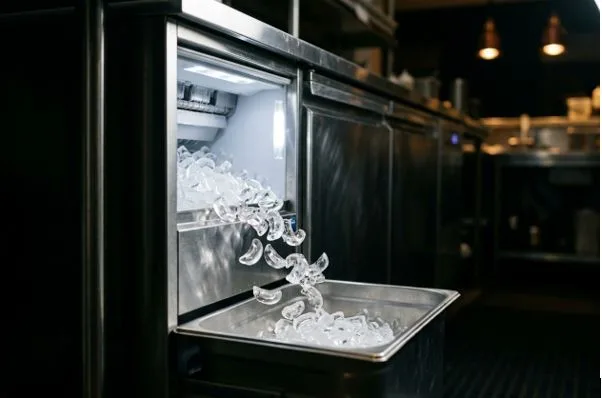
A commercial ice machine is one of those purchases that disappears into the background when it works — and dominates every conversation when it doesn’t. The wrong machine for a venue creates problems that compound daily: not enough ice at peak service, ice that dilutes drinks too fast, machines that struggle in hot kitchens, storage bins that can’t keep up with output.
Getting the decision right is less complicated than the product catalogues make it look. This guide covers what actually matters: ice type, daily output, condenser format, and the installation basics that suppliers don’t always walk buyers through upfront.
Ice Type Comes First
Before looking at any machine, decide what the ice will be used for. The shape and density of ice affects how fast it melts, how it interacts with drinks, and whether it’s fit for purpose in your specific application.
Cube ice
Full cube is the default in most bars and restaurants. It melts slowly, doesn’t over-dilute spirits, and looks presentable in a glass. Full cube machines are the most widely available format in Australia, with the broadest range of brands and service coverage.
Half cube is smaller, fills a glass faster, and is typically chosen for high-volume soft drink or casual bar service where presentation is secondary to throughput.
Crescent ice
Produced primarily by Hoshizaki machines, crescent ice has a curved half-moon profile that reduces splashing and is known for its clarity. It melts slower than half cube and is the premium choice for hotel bars and cocktail venues where ice quality is considered part of the service. If you’re specifying for a premium environment, this is worth looking at specifically.
Nugget ice
Sometimes called cubelet or Sonic ice, nugget ice is soft and chewable — it’s made from compressed flake rather than moulded water. It’s the standard in healthcare settings because patients can safely chew it. It’s also used in smoothie bars and fast casual venues. It absorbs drink flavour, which some customers actively seek out. The trade-off is faster melt compared to cube formats.
Flake ice
Flake ice is a display and storage medium, not a drinks ice. It moulds around seafood, fresh produce, and deli product, keeping it cold and presented correctly. Most venues that use flake ice for display will need a separate cube or crescent machine for bar service.
Sizing: How Much Ice Do You Actually Need?
Ice machine output is rated in kilograms per 24 hours under test conditions: typically 21 degrees Celsius ambient air and 10 degrees Celsius water inlet temperature. Real-world output in a hot Australian kitchen in summer will be lower — how much lower depends on the machine, its condenser type, and the ambient environment.
A practical starting framework:
- Small cafe or low-volume bar (under 80 seats): 60-100 kg/day rated output
- Mid-volume restaurant or pub (80-200 seats): 100-200 kg/day
- Hotel bar, function centre, or high-volume venue: 200 kg/day and above
- Seafood display: size to the display footprint, not seat count
The consistent mistake is buying to average demand. Size to your peak service day with a 20-25% buffer. Storage bin capacity is a separate calculation — a machine producing 150 kg/day with a 40 kg bin will struggle during a dinner service even if the 24-hour output is technically adequate.
Condenser Format: The Decision Most Buyers Skip
The condenser is how the machine removes heat from the refrigeration cycle. The format you choose affects purchase price, running costs, kitchen temperature, and real-world output consistency.
Air-cooled
Air-cooled machines draw ambient air across the condenser to dissipate heat. They’re the most common type in Australian commercial kitchens — less expensive to buy, straightforward to install, and cheaper to run than water-cooled equivalents.
The practical requirements: adequate ventilation clearance (manufacturers specify minimums, typically 150mm on vented sides), and an ambient environment that isn’t excessively hot. In a kitchen that regularly exceeds 35 degrees Celsius around the machine, air-cooled output drops measurably. The machine still works — it just doesn’t meet its rated spec.
Water-cooled
Water-cooled machines use a water circuit instead of air to remove heat. Output is more consistent regardless of ambient temperature, and they don’t heat the surrounding space. The trade-offs: higher water consumption, higher running cost, and in some local council areas, restrictions on water-cooled equipment apply due to water conservation requirements. Confirm with your local authority before specifying one.
Remote condenser
The condenser unit is installed separately — typically on the roof or outside the building — connected to the ice machine via refrigerant lines. This completely removes heat rejection from the kitchen space and allows the machine to operate at rated output even in hot conditions. Installation is more involved and the upfront cost is higher, but for high-output applications or kitchens with persistent heat problems, it’s often the right call.
Self-Contained vs Modular
A self-contained machine integrates the ice-making head and storage bin in one unit. It’s simpler to install, takes a defined footprint, and is the right choice for most small to mid-sized venues.
A modular machine produces ice only and requires a separate bin. This allows you to match a high-output head unit with a larger storage bin when the self-contained options don’t provide enough storage for your peak demand. Modular setups are common in hotel bars, large function centres, and venues with high sustained volume.
Brands in the Australian Market
Three brands dominate the commercial ice machine market in Australia:
- Scotsman: American brand, long established in Australia, broad product range across cube, nugget, and flake formats. Strong service and parts availability nationally, including regional areas. The Prodigy series includes self-monitoring and diagnostic features.
- Hoshizaki: Japanese brand, known for engineering reliability and lower maintenance requirements. The crescent cube format is their signature offering. Premium price point, well-supported in metro markets.
- Ice-O-Matic: Value-positioned brand well-suited to mid-range applications. Good choice for venues that need reliable cube ice output without the premium price of the top two.
Suppliers like Snowmaster stock multiple brands and can provide side-by-side comparisons of specific models at equivalent capacity points, which is a more useful basis for decision-making than brand reputation alone.
Installation: What to Confirm Before You Order
These details should be confirmed at the site before committing to a machine:
- Power supply: Confirm amperage and whether the circuit is 10A or 15A. Larger machines may require 15A or three-phase supply. Check the spec sheet, not the salesperson’s estimate.
- Water connection: Cold water inlet and a suitable drain outlet within reach of the installation point. Ice machines drain continuously during normal operation.
- Ventilation clearance: Air-cooled machines need the clearances specified by the manufacturer — typically 150mm minimum on vented sides. Installing flush against a wall on the wrong side will reduce output and shorten component life.
- Ambient temperature: If the installation location regularly exceeds 32 degrees Celsius, discuss condenser options with your supplier before ordering. Some air-cooled machines have high-ambient ratings; others don’t.
- Water quality: Hard water causes scale build-up in evaporators and distribution systems. Most commercial ice machines recommend or require a water filter. In hard water areas, a dedicated descaling schedule is also needed.
- Council requirements: Water-cooled equipment may be restricted in drought-affected regions. Confirm before specifying.
Maintenance Basics
Commercial ice machines require cleaning and sanitising on a scheduled basis — typically every three to six months depending on usage and water quality. The bin, distribution system, and evaporator all need attention. Scale accumulation reduces output; organic build-up creates food safety risk. Ice is classified as food under Australian food standards — it’s subject to the same hygiene requirements as anything else that goes in a customer’s glass.
When evaluating machines, ask about cleaning procedure, descaling requirements for your local water, filter specifications, and service availability in your area. The machine with the best spec sheet but the longest parts lead time in your region may not be the right choice.
The Decision
Match the ice type to the application. Size to peak demand, not average. Confirm the installation requirements before ordering, not after. And prioritise service coverage for your location — a machine that goes down on a Friday night is only as good as how fast someone can get to it.
For venues that want guidance through the process rather than just a catalogue, a supplier with experienced staff who ask the right questions upfront is worth more than one who ships the same day.